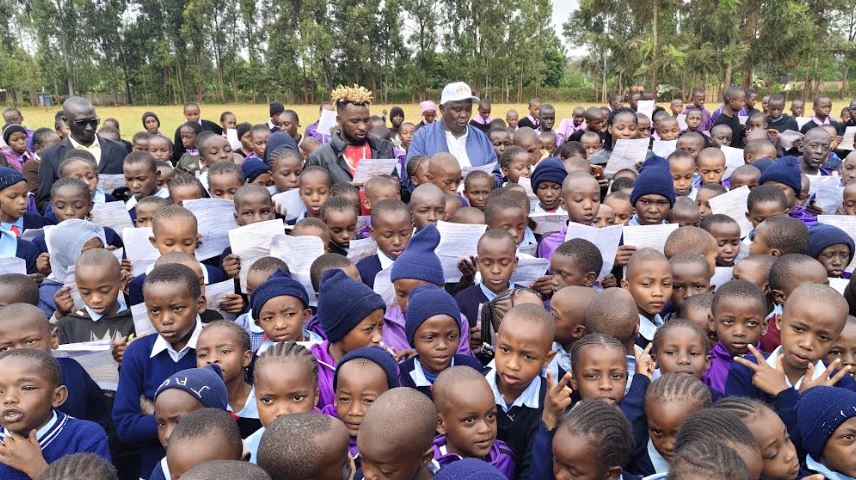
More than 600 learners at Kaharati Comprehensive School in Murang’a County on Friday joined over one million pupils across Kenya in the National Read Aloud 2026 World Record Attempt, as teachers and education stakeholders called for better-equipped school libraries and curriculum-based reading materials.
The nationwide initiative, organized by Storymoja Africa and Start A Library Trust, brought together learners from more than 1,000 schools who simultaneously read the same text in an attempt to set a new world record while promoting a culture of reading among children.
While welcoming the initiative, teachers said it has helped build learners’ confidence and nurtured a love for reading.
However, they observed that although many pupils can read fluently, comprehension remains a major challenge highlighting the need for greater investment in reading resources.
Ahadi Kenya Trust Executive Director Dr. Stanley Kamau who led the occasion at the school said many public primary schools still lack functional physical libraries denying learners access to quality reading materials that are essential for improving literacy and critical thinking skills.
He called on education stakeholders, the Teachers Service Commission, development partners and well-wishers to support the establishment and equipping of school libraries.
Dr. Kamau also urged donors to provide age-appropriate and Competency-Based Education (CBE) books instead of using school libraries as dumping grounds for outdated and irrelevant publications.
“We need libraries stocked with books that support the current curriculum and inspire children to read. Learners benefit most when they have access to relevant and engaging reading materials,” He remarked.
English teacher at Kaharati Comprehensive School Sarah Makau noted that the Read Aloud programme will improve learners’ reading skills, comprehension and confidence.
She appealed for more investment in school libraries to ensure pupils have regular access to quality books.
Makau also called for provision of ICT supported reading materials to help training learners on how to read and comprehend information from various sources.
“Having ICT equipment like projectors, computers in our libraries can greatly assist our children to read better and comprehend what they read,” She added.
The school’s Headteacher, Simon Mwangi, described the initiative as an important step towards nurturing a lifelong reading culture among children, saying strong reading habits are key to better academic performance.
This year’s National Read Aloud was held under the theme Human-Wildlife Coexistence, with learners reading an excerpt from The Boy and the Lion by Kenyan Maasai game ranger Mike Saitoti.
The National Read Aloud campaign seeks to inspire children to embrace reading beyond the classroom while strengthening literacy, comprehension and critical thinking skills.
The event, held simultaneously from 8.30 a.m. on Friday, July 10, 2026, brought together more than one million learners from over 1,000 registered schools in what organizers hope will become the world’s largest coordinated read-aloud.
By Bernard Munyao and Florence Kinyua