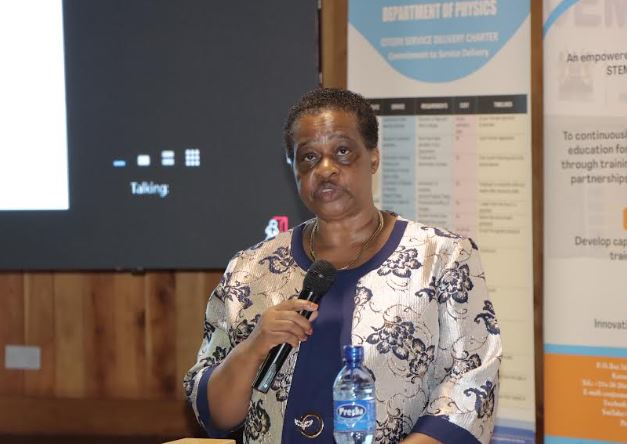
Acting Chief Executive Officer of the Centre for Mathematics, Science, and Technology Education in Africa (CEMASTEA), Gladys Masai, has called for continuous professional development for teachers to equip them with the knowledge, skills, and innovative teaching approaches needed to prepare learners for emerging technological trends.
Speaking during the ongoing 9th African School of Fundamental Physics and Applications (ASP2026), the CEO said investing in teachers remains one of the most effective ways of improving the quality of science education and preparing the next generation of scientists, engineers, and innovators.
The CEO said continuous professional development for teachers is essential to achieving quality teaching and learning in schools.
“Professional development is therefore not optional. It is essential for maintaining high-quality teaching and learning,” said Ms. Masai.
The CEO clarified that physics remains one of the most important disciplines driving scientific and technological advancement, providing the foundation for engineering, medicine, information technology, renewable energy, space science and other sectors that are shaping modern economies.
“Physics is one of the most important disciplines for scientific and technological advancement. It provides the foundation for engineering, medicine, information technology, energy systems, space science and many other fields that drive economic and social development,” Ms. Masai
She, however, said that teaching the subject presents significant challenges, as many learners perceive physics as abstract, mathematical, and difficult to relate to everyday life.
Ms. Masai added that rapid scientific discoveries, technological innovations, and emerging pedagogical approaches require teachers to continuously update both their subject knowledge and classroom practices.
According to the CEO, continuous professional development enables physics teachers to deepen their understanding of complex concepts, improve pedagogy, address learner misconceptions, integrate digital technologies into classroom instruction, strengthen assessment practices and inspire more learners to pursue careers in science, technology, engineering and mathematics (STEM).
She commended CEMASTEA for spearheading programmes including in-service education and training (INSET), saying it has strengthened Science, Technology, Engineering, and Mathematics (STEM) education in Kenya.
“We seek to support teachers in creating learning environments where learners actively construct understanding, investigate phenomena and apply knowledge to solve problems,” Ms. Masai said.
She added that the professional development programmes offered by the institution are designed to transform classroom practice by promoting learner-centred instruction that actively engages students in constructing knowledge, investigating scientific phenomena, and solving real-world problems.
The CEO said CEMASTEA’s professional development programmes also promote inquiry-based and problem-solving approaches; hands-on laboratory investigations and demonstrations; the effective use of virtual laboratories, simulations, and digital technologies; and the implementation of the competency-based curriculum.
She encouraged teachers to actively participate in the programme so they can effectively implement the approaches in their classrooms and cascade the knowledge and skills acquired to their colleagues, who will in turn transfer them to learners in their respective schools.
Throughout the programme the teachers engaged in hands-on activities, experiments, demonstrations, simulations, and collaborative lesson design. This enables them to experience effective teaching approaches from a learner’s perspective before applying them in their own classrooms.
They are also reflected in classroom practice by analysing classroom challenges, sharing experiences with colleagues, and identifying practical solutions to improve learner engagement and academic achievement.
“Teachers are supported to implement new approaches in their classrooms, evaluate their effectiveness, and refine their practice based on evidence and reflection,” said the CEO.
To promote equitable learning opportunities for all learners, the CEO said the institution has expanded the use of virtual laboratories and computer-based simulations.
“These digital tools enable teachers and learners to visualise abstract physics concepts, conduct investigations that may be difficult to perform in conventional school laboratories, and extend learning beyond the physical classroom while complementing practical laboratory experiences,” she said.
The CEO noted that mentoring, collaboration, and professional learning communities remain central to sustaining teacher growth, enabling educators to continue learning from one another even after formal training programmes.
She said through such trainings, teachers are increasingly helping learners connect classroom concepts with real-life situations and emerging technological developments, making physics more relevant and stimulating greater interest in STEM studies and careers.
As physics education continues to evolve, the CEO said learners must be prepared for emerging fields such as artificial intelligence, renewable energy technologies, quantum science, advanced manufacturing, space exploration, and data science.
She noted that preparing learners for these opportunities begins with preparing their teachers.
“When teachers are empowered with strong content knowledge, effective pedagogy, and appropriate technologies, they are better able to inspire learners, improve achievement, and nurture future scientists, engineers, and innovators,” the CEO said.
The CEO called for stronger collaboration among schools, universities, research institutions, governments and international partners to strengthen physics education and ensure teachers remain equipped to respond to rapidly changing scientific and technological landscapes.
By Ian Chepkuto and Malinda Boniface