The government will soon be launching farmer-led irrigation projects in Western Kenya, with the support of the German Development Bank.
Targeting smallholder farmers, the initiative will provide subsidized irrigation equipment, climate-smart technologies, water pans and innovative financing to reduce over-reliance on rain-fed agriculture, aimed at boosting food security.
Speaking when he commissioned Raongo Primary School Micro-Irrigation Project in Karachuonyo Constituency, the Secretary Administration (SA), State Department for Irrigation, David Yatich Kipkemei, who represented the Irrigation Principal Secretary Ephantus Kimotho, noted that Homabay County is one of the six Counties in Western Kenya that will benefit from the programme.
Kipkemei emphasized the government’s commitment in ensuring food security for the people through irrigation, adding that the state had invested more than Sh2.7 billion in irrigation projects across Homabay County.
He cited the newly commissioned Raongo Primary Micro Irrigation project as an example of this commitment, adding that the new project will not only support the over 400 members of school community with water for consumption and irrigation, but will also serve the over 2000 nearby community households with clean water.
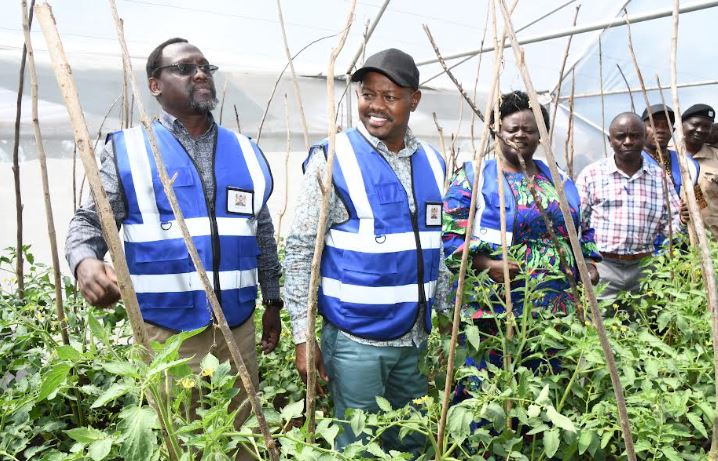
The Sh16 million Raongo Micro Irrigation Project included the drilling of a borehole, equipping the borehole with a solar-powered pump, a 15-meter-high steel tower, a 20,000 cubic metres steel water tank, solar panels, a pupils’ watering point, a community water kiosk, two green houses and a quarter-acre open field equipped with drip irrigation systems.
The SA noted that the two greenhouses and a quarter-acre open field will provide the over 400 school community 4K clubs with an opportunity to practice irrigation.
Kipkemei observed that the project offers practical lessons on water management for irrigation, a culture that, once inculcated at an early age, will permeate the society once the pupils complete school.
“When you teach about a greenhouse and drip irrigation, pupils can now relate as they are seeing them practically, unlike before,” he observed.
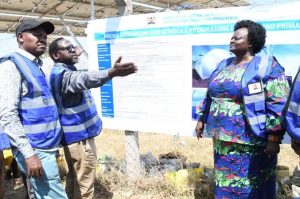
Photo by Benedict Wasiche (KNA).
The SA added that the project will enhance the pupils’ nutrition and also support the school in purchasing crucial learning equipment through the money earned from their produce.
“The first crop of tomatoes yielded 60 crates and earned the school Sh180,000, which has gone a long way in addressing the financial challenges experienced by the school,” Kipkemei revealed.
Members of the community hailed the completion of the project saying they used to take more than one hour to fetch water from the river and they were now taking only 10 minutes.
David Owade, the agriculture teacher at Raongo Primary School, pointed out that the project has made teaching agriculture lessons more practical.
“Whatever we teach theoretically, we reinforce with practical lessons,” Owade said, adding, “This makes it very difficult for pupils to forget.”
While thanking the State Department for delivering the project, Homabay County woman representative Dr. Joyce Atieno Bensuda pledged to collaborate with the Ministry of Water in ensuring that the project succeeds.
Others present included Thande Githae, the director of climate resilience for food and water security at the Ministry of Water and Sanitation.
By Benedict Wasiche and Penina Kihika (PCO)