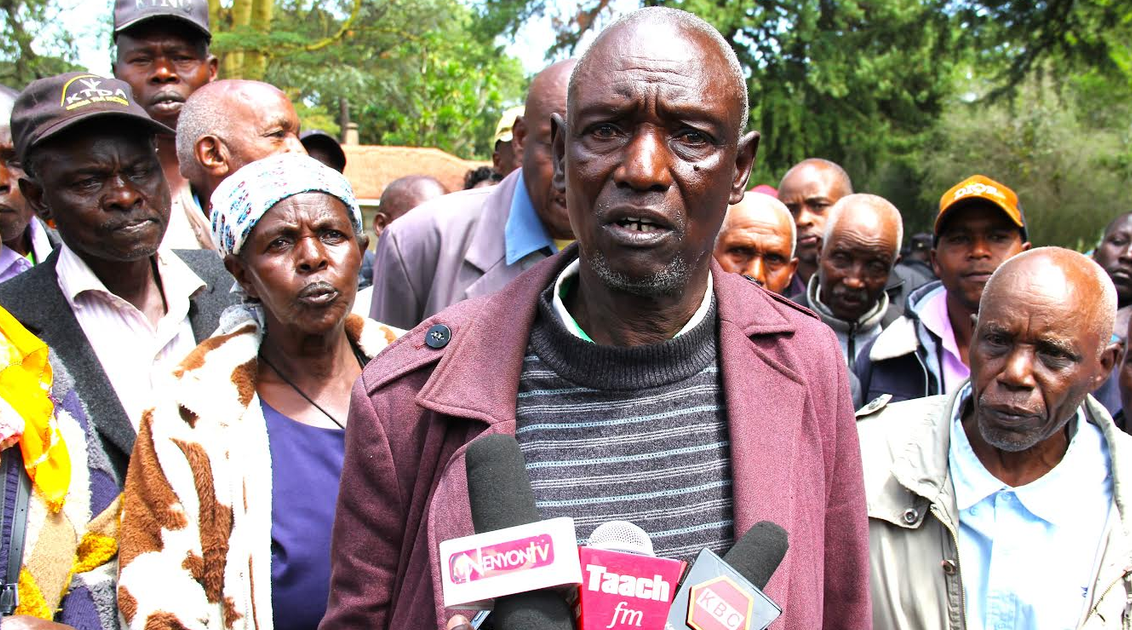
At least 1,500 members of the Ogiek community have decried decades of unresolved colonial era land injustices and urged the government to expedite redress, saying continued displacement from their ancestral land has condemned generations to social and economic deprivation.
Speaking during a meeting held at Kericho Tea Hotel, community members recounted how British colonial authorities allegedly forced their ancestors out of their traditional settlements, destroyed homes, confiscated livestock and scattered families across different parts of the country. They said the displacement not only deprived them of their land but also denied subsequent generations access to education, stable livelihoods and opportunities for economic advancement.
Paul Kitur said the pain experienced by the community has been passed down to generations, with many families still living without land despite having historical ties to areas they once occupied.
“Our suffering began during the colonial period when the Europeans forcefully dispersed our people from their ancestral land. They took away our cows and goats, destroyed our homes and left our families with nothing. That displacement changed the course of our lives because many of us have grown up without land, without property and without the opportunities that come with having a place to call home,” said Kitur.
He urged the government to recognize what he termed as the Ogiek community’s historical ownership of parts of the former African Highlands, arguing that evidence exists to demonstrate their long-standing attachment to the land.
“We are appealing to the government to acknowledge that this land had owners before colonial occupation. There is enough historical evidence showing that the Ogiek belonged to these areas. We are not asking for special treatment; we are asking for justice and recognition of our history so future generations can have a secure future,” he said.
Kitur further observed that the loss of land had ripple effects beyond shelter and livelihoods, saying many Ogiek children missed educational opportunities because their families were constantly struggling to survive after being uprooted.
Sarah Koskei, a member of the Kipsigis Ogiek community, said the meeting was convened to seek justice for families who have remained landless for decades despite tracing their roots to specific settlements occupied before colonial displacement.
“We have gathered here because we want our rights to be fulfilled. Our parents told us about the lives they lived in places such as Sambret and Chepkoibei before colonial authorities scattered them to different places. Those stories have remained with us because we have never had the opportunity to return to the land our ancestors called home,” she said.
Koskei said members of the Changkelek group continue to live without permanent settlement, forcing many households to depend on casual labour for survival.
“Our parents died without recovering their land and today we are still wandering from one place to another. We have nowhere we can confidently call our home. We are asking the government to remember us so that our children can inherit something instead of growing up in the same uncertainty that our parents endured,” she said.
She appealed to President William Ruto to ensure the Ogiek community benefits from government programmes, saying restoring land rights would help families rebuild their livelihoods and preserve their heritage.
“We want to return to the places where our fathers and grandfathers lived and where many of them were buried. That is our history and our identity. We ask the government to help us recover that connection,” she added.
David Rono said many members of the community still identify Cheptembe and neighbouring areas as their ancestral home despite being forced to settle elsewhere following colonial displacement.
“Today I live in Changkelek, but our true home is Cheptembe. We are appealing to the government to recognize those historical ties and help us regain the land where our ancestors lived,” he said.
Alice Koskei said the destruction caused during the colonial period stripped many Ogiek families of both their property and dignity, leaving wounds that have never fully healed.
“Our parents suffered immensely during the colonial period. Everything they owned was taken away. They had food stored in their homes, livestock to sustain their families and property they had built over many years, but all of it was destroyed. Since then, we have continued to live in hardship because we have never recovered what was lost,” she said.
She questioned where future generations of the community would settle if their historical grievances remained unresolved.
“Where else can we go? We continue to cry every day because even getting food is uncertain for many families. We are asking the government to intervene so that our children can have a better future than the one we inherited,” she added.
Joseph Korir said restoring land to affected families would not only correct a historical injustice but also enable them to engage in farming and improve their living standards.
“People cannot build meaningful lives without land. If our community is given land, families will farm, educate their children and improve their livelihoods. That is why we are asking the government to help us resolve this matter once and for all,” he said.
Korir also urged different Ogiek groups, including the Changkelek and Talai, to remain united in pursuing solutions to the longstanding land question, saying unity would strengthen their engagement with government institutions.
Alice Chelangat said the effects of colonial displacement continue to be felt by vulnerable families, some of whom are still living in temporary conditions decades later.
“Some of our people are living by the roadside because they have nowhere else to go. Many of us never even knew our parents because of the hardships that followed their displacement. We only grew up hearing stories about how they lived before everything changed. We are asking leaders not to forget communities like ours when addressing issues affecting vulnerable Kenyans,” she said.
Chelangat also appealed for peaceful coexistence among neighbouring communities, saying unity and dialogue would create a conducive environment for resolving historical grievances.
The community appealed to the government to address the historical land injustices arising from the colonial period through dialogue, recognition of ancestral land rights and measures aimed at restoring the dignity and livelihoods of affected Ogiek families.
By Gilbert Mutai and Faith Chelangat