For 37-year-old Alex Munyiri, the future of basketball in Kenya is not only about discovering talent; it is about building spaces where that talent can thrive and doing so in a way that is eco-friendly.
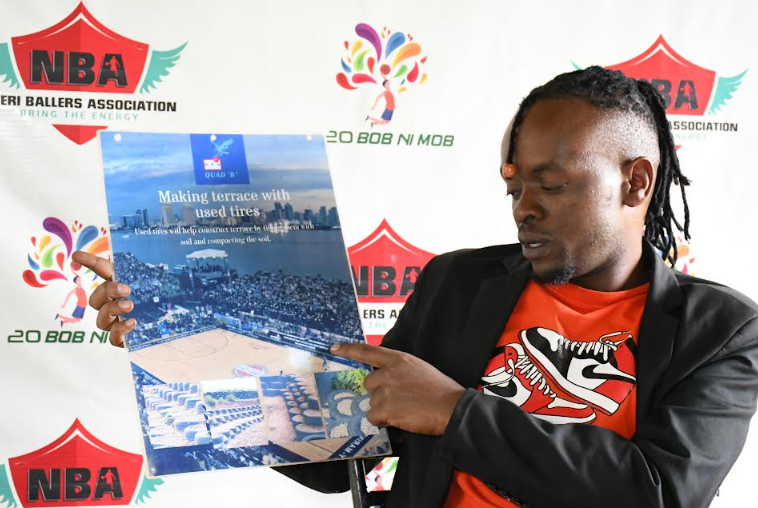
He harbours an ambitious vision of constructing a basketball arena using plastic waste and old tires and roofing it with ethylene tetrafluoroethylene (ETFE).
The proposed facility will also incorporate the use of solar energy and rainwater harvesting systems, creating what Munyiri hopes will be one of the most environmentally sustainable sports facilities in the world.
“We want to use pollution to construct sports infrastructure that is environmentally friendly. My hope is that a facility constructed using waste material in Kenya can compete with other stadiums that have employed an environmentally friendly approach in their construction,” Munyiri says.
This idea is rooted in both his lifelong love for basketball and his frustration with the lack of proper sporting infrastructure in the country.
He reckons that although much has been done to develop the sport in Kenya, many basketball courts do not meet the threshold stipulated in International Basketball Federation (FIBA) rules.
Munyiri argues that Kenya has often invested in outdoor basketball facilities without addressing the gap in the sport itself.
“Despite introducing the game in Kenya in 1960 at Mang’u High School, our country has always failed the basketball players in that we lack the bare minimum infrastructure and equipment that have been spelt out by Article 2 and Article 3 of FIBA rules,” he says.
His basketball journey began in 1998, when he started playing under the guidance of a missionary coach, Greg Feltre.
He later joined St. Mary Secondary School in Nyeri, where his prowess at the sport saw him rise to become the captain of the school’s basketball team.
After completing high school in 2007, his former coach invited him to Nairobi to tutor him on the fundamentals of basketball coaching.
After learning the ropes, he later joined the Kenya Basketball Federation’s (KBF) refereeing structures.
In 2008 he obtained his first refereeing license through the Kenya Basketball Referee Association (KBFA), allowing him to officiate school competitions, national team matches, and other major games.
He went on to officiate Kenya Universities Sports Association (KUSA) matches and DSTV fixtures.
That certificate also paved the way for him to be hired as a referee in notable schools like the International School of Kenya, Brook House School, and Rift Valley Academy.
His experience eventually attracted international attention.
In 2016, he was spotted by the National Basketball Association (NBA) and was invited to pursue refereeing as a profession.
He received further invitations in 2017 and 2018 but could not raise the funds needed to travel for the trials.
By then, however, Munyiri had reached a turning point.
“I made a decision that I will not leave the country to go and build basketball in another country while in our country we don’t have sports facilities,” he says.
Instead, he chose to focus on the problem at home.
Munyiri returned to Nyeri in 2019.
By 2020, he was coaching the national deaf basketball team as well as a deaf team from Nyeri. Due to lack of a dedicated basketball court in Nyeri, he returned to his alma mater and sought permission to train the Nyeri deaf team.
His efforts paid off when three players from the Nyeri team were selected to represent the country in international competitions in Brazil and Poland.
The teams lost, but for Munyiri, the defeats exposed a deeper problem.
He did not believe Kenya lacked talent or commitment.
He believed the country lacked the infrastructure necessary to develop its players.
“Knowing clearly that the problem we had as a country was not the talent in terms of players or the training, it was the infrastructure I decided to look for ways to solve this infrastructure problem,” he says.
Nyeri, he notes, has not had a proper basketball court since the sport was introduced to the country in the 1920s.
While international schools have access to standard courts and equipment, many local players and teams have been forced to depend on school facilities.
That loss prompted Munyiri to seek government support for a sports facility.
When he approached the county government of Nyeri with a request for land to construct a basketball court, he was directed to the dilapidated Kinunga Stadium.
The existing surface, he says, had protruding stones and therefore was not suitable for a standard basketball court.
His proposal to renovate the facility was also turned down.
The setbacks did not end the project. Instead, they pushed Munyiri to rethink how the facility could be built.
“Looking at the frustration I was getting from the county government, I thought it wise to do something as a basketball commissioner to ensure that we have a structured infrastructure. This would allow the talent to speak for itself,” he says.
And with that the idea of turning pollution into a sports facility came to fore.
His solution is a community-driven arena made largely from waste material.
Plastic waste will be collected and processed into chips, which could then be molded into items such as seats and flooring.
Used tires will be collected and repurposed to create terraces.
Munyiri also wants to challenge the traditional design of stadium terraces, which typically rely heavily on concrete.
His proposal includes the use of grass in parts of the terraces, reducing the environmental impact of construction while creating a greener space.
The roof would be made from ETFE, a lightweight material that is translucent.
For Munyiri, the roof is especially important because basketball was designed primarily as an indoor sport.
“Over time, you notice that there are people who have tried to play it as an outdoor sport, but weather and other constraints like wind and air resistance have affected the sport,” he says.
His ambition is to help restore the game to a proper indoor environment.
The proposed arena would also include rainwater harvesting.
Water collected from the roof would be channeled into a reservoir serving the facility.
Solar panels would provide renewable energy, helping the arena generate its own power.
Even the collection of waste materials is being designed with sustainability in mind.
Munyiri proposes using donkeys to help collect discarded tires, reducing the emissions associated with motor vehicles.
The project would also rely on existing waste-collection networks.
Plastic collectors and recycling companies would supply materials, while partners such as Think Ocean could help with the collection of plastic waste from oceans and water catchment areas.
Munyiri believes that transforming this waste into sports infrastructure could address two problems at once.
“The collection of plastics will create a lot of employment,” he says.
Rather than relying solely on a conventional budget, Munyiri wants the project to be built through community involvement.
Volunteers, basketball players, and waste collectors will help gather materials.
Donated tires could be collected from communities, with contributors receiving T-shirts carrying environmental or basketball messages.
Even though he cannot give the exact cost of construction, he believes this approach could significantly reduce construction costs.
“I cannot quantify the exact amount of money it will cost to construct an environmentally friendly facility versus constructing a normal stadium because we are using a community approach,” he says.
The project has already attracted interest.
At the moment Munyiri is looking for more partners to help finance the construction.
But his immediate need is land.
He has approached the county government, but if that effort fails, he says he will seek support from communities willing to set aside land for the project.
But his deeper purpose is to give Kenyan basketball players the facilities they need to fulfill their potential.
“For me, as a commissioner, I want to lead in the development of the game as an indoor sport, not as an outdoor sport,” he says in conclusion.
By Samuel Maina