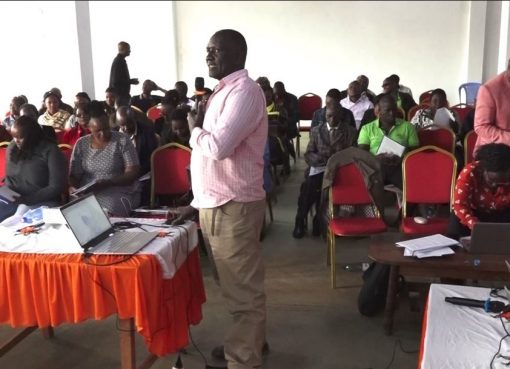
Learners from 22 schools across Embu County have benefited from training on environmental conservation and smart farming through a partnership between an NGO, ‘Rainforest Alliance’ and the Kenya Scouts Association (KSA).
The NGO, through the Mount Kenya Sustainable Landscape and Livelihoods Programme (MSULLI), has been able to equip school-based scouts and learners with hands-on skills in smart farming to enhance food security as well as techniques for combating climate change.
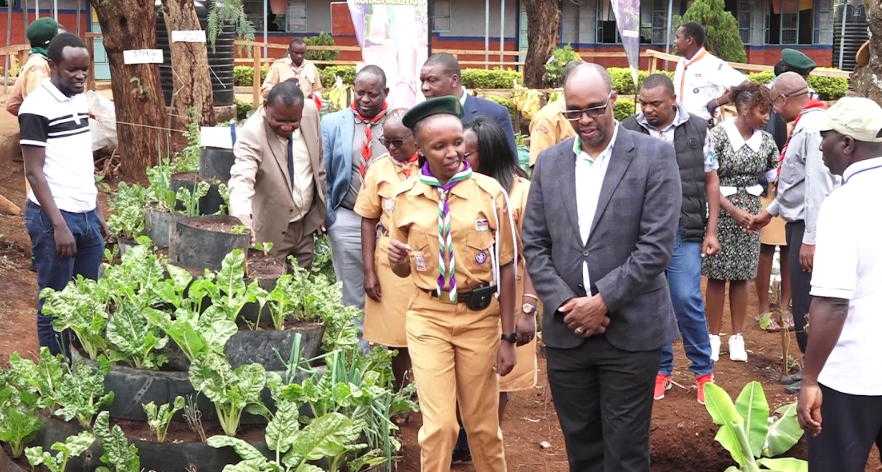
Through the initiative, Rainforest Alliance has assisted learners acquire practical skills to transform their spaces in schools and homes into smart farms using eco-friendly methods such as soil conservation, water harvesting, crop diversification, and multi-storey and kitchen gardens.
“Through this program, young people in the schools we have partnered with are working towards conserving their environment and also coming up with kitchen gardens where food crops are grown for food security at their schools,” said MSULLI Program Manager Dida Wario.
He reported that in each of those schools, they have managed to establish smart farms where crops such as vegetables are grown for supplementing the school feeding program and the surplus is sold for income generation.
Wario said the smart farms not only serve as solutions for immediate food needs but also equip young people with long-term climate-resilience skills that act as a shield against effects of climate change.
In addition to food security, Wario said through the partnership with KSA, they have managed to restore degraded lands in the Mount Kenya landscape ecosystem.
“In total, we have managed to restore over 200 hectares by planting more than 220,000 tree seedlings in critical zones of the ecosystem that have been degraded through deforestation or unsustainable farming,” he reported.
Wario said in each of these schools, they have also been running tree-growing initiatives with a focus on fruit trees such as avocado, macadamia, and other fruit-bearing trees to enhance nutrition and income generation.
He noted that by involving learners, the partnership has managed to turn environmental conservation and farming into a practical activity and not just theory in class.
Wario noted that it has also inculcated a sense of responsibility in the learners since each had been allocated several trees to nurture and were able to pass these techniques to their parents and neighbors, thus scaling up conservation efforts.
He was speaking on Thursday while awarding schools that excelled in the program at DEB Iveche Primary and Junior Secondary School in Manyatta Constituency. The program has been running for the last six years.
The School Head Teacher, Edwin Njiru, said the initiative of setting up smart gardens was of much benefit to learners in light of the new Competency-Based Curriculum (CBC) that places more emphasis on practical learning.
“We have seen it become of much help, especially where learners are able to apply what they have learned in class by performing various practical tasks within the school compound,” he said.
He added that the program has also been of great value to learners from urban areas who have not had a chance to interact with farming before by transforming them from passive consumers to active producers.
County Director of Education Dr. Peter Kirika welcomed the initiative, saying it had served to actualize the CBC practical framework from theory to experimental learning.
Kirika noted that the smart farms could serve as perfect setups for CBC assessment at the school level and also as foundations for building students’ capabilities as envisioned by the Ministry of Education.
“Food security has been a big agenda in the country, and training of young people in agriculture is a big step towards attainment of national food security and economic growth,” he said.
By Samuel Waititu