The County Government of Nakuru is crafting public-private partnerships (PPP) to promote uptake of solar energy for both industrial and domestic use to help combat carbon emissions and foster environmental conservation.
The County Executive Committee Member (CECM) for Education, ICT, e-Government and Public Communication, Ms Zipporah Wambui, said the County government was committed to ensuring a double utilization of solar energy across the Devolved Unit, as it accelerates its shift to renewable energy.
According to the CECM, the county’s administration was applying good energy management practices across its operations and installing solar panels on boreholes and street lights as part of its journey towards cutting greenhouse gas emissions as close to zero as possible.
Ms. Wambui indicated that with the intensifying effects of climate change, such as floods, heat waves, drought and forest fires, it was not business as usual, as priority shifts towards sustainable and environmentally responsible projects and operations.
“Clean energy is the buzzword today. If the world will win the war against climate change, clean energy will play a pivotal role,” the official added.
The CECM said Kenya ranks high among countries that rely heavily on renewable energy sources, including Solar, wind and geothermal energy, which she claimed were at their disposal.
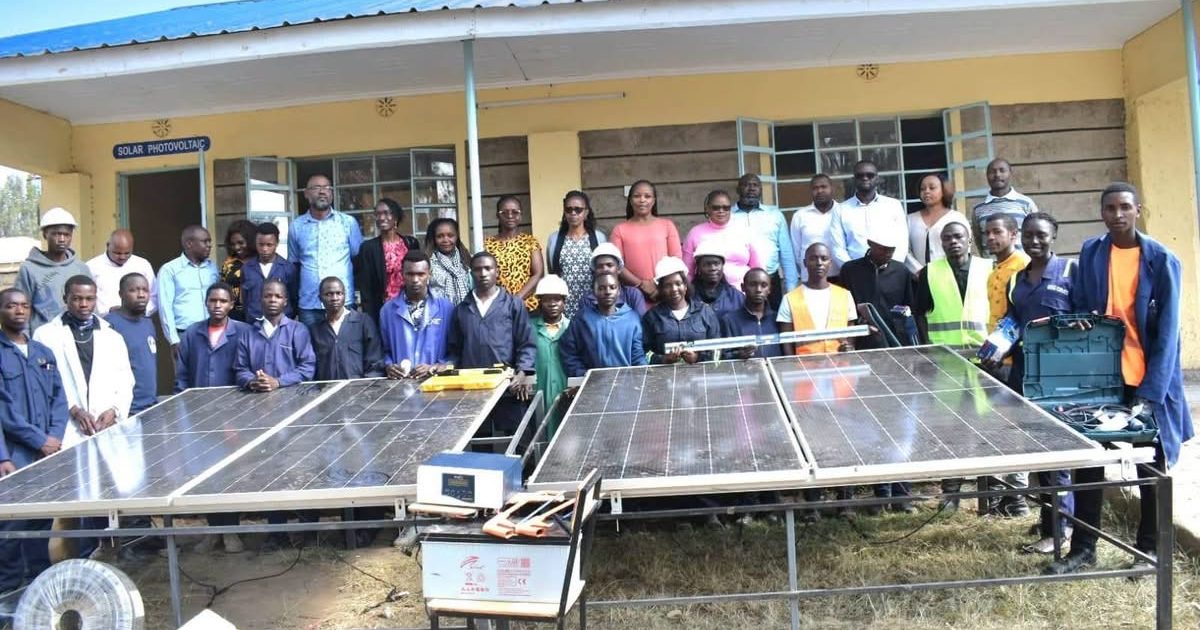
The Officer spoke during a meeting at Mirera Vocational Training Centre (VTC), that focused on the implementation of the Solar Photo-Voltaic training programme at the TVET. The CECM also received a donation of solar installation equipment worth Sh3 million.
Through the training initiative being implemented by German Development Cooperation (GIZ) under the Employment and Skills for Development in Africa (WE4D) Programme, funded by the Governments of Germany and Norway, in partnership with WTS Foundation, over 50 youth and women have already been trained in solar energy installation, verifying quality of solar equipment and maintaining solar system.
The partnership aims to support the skilling of young Kenyans by unlocking employment opportunities for youth and women in renewable energy and e-mobility, with a special focus on solar energy.
Wambui noted that one of the costliest mistakes consumers make when installing solar systems, is failing to engage qualified technicians.
She pointed out that many people were often duped into hiring individuals whose professional background is unknown, despite solar installations requiring thorough technical expertise.
She explained that some local installers only possess basic knowledge of electrical works or limited, informal skills in fixing solar panels, competencies that are often insufficient for proper and safe installation.
She added that trained technicians can use meters to test solar panels and verify their performance, helping consumers avoid such discrepancies.
Noting that increased adoption of solar equipment, solutions could also help reduce operational costs for businesses and protect the environment, the CECM further urged the partners to extend the Solar PV training program to other TVETS across the County so that more young people can benefit from the opportunities in the growing renewable energy sector.
“Sustainability and inexhaustible characteristics of solar energy have made it affordable and reliable for businesses and households,” she said.
Ms. Wambui advised small scale farmers to exploit the full potential of solar energy given its advantages over some of the more exploited energy sources.
She added that despite the high initial costs of installation and power storage, solar energy has low maintenance costs and turns out to be cheaper in the long term.
She observed that the country had adequate sunshine throughout the year to generate enough power that would satisfy power demand for all small-scale farmers, adding that harnessing this power by installing solar panels could make a significant difference in the cost of
The CECM pointed out that with its prime location on the equator, Kenya had more potential for solar than any other renewable electricity source: eight times as much as geothermal and 13 times as much as hydro.
To maximise the potential of solar, the CECM stated that Governor Susan Kihika’s administration was supporting strategies for all sectors towards installing solar panels on household rooftops, industrial and commercial premises and large-scale farms.
The options for solar, she said, were limitless as technology takes off in a huge way worldwide.
The International Energy Association (IEA) has forecast that solar could be the top source of electricity by 2050.
It is further projected that by 2050, investment in urban climate interventions in major cities in Ethiopia, Kenya and South Africa could deliver Sh26.568 trillion, Sh15.498 trillion and Sh77.49 trillion in benefits, respectively —equivalent to 250 percent of annual GDP (2020) in Ethiopia, 150 percent in Kenya and 200 percent in South Africa.
To achieve this, nonetheless, new investment in urban climate interventions is also expected to generate significant wider economic benefits, including additional employment compared to traditional fossil fuel energy consumption, resulting in an average of 210,000 net new jobs in Ethiopia, 98,000 in Kenya and 120,000 in South Africa by 2050.
The training initiative comes at a time when the country is already feeling the pinch of global warming due to rising sea levels, droughts, erratic weather patterns, among others.
Kenya’s temperature has been rising over the years amid burning of fossil fuels. From 1960, this has risen by 1.0 Celsius (C). In Nairobi, for instance, average temperatures are said to have risen from 18.8° C in the 1950s to 19.5°C in the 2000s.
As the temperatures rise, an estimated 17 per cent of the area in Mombasa, amounting to 4,600 hectares, could be submerged by a sea-level rise of 0.3 metres, with a larger area rendered uninhabitable or unusable for agriculture, because of water logging and salt stress.
By Esther Mwangi and Carol Nyakio