The National Government has stopped all sugar imports into the country with immediate effect, following a sharp increase in local production, mainly from four leased-out sugar factories in Western Kenya.
The Principal Secretary in the State Department for Agriculture, Dr Paul Kipronoh Rono, said reforms in the sugar sector had enabled Kenya to produce more sugar than it consumes, eliminating the need for imports.
Dr Rono said monthly sugar production had increased from 40,000 metric tonnes in 2022 to 89,000 metric tonnes recently, following the leasing of Chemelil, Nzoia, Muhoroni and South Nyanza (Sony) sugar factories, surpassing the country’s monthly consumption of 82,000 metric tonnes. The Principal Secretary noted that the country might even start exporting sugar in the near future.
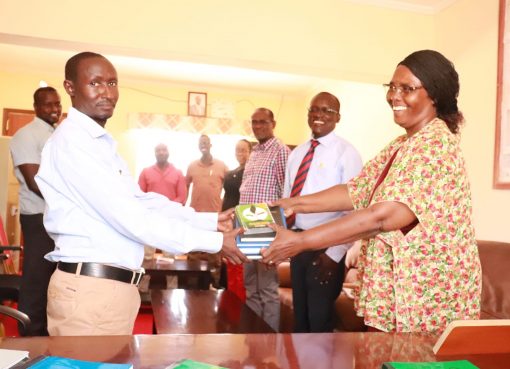
Dr Rono was speaking on Wednesday during the handover ceremony of the Pap Konam Agricultural Training Centre in Seme Sub-County, whose construction was fully funded by the County Government of Kisumu, to the National Government to strengthen agricultural education and skills development.
He warned against illegal sugar imports and smuggling, saying the government would not tolerate activities that undermine local farmers and the ongoing reforms in the sugar industry.
“We have stopped the importation of sugar because Kenya is producing enough for its own consumption. Anyone involved in smuggling sugar into the country must stop immediately,” he said.
Kenya has been producing roughly 550,000 to 613,000 metric tonnes of sugar annually, while total national demand sits at approximately 1.1 to 1.2 million metric tonnes, leaving a structural production deficit of about 500,000 to 600,000 metric tonnes that is plugged through regional and international imports.
But things are looking up as the new reforms in the sector seem to be working to turn around production.
Data from the Agriculture Ministry shows national output reached roughly 613,000 metric tonnes recently, recovering from factory maintenance and cane maturity cycles. Data from the Kenya National Bureau of Statistics indicates production hit 348,143 metric tonnes in the first five months of this year.
The Principal Secretary also clarified that Chemelil Sugar Academy remains a public institution under the Ministry of Education and had not been transferred to any private individual, saying the academy would continue serving students and farming communities as originally intended.
The institution which lies on Chemilil Sugar land has been embroiled in an ownership wrangle with some private individuals.
Dr Rono reiterated that the Government will continue supporting the milling of rice locally in Ahero and other parts of the country to enable farmers earn better returns while creating more employment and economic opportunities within the county, instead of the milling being done in the neighbouring Uganda as the case has been in the past.
At the same event, Kisumu Governor Prof. Anyang’ Nyong’o said the County Government handed over the Pap Konam Agricultural Training Centre to the Kenya School of Agriculture (KSA) because of the institution’s long-standing experience in agricultural education, research, curriculum development and professional training. This, he said will enable the training centre to help the entire country.
The Governor said the partnership reflects cooperative governance between the County and National governments, with the county investing in infrastructure while the Kenya School of Agriculture provides academic leadership, technical expertise and institutional capacity.
“The County Government has made the capital investment, while the National Government through the Kenya School of Agriculture will now provide the academic leadership, technical expertise and institutional capacity necessary to make this centre thrive. The greatest beneficiaries will be the people of Kisumu,” Prof. Nyong’o said.
He said the partnership would equip farmers, extension officers, young agripreneurs and agricultural professionals with nationally accredited training delivered by qualified instructors using modern curricula that respond to emerging technologies and changing agricultural needs.
Prof. Nyong’o said the centre will offer specialized training in rice production, fisheries and aquaculture, dairy farming, poultry, horticulture, indigenous vegetables, irrigation farming and climate-smart agriculture, while also providing continuous professional development for extension officers.
He added that demonstration farms and farmer field schools established at the centre would accelerate the adoption of improved farming technologies across Kisumu County, while students, researchers and agricultural practitioners attending the institution would stimulate the local economy through accommodation, transport and other businesses.
Pap Konam Agricultural Training Centre officially became the 10th campus of the Kenya School of Agriculture, marking a significant milestone in strengthening agricultural education, innovation and food security in the region.
The ceremony was attended by Deputy Governor Dr Mathew Owili, Seme Member of Parliament Dr. James Nyikal, Kisumu County Commissioner Mohamed Mwabudzo, Finance County Executive Committee Member George Okong’o and other county and national government officials.
By Mabel Keya – Shikuku and John Yuri Ochieng