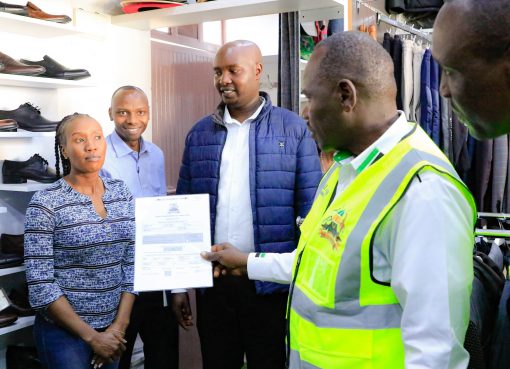
The Ministry of Investments, Trade and Industry, in collaboration with relevant ministries, departments, and agencies, has intensified public awareness on the Draft National Intellectual Property Policy and Strategy (NIPPS) 2026, with a focus on equipping small-scale entrepreneurs with knowledge on intellectual property (IP) rights and their role in driving innovation and economic growth.
The draft policy provides a comprehensive framework for harnessing intellectual property as a catalyst for innovation, creativity, industrialization, and wealth creation, and it is anchored on the vision of transforming ideas into valuable assets that drive innovation, creativity, and industrial growth, positioning intellectual property as a key pillar of Kenya’s modern economy.
Speaking on behalf of the Principal Secretary for the State Department for Industry Dr Juma Mukhwana during a public participation forum in Mombasa, KIPI Board Member Lawrence Njenga said intellectual property has evolved beyond being merely a legal concept to become a critical driver of national development.
“Intellectual property is no longer just a legal mechanism but the cornerstone of national development,” said Njenga.
He noted that the National Intellectual Property Policy and Strategy provides a comprehensive roadmap for transforming innovative ideas into high-value strategic assets across the country’s key economic sectors.
Njenga emphasized the importance of collaboration among regulatory bodies, including the Kenya Industrial Property Institute (KIPI), Kenya Copyright Board (KECOBO), Anti-Counterfeit Authority (ACA), National Research Fund (NRF), Kenya Plant Health Inspectorate Service (KEPHIS), and Kenya National Innovation Agency (KeNIA).
He said the policy seeks to strengthen Kenya’s institutional framework by harmonizing and leveraging the mandates of the key agencies responsible for intellectual property.
“A well-coordinated institutional framework is vital to transitioning Kenya into a knowledge-based economy,” he said.
Njenga added that in today’s global economy, the greatest wealth lies not beneath the ground but in the minds, innovations, and cultural heritage of the people.
“We do not develop policies in isolation. We require practical insights from stakeholders to ensure the final document reflects the realities and aspirations of Kenyans. Your feedback will directly shape the policy that will eventually be presented to the Cabinet and Parliament,” he said.
The Director of Research, Planning and Quality Assurance at the Anti-Counterfeit Authority, Dr John Akoten, said the nationwide public participation exercise began three weeks ago to create awareness about the draft policy and collect views from stakeholders across the country.
Members of the public had been invited to review the draft document and submit formal recommendations through written memoranda, while multi-agency teams had been deployed in phases across the country to ensure broad representation in the consultation process.
“We have travelled to different regions, including Garissa, where we engaged stakeholders from neighboring counties. The objective is to ensure that every region contributes to the development of a policy that serves the interests of all Kenyans,” said Dr Akoten.
He explained that the draft policy addresses a wide range of intellectual property rights, including copyrights, patents, utility models, traditional knowledge, and other forms of intellectual property. It also outlines strategies for commercialization, protection, and enforcement while strengthening coordination among government institutions responsible for the sector.
He encouraged members of the public to review the draft policy and submit their views before the consultation period ends.
“We still have two and a half days for the public to read the draft policy and submit comments that will help improve the final document,” he said.
Anti-Counterfeit Authority Coast Regional Manager Ibrahim Bulle said the government is working to strengthen and coordinate intellectual property protection, innovation, and patent systems to ensure innovators, entrepreneurs, and creators can easily access government support.
He said the reforms are intended to commercialize intellectual property and transform innovation into a source of wealth creation, employment, and sustainable economic growth.
On the fight against counterfeit goods, Bulle said the Anti-Counterfeit Authority has put in place robust safeguards and enforcement measures to protect intellectual property rights from infringement.
He warned that individuals involved in the production, distribution, or sale of counterfeit goods would face legal action.
“We will take firm action against anyone who infringes intellectual property rights. Those engaging in counterfeit activities should stop because the law will take its course,” Bulle said.
Shufaa Ali, a resident of Mvita Constituency, urged the government to plan such public participation forums well in advance and involve more business people across the county to ensure wider public awareness.
She noted that the high cost of living has forced many Kenyans to purchase cheaper products, which are often counterfeit, harmful, and less durable because genuine products are beyond the reach of many consumers.
“Mombasa has many entrepreneurs. We are brand ambassadors, but we cannot reach all entrepreneurs in the county. You also need to tell us how many times each year you will return to Mombasa to conduct public participation,” said Shufaa.
Another resident, Philip Baya, proposed the establishment of Anti-Counterfeit Authority offices at lower administrative levels to enhance the fight against counterfeit goods.
He said cases of counterfeiting had reached alarming levels, posing a serious threat to the lives and safety of Kenyans.
Baya further urged the government to hold similar public participation forums regularly at the grassroots level, saying increased public awareness would discourage those engaged in the counterfeit trade.
By Mary Mtawa and Vincent Kiptoo