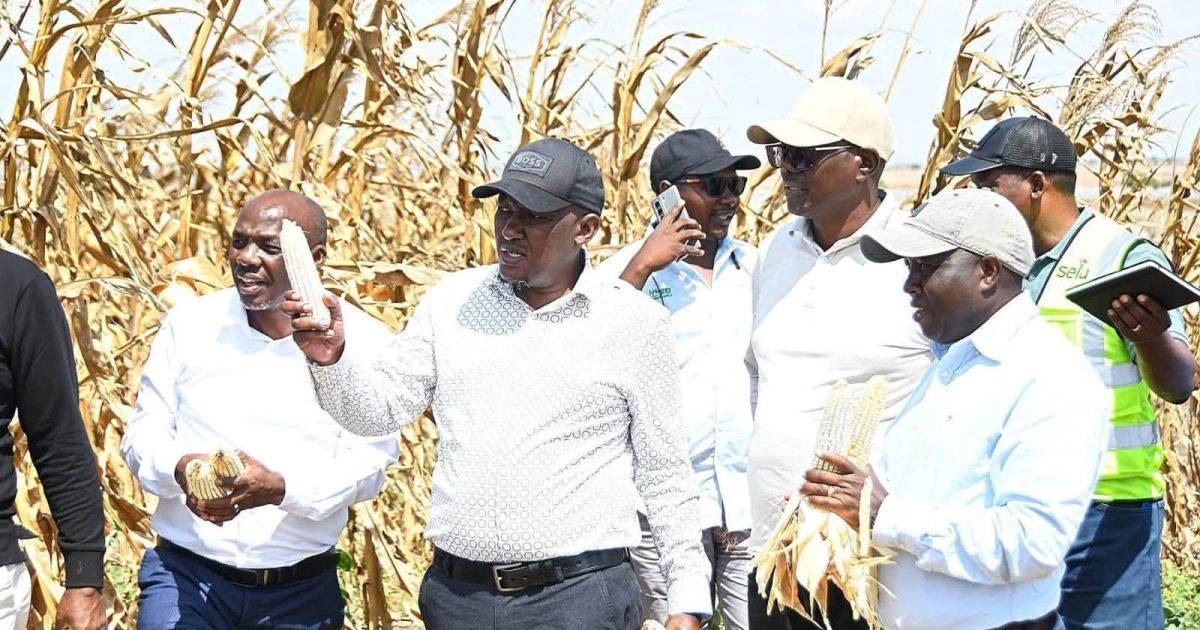
The Government has reaffirmed its commitment to the Galana-Kulalu Irrigation Scheme, describing the flagship project as a cornerstone of Kenya’s long-term food security strategy and a key investment in climate-smart agriculture aimed at increasing food production, creating employment and reducing reliance on rain-fed farming.
Speaking during an inspection tour of the project, the Principal Secretary for Agriculture Dr Kipronoh Ronoh said the expansive irrigation scheme represents a major shift in Kenya’s agricultural transformation agenda by embracing modern irrigation technologies capable of ensuring year-round food production despite the growing impacts of climate change.
Dr Ronoh led a high-level government delegation that toured the project to assess the progress of irrigation infrastructure and review preparations for large-scale commercial farming.
The delegation included Principal Secretary for ICT and the Digital Economy Eng. John Tanui, Irrigation Principal Secretary Ephantus Kimotho Kimani, Agricultural Development Corporation (ADC) Managing Director Wilison Tanui, officials from the National Irrigation Authority (NIA), development partners, investors and technical experts.
The Principal Secretary said Galana-Kulalu has evolved from being viewed as a simple irrigation initiative into a strategic national investment designed to strengthen Kenya’s food security while promoting sustainable agricultural production.
“Galana-Kulalu is no longer just an irrigation project; it is a national food security investment that demonstrates Kenya’s determination to produce enough food for its people regardless of changing weather patterns,” said Dr Ronoh.
He observed that climate change has increasingly disrupted traditional farming systems that depend on seasonal rainfall, making irrigation an essential component of future agricultural production.
“For decades, Kenyan agriculture has relied heavily on rainfall, but changing weather patterns have made that model increasingly unreliable. Through irrigation, mechanisation, modern technology and strategic partnerships, we are securing the future of agriculture in Kenya,” he said.
Once fully operational, the project is expected to produce more than five million 90-kilogramme bags of maize annually, significantly boosting the country’s strategic grain reserves and reducing dependence on food imports during periods of shortage.
Beyond maize production, Dr Ronoh said the project has enormous potential to diversify into horticulture, oil crops, livestock fodder and other high-value crops capable of serving both domestic and export markets.
He noted that the availability of reliable irrigation infrastructure would allow farmers and investors to undertake continuous production throughout the year, thereby increasing agricultural productivity and improving returns on investment.
The Principal Secretary said the project aligns with the government’s broader agricultural transformation agenda, which seeks to enhance food security, increase farmer incomes and build resilience against climate change.
The Principal Secretary for ICT and the Digital Economy Eng. John Tanui said digital technologies will play a central role in ensuring efficient management of the irrigation scheme.
He said the project will integrate precision agriculture, satellite monitoring, digital extension services and data-driven farm management systems to improve productivity, efficiency and transparency.
“Agriculture is becoming increasingly technology-driven. By integrating ICT solutions into Galana-Kulalu, we are creating a modern agricultural ecosystem that improves productivity, efficiency and transparency,” said Eng. Tanui.
The Principal Secretary for Irrigation Ephantus Kimotho Kimani said substantial investments have already been made in irrigation infrastructure, including water abstraction systems, canals, pumping stations and water distribution networks designed to support year-round crop production.
He noted that efficient utilisation of available water resources remains critical to the project’s long-term sustainability.
“Water is the backbone of this project. Our focus is to ensure reliable irrigation systems that maximise every drop of water while supporting sustainable agricultural production,” he said.
Agricultural Development Corporation Managing Director Wilison Tanui said the corporation remains committed to ensuring the commercial success of the project by attracting private sector participation while maintaining effective government oversight.
He said Galana-Kulalu presents enormous investment opportunities across the agricultural value chain, including crop production, agro-processing, storage, logistics, mechanisation and value addition.
“Galana-Kulalu offers tremendous investment opportunities in farming, agro-processing, storage, logistics and value addition. It is a project that can stimulate economic growth far beyond agriculture,” he said.
The Galana-Kulalu Food Security Project was conceived as one of Kenya’s flagship agricultural initiatives under Vision 2030 to unlock the vast agricultural potential of the Galana and Kulalu ranches located in Kilifi and Tana River Counties.
The project was officially launched in 2014 following the government’s decision to establish a large-scale irrigation scheme using water from the Galana River to facilitate year-round food production.
Its original master plan envisioned irrigating more than one million acres over time, making it one of Africa’s largest irrigation projects.
However, implementation encountered numerous challenges, including contractor disputes, high infrastructure costs, technical difficulties, funding constraints and changes in policy direction.
Following several reviews by successive administrations, the government restructured the implementation model by prioritising completion of critical irrigation infrastructure before expanding commercial production through public-private partnerships.
Under the revised strategy, emphasis has shifted to constructing irrigation canals, pumping stations, power infrastructure and modern farm management systems while encouraging private investors to cultivate irrigated land under commercial arrangements.
Government officials said the revised approach has improved implementation efficiency while restoring investor confidence and strengthening partnerships with development agencies.
The renewed focus on Galana-Kulalu forms part of broader efforts to increase domestic food production, reduce dependence on imports, create employment opportunities and enhance resilience to climate change.
Agricultural experts noted that the project is strategically positioned to become one of Kenya’s leading food production zones due to its proximity to permanent water sources, extensive tracts of arable land and improving transport infrastructure connecting the Coast region to major markets.
Local leaders welcomed the government’s renewed commitment, saying the project is already creating employment opportunities for surrounding communities while opening up new business prospects in transport, construction, hospitality and agricultural services.
Residents expressed optimism that successful implementation would transform the economies of Kilifi and Tana River counties through increased investment, expanded agricultural production and improved household incomes.
Government officials expressed confidence that, once fully developed, the Galana-Kulalu Irrigation Scheme will become a model for climate-smart agriculture and one of Kenya’s most significant long-term investments in sustainable food production and national food security.
By Absalom Namwalo