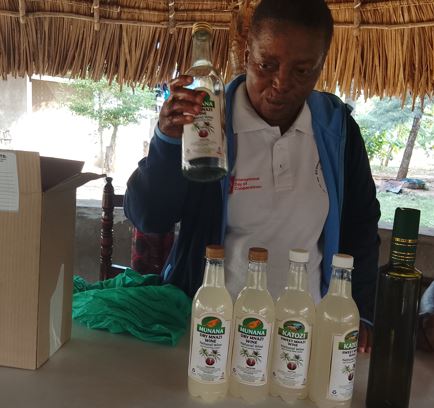
A local company in Mtondia, Kilifi County, is transforming the coconut wine industry from a roadside tipple into a bottled, marketable product, in a move set to create jobs and unlock new income streams for coconut farmers along the Coast.
Kilifi Mnazi Wines Limited, which began operations in March 2026, has succeeded in processing and bottling Mnazi, the traditional coconut wine long associated with informal village bars known as mangwe, into a packaged product now attracting attention from Pwani University, County Government officials and regulatory agencies.
Company Chairperson, Dr. Mtana Lewa, said the venture seeks to unlock the full value chain of the coconut plant, which he said has been neglected for decades despite its economic potential.
“The coconut plant has many values and products, which can grow the economy of the Coast and the coconut farmers. We thought the coconut wine, which has mainly been put on the back shelf, deserved to be brought to the front, to bring out its full commercial potential,” Lewa said.
He added that the enterprise could generate significant income for tappers, noting that a single tapper harvesting five trees a day at 20 litres per tree could earn around Sh5, 000 daily once the market matures.
Beyond tapping, he added, transport, processing, packaging, and factory work would create further employment, especially if production scales up to between 10,000 and 60,000 litres a day.
Technical Manager Marietta Gona said the company sources raw Mnazi from tappers at between Sh60 and Sh80 per bottle before processing it into two products: Mnana, a dry wine with an alcohol content of about 24 per cent, and Katozi, a sweet wine averaging four per cent alcohol. The bottled product has a shelf life of roughly three months.
Gona said the firm is working to meet standards set by a multi-agency team that includes the National Authority for the Campaign Against Alcohol and Drug Abuse (NACADA), public health officials and the Kenya Bureau of Standards (KEBS), including upgrading packaging from plastic to glass and amber bottles, fencing off the premises and repainting the factory.
“We just feel in the next two weeks we’ll be able to satisfy the multi-agency team and maybe even get standards from KEBS,” Gona said, adding that the company has signed a Memorandum of Understanding with Pwani University for research support and engaged the Kenya Industrial Property Institute (KIPI) in drafting the liquor bill.
She said the company hopes to fully comply with NACADA, public health, KRA, and other liquor regulatory bodies in time to showcase and sell its products at the upcoming Mombasa International Show.
Francisco Mwatsuma, a consumer, praised the product after tasting it for the first time, saying it addressed one of the biggest complaints against traditional Mnazi.
“People were shunning Mnazi Brew because of its smell. But this one, the smell has drastically reduced, and it can be transported to far-flung areas of the country. This product is super nice, but people should drink it responsibly,” Mwatsuma said.
By Ramadhan Nassib