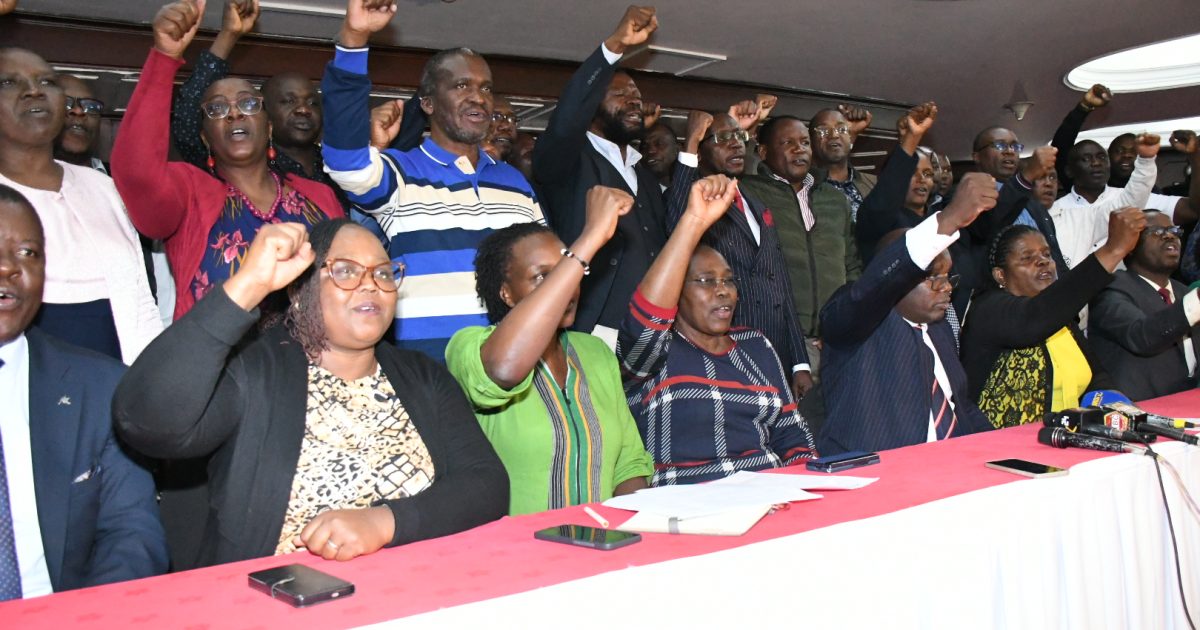
The Universities Academic Staff Union (UASU) has called on the Government to urgently intervene and address what it describes as a deteriorating situation in Kenya’s public university sector.
In a statement read by UASU Secretary General (SG) Dr. Constantine Wasonga in Nairobi on Friday, the union cited stalled negotiations for the 2025–2029 Collective Bargaining Agreement (CBA), persistent underfunding, increasing reliance on part-time lecturers, inadequate staffing, and concerns over the retirement age of academic staff.
Wasonga said UASU was concerned that negotiations for the 2025–2029 CBA had not been concluded despite an agreement under the November 2025 Return-to-Work Formula between UASU and the Inter-Public Universities Councils Consultative Forum (IPUCCF) to conclude the negotiations before the end of 2025.
He noted that nearly a year later, IPUCCF and the Government had yet to table a financial counter-proposal, creating anxiety among public university academic staff.
“UASU gives IPUCCF and the Government one month from today to table a substantive counter-proposal, negotiate, sign, and implement the 2025–2029 CBA,” declared the SG.
The union also raised concerns over the financing of public universities, arguing that academic staff are public officers whose remuneration and benefits should be funded from the Consolidated Fund or money appropriated by Parliament.
According to UASU, the recently published Tertiary Education, Placement and Funding Bill, 2026 does not address the mechanism for remunerating academic staff.
To this regard, Wasonga said it was unsustainable to finance university lecturers’ salaries from student fees and called for legislation concerning the financing of public universities to include provisions safeguarding the remuneration of academic staff from the Exchequer.
The union further criticised the role of the Salaries and Remuneration Commission (SRC), saying it had declined to approve several internal CBAs negotiated between individual universities and UASU chapters.
Importantly, UASU cited the University of Nairobi 2017–2021 CBA, which it said was signed after nine years of negotiations, and called for a practical pathway for the registration and implementation of signed internal CBAs.
On part-time teaching, the union expressed concern over what it termed as increasing reliance on part-time academic staff as a substitute for recruiting permanent lecturers.
To elaborate, the SG pointed out that the expansion of student enrolment had not been matched by corresponding recruitment, resulting in excessive workloads and growing dependence on insecure employment.
As a result, the union called for an immediate review of part-time teaching policies and insisted that part-time lecturers should be considered for absorption into available permanent positions.
Equally, the union also raised concerns over what it described as continued attempts to reduce the retirement age of academic staff in public universities, saying this would violate the existing CBA.
In this respect, Wasonga stated that it was illogical for universities to rely on part-time lecturers while simultaneously forcing experienced academics out of permanent employment.
“It takes decades to produce a professor,” he pronounced, noting that Kenya has fewer than 2,000 professors.
Similarly, the SG also linked the retirement-age issue to the pension situation in public universities, claiming that the institutions collectively owe pension schemes more than Sh20 billion in remittances and related obligations.
On the Moi University redundancies, the union further called on the Government to suspend the redundancy process at the University, arguing that the institution should first undergo an independent staffing audit.
To contextualize, the SG said reports by regulatory bodies indicated that Moi University was severely understaffed, making it contradictory for the institution to pursue redundancies while seeking additional part-time teaching staff.
Therefore, Wasonga called for the suspension of all redundancy notices pending the proposed staffing audit.
Meanwhile, he urged the Government to address the issues without delay to protect the quality of university education, the welfare of academic staff, and the future of students.
by Aron Kinyamasyo