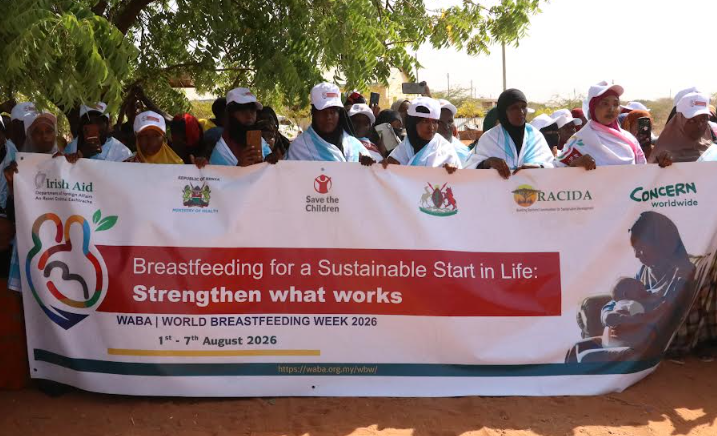
Mandera County has emphasized its commitment in improving maternal and child health by promoting breastfeeding, with health officials calling for breastfeeding-friendly workplaces, stronger community support, and sustained public awareness to help mothers exclusively breastfeed their infants for the first six months.
Speaking during this year’s World Breastfeeding Week celebrations, County Executive Committee Member (CECM) for Health Mumtaza Bishar said breastfeeding remains one of the most effective and affordable interventions for ensuring child survival, preventing disease, and promoting healthy growth and development.
She noted that Mandera continues to register impressive breastfeeding outcomes compared to many counties across the country.
“Our breastfeeding indicators are encouraging. According to the Kenya Health Information System (KHIS), Mandera County records an average breastfeeding rate of more than 80 percent, demonstrating the significant progress we are making in protecting the health of our children,” said Mumtaza.
County nutrition data shows that more than 98 percent of children in Mandera are breastfed, while exclusive breastfeeding among infants below six months stands at approximately 68 percent, surpassing the national average. Health experts say exclusive breastfeeding during the first six months of life significantly lowers the risk of infections, malnutrition, and infant deaths.
Despite the achievements, the Health CECM said several barriers continue to hinder exclusive breastfeeding.
She identified the lack of breastfeeding-friendly workplaces as one of the biggest challenges facing working mothers.
“Many mothers returning to work do not have access to safe and private lactation spaces where they can breastfeed or express breast milk. We need to invest in workplaces that support breastfeeding so mothers can continue nursing their babies even after maternity leave,” she said.
Mumtaza also cited cultural beliefs and misconceptions surrounding infant feeding as a major concern.
“Harmful practices such as introducing mixed feeding too early or believing that breast milk alone is insufficient continue to undermine exclusive breastfeeding. These misconceptions can only be addressed through sustained community education and behaviour change,” she added.
To strengthen breastfeeding support, the county, in partnership with UNICEF, is implementing a Reproductive, Maternal, Newborn, Child and Adolescent Health and Nutrition (RMNCAH+N) programme. The initiative focuses on empowering mothers through community-based support groups and expanding the role of Community Health Promoters (CHPs).
Under the programme, Community Health Promoters are trained to provide household counselling and follow-up services, while health facilities are encouraged to carry out comprehensive breastfeeding assessments during antenatal and postnatal visits.
“Every mother attending our health facilities should receive counselling, breastfeeding assessment and continuous support. Our mother-to-mother support groups and Community Health Promoters must continue working closely with families to ensure mothers are able to exclusively breastfeed their babies for the first six months,” Mumtaza said
She called on employers, healthcare workers, community leaders and families to work together in creating an environment that enables mothers to breastfeed successfully, both at home and in the workplace.
“As we commemorate World Breastfeeding Week, let us strengthen our health systems, dispel harmful myths surrounding breastfeeding, and foster supportive workplaces and communities. By working together, we can give every child the healthiest possible start in life through optimal breastfeeding,” she said.
World Breastfeeding Week aims to raise awareness about the vital role of breastfeeding in improving child nutrition, health and development.
The global campaign also advocates for policies and practices that protect, promote and support breastfeeding, ensuring that every mother is empowered to give her child the best possible start in life.
By Adan Mohamed