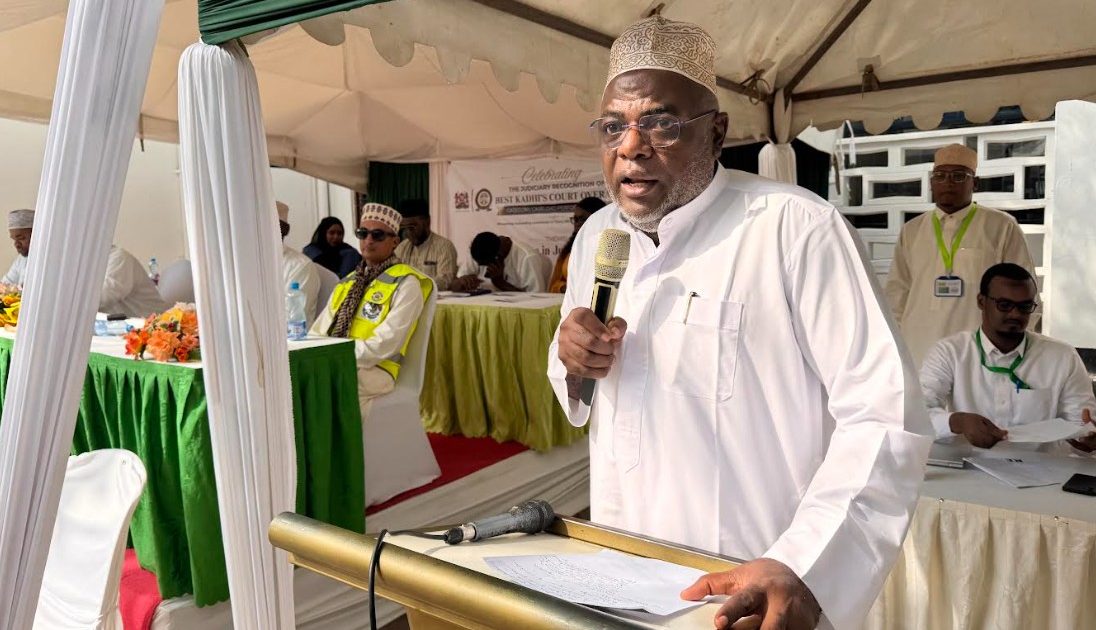
The Judicial Service Commission (JSC) has been urged to fast-track the recruitment of a substantive Chief Kadhi and increase the number of Kadhis across the country to improve access to justice and enhance service delivery in Kadhi’s Courts.
The position of Chief Kadhi has remained vacant since the death of Chief Kadhi Sheikh Athman Abdulhalim on July 9, 2025, with Senior Principal Kadhi Sheikh Sukyan Omar Hassan serving in an acting capacity.
Although the JSC advertised the position on January 16, 2026, stakeholders say there has been little progress in filling the office.
Speaking during celebrations marking the recognition of the Mombasa Kadhi’s Court as Kenya’s best-performing Kadhi’s Court in the overall caseload performance category, Mombasa Senator and High Court advocate Mohamed Faki called on the JSC to prioritise the appointment and increase investment in Kadhi’s Courts.

Faki said judicial investment in Kadhi’s courts had remained inadequate despite growing demand for their services during his more than two decades of legal practice.
According to court statistics, the Mombasa Kadhi’s Court handled 2,832 cases during the 2024/2025 financial year, up from 2,484 cases in the previous financial year, reflecting an increasing workload.
The Senator also commended Helping Hands Pwani for financing renovations at the Mombasa Kadhi’s Court, saying partnerships with development organisations had helped bridge gaps in infrastructure and service delivery.
“Even now, the office of the Chief Kadhi remains vacant almost one year after the death of the former Chief Kadhi. There are administrative issues that require urgent attention,” Faki said.
He said although the JSC had advertised the position, there had been no communication on the progress of the recruitment process.
“I am aware there was an advertisement for the position of Chief Kadhi, but after that, nobody has heard anything about it for almost a year,” he said.
Faki also called for the recruitment of more Kadhis, noting that Kenya currently has only 43 Kadhis serving the entire country.
“Even if we assigned one Kadhi to each county, four counties would still remain without one. Moreover, some stations require more than one Kadhi because of the heavy workload,” he said.
He cited Mombasa, which has three Kadhis despite its high caseload, and Msambweni, which has one Kadhi despite handling a large number of cases.
“Here in Mombasa we have three Kadhis, yet the caseload remains high. Msambweni has only one Kadhi despite handling a huge number of cases, and another Kadhi is urgently needed,” he said.
To improve access to justice, Faki pledged to petition the JSC to establish a Kadhi’s Court at Shanzu Law Courts to serve residents of Shanzu, Utange, Mtwapa and the wider Kisauni Sub-County.
He also lauded Kadhi’s Courts for maintaining high standards of integrity, impartiality and adherence to the law, saying he had not encountered allegations of corruption against Kadhis throughout his years of legal practice.
“If you appear before a Kadhi’s Court, especially in succession matters, you are assured of justice. There are no unnecessary delays or underhand dealings because the decisions are guided by the Holy Qur’an and the Sunnah of the Prophet,” he said.
Head of the Mombasa Kadhi’s Court Station Abdulaziz Mohamed attributed the court’s recognition as the country’s top-performing Kadhi’s Court to teamwork, innovation and collaboration with the Court Users Committee (CUC).
He said the station had focused on strengthening its internal systems and partnerships instead of dwelling on resource limitations.
“Instead of focusing on what we lacked, we concentrated on what we could build. We strengthened teamwork, embraced innovation, improved our internal systems, mobilised external partnerships, enhanced accountability, invested in technology and placed the Court Users Committee at the centre of every decision we made,” Mohamed said.
He noted that lasting transformation in the judiciary could only be achieved when judicial officers, staff and stakeholders embraced a culture of service, integrity, professionalism and continuous improvement.
“The future of justice belongs to institutions that build partnerships, embrace innovation and work together for the common good,” he said.
Mohamed said the station would continue strengthening access to justice, accelerating digital transformation, improving institutional efficiency and promoting Alternative Justice Resolution mechanisms.
Helping Hands Pwani Executive Director Habib Omar said the organisation remained committed to supporting Kadhi’s Courts, many of which had suffered from inadequate infrastructure despite serving thousands of Muslims seeking justice.
Omar said stronger partnerships were necessary to improve the physical infrastructure and communication systems of the courts.
“If stakeholders do not come together to support these Kadhi’s Courts, many of their buildings and communication systems will continue to deteriorate,” he said.
He urged other non-governmental organisations to support Kadhi’s courts and help strengthen the institutions so they can serve more Muslims across the country.
By Sadik Hassan