

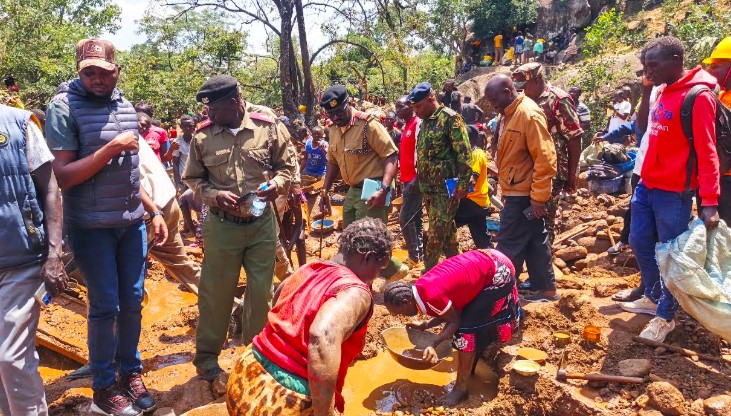
A gold rush in Kanyarkwat, West Pokot County, has attracted an estimated 10,000 people to Cheporor village within six days, raising concerns over an impending humanitarian crisis as authorities race to assess the situation.
The influx followed reports that some individuals had stumbled upon what was alleged to be valuable gold deposits in the area, prompting residents and people from neighbouring towns, counties and even neighbouring countries to converge on the site in search of fortune.
Deputy County Commissioner (DCC) for West Pokot Sub-County Samuel Kiarie, accompanied by the sub-county security committee, visited Cheporor to assess the rapidly developing situation and identify possible interventions.
Kiarie said the situation was growing beyond a mining activity and could quickly develop into a humanitarian crisis if urgent measures were not taken.
“A humanitarian crisis is about to take place. That is why we have come here to see and evaluate the situation so that we can make arrangements to ensure that no individual is harmed by what could happen here,” said Kiarie.
He said the sheer number of people at the site, combined with unsafe mining practices and lack of basic facilities, posed serious risks.
One of the major concerns identified was child labour, with school-going children actively involved in digging, while some toddlers have also been brought to the site and left unattended.
Kiarie warned that the situation could worsen when schools reopen in September, with some children potentially abandoning their education in pursuit of gold.
“Many school-going children are involved in the mining, while toddlers are also being brought here and left unattended. This is a big risk to their lives,” he said.
He added that the relevant stakeholders in the children’s department had been notified and would be expected to participate in an urgent collaborative meeting to determine measures to protect children and ensure they return to school.
The presence of large and deep holes dug by miners has also heightened fears of accidents, particularly given the high population and continued mining activities into the night.
The local administration further expressed concern that the growing population could attract the sale and consumption of illicit brews and other drugs, increasing the risk of accidents and insecurity.
Kiarie said the approaching rainy season could make the situation even more precarious.
Many miners are operating along a seasonal river, while some reportedly sleep in the open at night. Heavy rains could flood the area and the numerous open mining pits, potentially resulting in loss of lives and displacement.
“The magnitude of the problem we are handling is not small, and we anticipate challenges. But when we put our minds together, we are guaranteed to find a solution,” Kiarie said.
Apart from security and child-protection concerns, the gold rush has triggered an emerging public health crisis, with virtually no sanitation facilities available at the rapidly expanding settlement.
Residents say there are no adequate toilets or reliable supplies of clean water, despite thousands of people now living and working around the mining site.
Benson Lokipuna, a resident of Kanyarkwat who joined the gold search after hearing about the discovery, instead saw an opportunity in the growing population and started selling cereals and flour.
“Business is booming because of the large number of people who have come here,” said Lokipuna.
However, he warned that sanitation was already becoming a major concern despite the mining activities having started only recently.
“There are no toilets and there is no clean water. We fear that diseases such as cholera could come up if the situation is not addressed,” he said.
Lokipuna said the seasonal river, which is one of the main sources of water for the area, was already drying up, further increasing pressure on the available water resources.
He appealed to government agencies to intervene before the situation deteriorates.
His concerns were echoed by Leonard Tum from neighbouring Chepunpun village, who said the gold rush had emerged at a time when many households were struggling with the effects of prolonged dry conditions.
Tum said poor rainfall had affected crops such as maize and beans, while lack of water and pasture had also resulted in livestock losses.
“People saw the discovery of gold as an alternative means of livelihood to finance their daily needs,” he said.
The gold rush has also transformed the small area into a busy commercial centre, with food vendors, boda boda operators, traders and other businesses converging on the site to serve the growing population.
Beatrice Nasimiyu, a businesswoman from Makutano town, relocated her grocery business to Cheporor three days ago after seeing the commercial opportunity created by the gold rush.
She sells cabbages, tomatoes, sukuma wiki, onions and other vegetables and says the earnings have already surpassed what she normally makes in Makutano.
“The profits here are much higher than my normal income,” Nasimiyu said.
She has already employed two young women to help her run the business, adding that the physically demanding nature of mining means food and other basic commodities are consumed in large quantities.
The influx has also attracted investors and merchants dealing in precious metals, further accelerating commercial activity at the site.
However, authorities say the economic benefits should not overshadow the urgent risks emerging from the uncontrolled population growth.
The situation at Cheporor calls for an immediate and coordinated response involving the national and county governments, particularly in water, sanitation, health, security, child protection and disaster preparedness.
Humanitarian and non-governmental organisations with capacity in emergency response, water and sanitation, child protection, public health and disaster management are also being urged to support government efforts where necessary.
With thousands of people already concentrated in a small area and more expected to arrive, stakeholders face the challenge of containing the risks before the situation develops into a full-blown humanitarian emergency.
The priority, authorities say, should be protecting women and children, preventing loss of life in mining pits, providing clean water and sanitation, safeguarding children from labour and keeping school-going children in school, while also ensuring that mining and gold trading activities are undertaken within the law.
For now, Cheporor remains a symbol of both economic hope and an unfolding humanitarian challenge and the speed with which authorities and humanitarian actors respond could determine whether the gold rush becomes an opportunity for local communities or a crisis waiting to happen.
By Parklea Ivor

