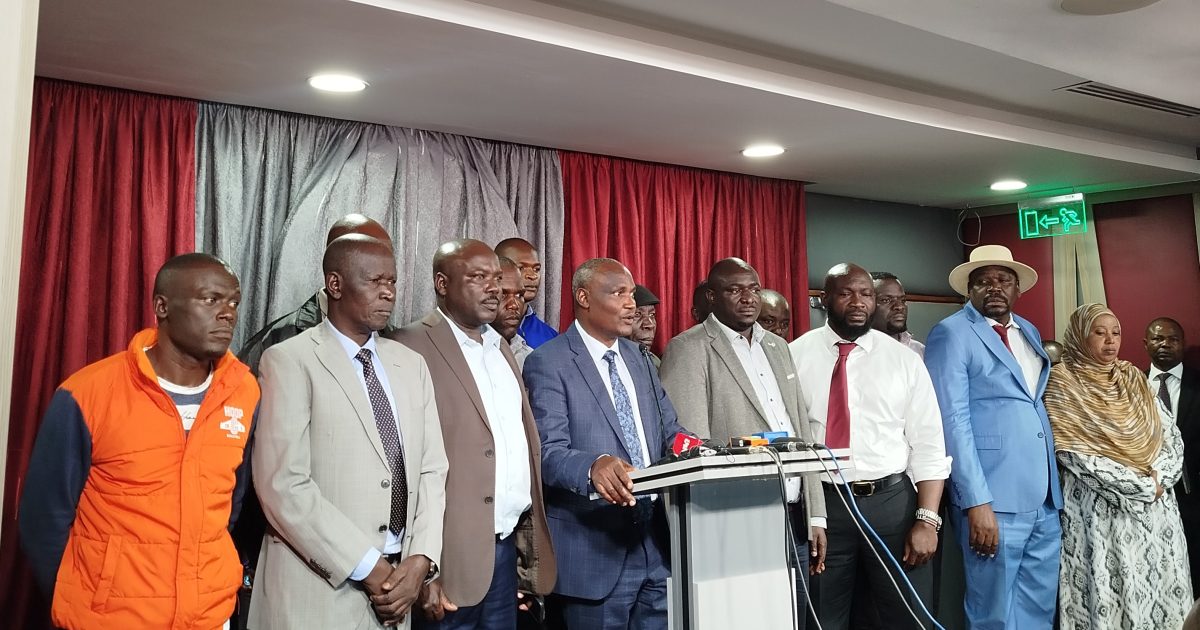
National Treasury and Economic Planning Cabinet Secretary John Mbadi has challenged political leaders and the media to scrutinise the Government’s economic record using verifiable data as Kenya prepares for the 2027 General Election.
Mbadi defended the Government’s performance, citing gains in agriculture, infrastructure, healthcare, debt management and foreign exchange as evidence of progress since President William Ruto assumed office.
Speaking in Nairobi on Tuesday, Mbadi urged journalists to subject political claims to rigorous scrutiny and independently verify statements made by politicians during the election period.
“Don’t let politicians go scot-free with mediocre reasons and arguments. And that calls for serious research,” he said.
Mbadi cited the reduction of fertiliser prices to Sh2,500 and increased distribution of the farm input as some of the Government’s achievements, alongside increased tea and milk production and expansion of acreage under food and edible-oil crops.
He said the country had also made progress in managing its foreign exchange position and meeting its international debt obligations, including the repurchase of a 900-million-dollar Eurobond that was due in 2027.
The CS also pointed to an improvement in the country’s debt-to-GDP ratio and increased registration under the Social Health Authority (SHA), compared with the former National Hospital Insurance Fund (NHIF).
On infrastructure, Mbadi said the Government had completed 2,665 kilometres of roads over the past four years, while additional roads remained under construction.
He dismissed claims that the administration had failed to deliver on its development agenda, challenging critics to distinguish political arguments from measurable economic performance.
“If it is economy, actually we should be called to be celebrated. Some of us should be given awards in this country because we have moved Kenya to where it was almost tipping,” Mbadi said.
The CS also addressed the impact of the ongoing conflict in the Middle East on fuel prices, saying the Government was balancing the need to raise tax revenue against the risk of fuelling inflation.
“We are balancing inflation vis-a-vis tax revenue. So much as we want tax revenue in terms of VAT, we must also understand that if it is causing inflation, it is going to have more harm to the economy,” he said.
Mbadi said the Government was exploring additional sources of funding to cushion consumers and subsidise petroleum products if necessary, as it continues monitoring developments in the Middle East.
On proposed income tax and PAYE reforms, the CS said the Treasury was undertaking public participation before preparing amendments to the tax laws.
He said proposals from Kenyans and stakeholders, including the banking sector, would be considered before the amendments are presented to Parliament.
Mbadi also announced that Kenya would tomorrow begin public consultations on the country’s next long-term development blueprint, Vision 2060, as Vision 2030 approaches its conclusion.
He said the process would allow Kenyans to assess the achievements and shortcomings of Vision 2030 and determine priorities for the next phase of national development.
“Tomorrow is the beginning of public engagement in terms of public participation as it is required and enshrined in our Constitution,” Mbadi said.
He said Vision 2060 should not be viewed as President Ruto’s personal project, noting that its implementation would extend beyond the current administration.
“The vision is not for Ruto. It is 2060. Ruto can only be in power up to 2032, not beyond. Therefore, this vision is not his,” he said.
Mbadi urged Kenyans, including those holding alternative views, to participate in the consultations and present ideas on the country’s long-term development.
“Tell Kenyans all those beautiful things, the better ideas that you think you have, that you can help lead this country going forward. Bring them beginning tomorrow, so that we can advance,” he said.
He said a team led by Prof. Anyang’ Nyong’o and an international consultant had prepared a framework to guide the consultations and inform the development of the proposed Vision 2060.
By Nancy Omondi and Phaeline Motari