The Kisumu County Government has invested Sh38 million in equipment for Vocational Training Centres (VTCs) across the county, Governor Prof. Peter Anyang` Anyang’ Nyong’o has announced.
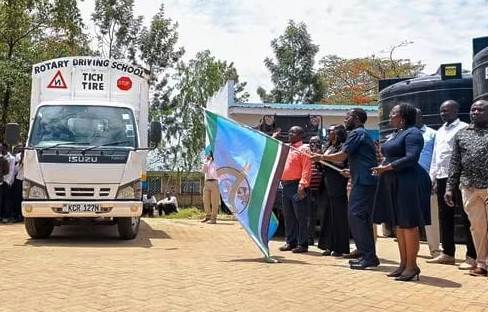
Speaking during the flagging-off of tools and equipment worth Sh20 million to equip VTCs in the county on Thursday, Nyong’o said the latest investment builds on Sh18 million that was allocated last year to equip 28 VTCs across the county’s wards.
He said the investment was not a one-off initiative, but a deliberate, budgeted and institutionalized effort to strengthen vocational training and equip young people with practical skills.
“The evidence of what this approach delivers is already before us. Our VTC network has grown from 28 to 30 centres, with St. Michael Mariwa in Koru; Muhoroni and Sang’oro in West Nyakach as the latest additions,” said Nyong’o.
The Governor said more than 6,500 young men and women are currently acquiring practical skills through the county’s VTCs in 11 disciplines, including electrical installation, welding, tailoring, masonry, ICT, agripreneurship and plumbing.
He said the skills acquired through vocational training will enable young people to access income-generating opportunities amid shrinking formal employment opportunities.
“Whereas formal employment opportunities are shrinking everywhere in the world, the market for skilled hands has never been stronger,” he said.
Nyong’o encouraged residents to enrol their sons and daughters in the VTCs, noting that the county government provides a Sh15, 000 subsidy for every student.
He said the county had also set aside Sh11.9 million for VTC bursaries, adding that no young person should be locked out of vocational training due to lack of fees.
On the shortage of trainers and managers, Nyong’o said the county was working to bridge the gap, with 97 trainers currently in place against a requirement of 384.
“We are now at 97, with a plan of recruiting 25 every financial year until we reach the requisite number,” he said.
Nyong’o also acknowledged the contribution of various development partners in particular; Pratham International, Comundo (from Switzerland), Colleges and Institutes (CICan) from Canada, the Kenya Blue Economy Skills Training Program (KBEST ) which is a 7-year initiative running from 2022 to 2029, Tools to Work, Ujima, Shining Hope for Communities ( SHOFCO); a major community-based organization and National Government Affirmative Action Fund (NGAAF), for supporting the county’s vocational training programme.
He urged young people to take advantage of the opportunities offered through the VTCs and acquire practical skills that can enable them to earn a livelihood.
Kisumu County has 28 public Vocational Training Centres (VTCs) managed by the county government, alongside major regional and national technical institutions like The Kisumu National Polytechnic and the Ramogi Institute of Advanced Technology (RIAT).
The student population in Technical and Vocational Education and Training (TVET) institutions in Kisumu County is approximately 20,814 students, based on recent educational demographic survey.
As of 2026, Kenya has a rapidly expanding Technical and Vocational Education and Training (TVET) sector with a total of over 3,100 public and private TVET institutions and an overall enrollment that has surged to 1.2 million learners. This is according to data from the State Department for Technical, Vocational Education and Training (TVET).
TVET is the broad system of practical and technical education, whereas a VOC/VTC is a specific, foundational level of institution within that broader system.
TVET training provides knowledge and hands-on skills for specific jobs, trades, or professions. And covers a wide spectrum from basic practical skills to advanced technical, engineering, and even higher diploma-level education
They range from basic vocational centers to technical training institutes, technical vocational colleges, and national polytechnics.
VTCs on their part are specific, entry-level institution that focuses heavily on practical, manual trades. Their scope narrower and more foundational; concentrates on direct, hands-on work like tailoring, masonry, welding, and hairdressing
They typically have the lowest academic entry requirements, welcoming primary school or lower secondary leavers and usually awards basic artisan or proficiency certificates
by Mabel Keya- Shikuku / Chrispine Onyango Oduor