When Vincent Chelule walks through his wheat field in Chesoton, Njoro, he is not simply looking at a crop.
He is looking at a family tradition, a business and, increasingly, a difficult calculation.
Chelule started growing wheat in 1994. His father was also a wheat farmer. “I liked the work he was doing, so I decided to follow in his footsteps,” he says.
But six years later, the attraction had faded. The cost of production was rising and his yields were falling. Chelule stopped growing wheat and took time to learn what it would take to make the crop profitable.
He eventually returned to the fields and, since then, has carved out a niche in seed production and bulking.
Today, he farms about 20 acres, rotating wheat with other crops. Last year, about half of his land was under wheat.
But even after more than three decades in the crop, he says the fundamental problem remains.
“The major challenge for us as farmers is therefore the market,” he says. “The market exists, but the problem is the price.”
Chelule’s dilemma mirrors a wider problem facing Kenya’s wheat industry.
Wheat is the country’s second most important food cereal after maize. Yet production remains far below demand.
Kenya produced about 350,000 tonnes of wheat in 2024 against consumption estimated at between 2.2 million and 2.4 million tonnes, according to figures provided by researchers at the Kenya Agricultural and Livestock Research Organisation (KALRO).
More than three quarters of the country’s requirement is met through imports.
The gap might appear to offer farmers an obvious opportunity. But growing wheat is expensive.
And as Chelule has discovered, producing more does not necessarily mean making more money.
WHEN THE NUMBERS STOP ADDING UP
For an ordinary farmer growing wheat for grain, Chelule says profitability has become increasingly difficult.
Fuel prices have pushed up the cost of land preparation, harrowing, harvesting and other operations. Inputs have also become more expensive.
He estimates that producing an acre of wheat can now cost more than Sh50,000.
If wheat sells at Sh6,000 a 90-kilogramme bag, a farmer needs to harvest more than eight bags per acre just to begin covering the cost.
A poor harvest can therefore turn a season’s work into a loss.
Chelule knows what that feels like.
Last year, he planted two acres of wheat with about 100 kilogrammes of Njoro seed. Drought affected the crop, and he harvested about 20 bags from the two acres.
Under favourable conditions, he explains, a farmer can harvest between 18 and 25 bags an acre. Then there is the market.
Two years ago, the situation became particularly difficult. Farmers harvested their wheat but struggled to find buyers. Some stored the grain for months before eventually selling at low prices.
Chelule remembers having about 200 bags at one point.
“Imagine harvesting in August and still having the wheat in your store in November,” he reflects.
For farmers who had already spent heavily on production, selling at Sh4,000 a bag meant making a loss.
The experience discouraged many growers.
“Many farmers have since stopped growing wheat,” Chelule says.
KALRO wheat breeder Dr Martin Lagat says the market problem is part of a larger set of pressures that have contributed to declining wheat production.
The cost of inputs, labour and land has risen. At the same time, farms are becoming smaller through subdivision.
Wheat is a crop that lends itself to mechanized production. But as farms are divided into smaller parcels, the economics of using machinery become more difficult.
Farmers are also comparing wheat with other crops and moving to those they consider more profitable or less costly.
“Wheat prices in Kenya are low as compared to the cost of production,” Lagat regrets.
The industry is therefore caught between a large national demand for wheat and the realities facing the farmers expected to produce it.
THE SEARCH FOR A TOUGHER WHEAT
At KALRO’s Njoro centre, scientists are trying to address the problems that can be tackled through research.
The breeding programme dates back to the late 1920s, when the Njoro research station was established.
Since 1975, KALRO has released and registered 38 wheat varieties.
The progress has been significant. According to Lagat, the yield potential of varieties has risen from about 1.5 tonnes per hectare in 1975 to as much as eight tonnes per hectare for the latest varieties.
But developing a high-yielding variety is only one step. Farmers have to know about it, obtain the seed and be convinced that it will perform better under their conditions.
Chelule says lack of information is one reason some farmers continue planting older varieties.
He has worked with KALRO for years and currently grows the Jacana variety. “I planted it last year and the seed performed well, so I decided to plant it again,” he says.
His relationship with KALRO began through a farmer-group project, after an agricultural officer selected his group to participate in wheat seed production.
He later attended training in seed production, including a two-week course at Ol Joro Orok.
The work has given him another source of income.
Seed production, however, demands more attention than growing wheat purely for grain.
Chelule and his workers must remove off-types — plants that differ from the variety being produced.
On one acre, he may need about four people for a day to remove such plants.
Workers also help with spraying and other field operations.
Once the crop is harvested, the seed cannot simply be taken home and stored like ordinary grain.
It goes through a controlled process before it can reach other farmers.
WATCHING THE DISEASES
One of the reasons Chelule prefers improved KALRO varieties is the threat posed by wheat rust.
When he began working with KALRO, he grew Robin.
After two or three years, he says, Robin became susceptible to stem rust and was eventually removed from the recommended list.
KALRO breeders went back to work.
At the international wheat phenotyping platform in Njoro, plant pathologist Dr Zennah Kosgey and her colleagues are part of that continuing battle.
The facility was established in 2008 through collaboration between KALRO and the International Maize and Wheat Improvement Center (CIMMYT), following the identification of the Ug99 stem rust race.
Today, wheat and barley material from several countries is sent to Njoro for screening against rust diseases.
The facility evaluates about 25,000 wheat lines for stem rust and yellow rust.
The work continues twice a year.
During the dry season, irrigation from a tank holding up to one million litres of water enables the scientists to maintain the trials.
The objective is straightforward: expose wheat lines to disease and identify those that can withstand it.
Kosgey points to the symptoms in the experimental plots.
“Stem rust attacks the stem. Yellow rust, also known as stripe rust, attacks the leaves,” she points out.
When rust destroys the leaves prematurely, the plant loses much of its ability to photosynthesise and fill the grain.
For a farmer, that translates into lost yield.
But even a resistant variety is not necessarily protected forever.
Pathogens change. Resistance can eventually be overcome.
That is why Kosgey recommends an integrated approach.
“Farmers should start with certified seed and resistant varieties, scout their fields early, maintain good crop-management practices and use approved fungicides when necessary,” she suggests.
The timing is important.
By the time a farmer sees severe infection across a field, much of the damage may already have occurred.
“You’d rather prevent it than curing it later on,” Kosgey says.
WHEN RAIN BECOMES THE PROBLEM
Disease is not the only threat.
Wheat is largely rain-fed in Kenya, leaving farmers exposed to increasingly unpredictable weather.
Chelule experienced that uncertainty this year.
There was initially too much rain.
Germination was poor because the fields held too much water.
Then, about a month after planting, the rains stopped.
That happened just as the crop was producing tillers — shoots that contribute to the development of the wheat plant and ultimately its yield.
The crop eventually received rain, but Chelule says it came too late.
“You may expect rain and get drought, or expect drought and get rain,” he says. “This has become a major problem for farmers.”
At KALRO, scientists are responding by breeding varieties tolerant to water stress and acidic soils. Research is also under way on varieties that can perform better under low soil fertility and use nutrients more efficiently.
Lagat says irrigation could also open another chapter for the industry.
Kenya mainly grows spring wheat under rain-fed conditions. With irrigation, breeders could develop a wider range of wheat types, including softer white wheat that could complement the hard red wheat currently grown.
But excessive rain creates another problem: sprouting in the field as the grain matures.
Irrigation would give farmers greater control over water during the critical ripening period.
For now, however, most wheat farmers remain dependent on the weather.
FROM FIELD TO CERTIFIED SEED
Once the wheat is harvested, the battle does not end.
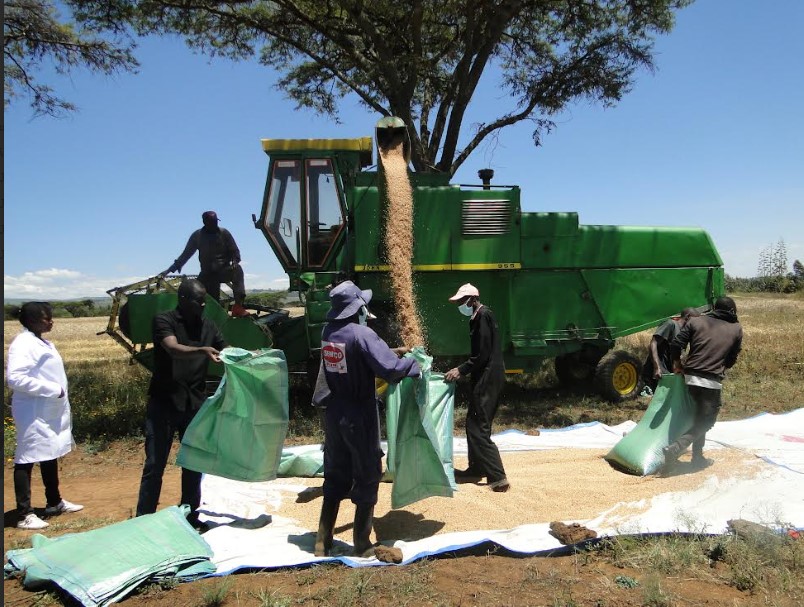
For seed farmers such as Chelule, harvesting must be carefully managed to prevent contamination between varieties.
The combine harvester must be cleaned before moving from one variety to another.
Seed scientist Cavin Otieno, who works at KALRO in Njoro, oversees the next stages.
After harvesting, seed is weighed and records checked. The Kenya Plant Health Inspectorate Services (KEPHIS) inspects the lots before processing and packaging.
The seed is then cleaned.
A cleaning machine removes weed seeds, chaff, stones, broken and shrivelled grains and other impurities using differences in size, weight and density.
The cleaned seed is then dressed to protect it against diseases before it is prepared for farmers.
It is a painstaking process, but one designed to ensure that the seed planted in the next season is what it is supposed to be.
For Chelule, that attention to quality is part of why he remains in the seed business.
But he worries about the future of ordinary grain production.
The cost of chemicals has risen sharply, he says, making it difficult for small-scale farmers to afford some of the products available on the market.
Some chemical packages are designed for farmers cultivating several acres. A farmer with one or two acres may be forced to buy more than needed, increasing the cost of production.
A FARMER’S CALCULATION
There is also a less visible threat to wheat farming around Njoro: the land itself.
Chelule says agricultural land is increasingly being subdivided into residential plots.
Fields that once supported wheat production are being broken into smaller parcels, making mechanized farming harder.
For a crop already struggling with high costs, unpredictable weather, disease and weak prices, the loss of farmland adds another pressure.
Chelule has seen the wheat cycle from close range.
He entered the crop because his father grew it. He left when the economics stopped making sense. He returned after learning how to produce seed and found a way to make the business work.
But he knows that seed production is not the same as growing wheat for the nation’s flour mills.
For the ordinary grain farmer, the numbers must still add up.
And that is where science meets the marketplace.
KALRO can breed wheat that resists rust. It can develop varieties that tolerate drought, acidic soils and low fertility. Scientists can screen thousands of lines and produce cleaner, certified seed.
But farmers still need affordable inputs, reliable markets, sufficient land and weather that does not work against them.
Chelule is still planting wheat.
He prefers Jacana because it appears less vulnerable to some of the bird damage that can devastate wheat fields.
Yet his continued presence in the wheat fields should not be mistaken for certainty.
For him, every season is another calculation.
The seed should perform. The rains should come at the right time. Diseases should be kept away. The combine harvester should arrive. And, after months of work, someone should be willing to buy the grain at a price that covers what went into producing it.
The science may help farmers grow a better crop.
But for Vincent Chelule, the bigger question remains whether Kenya can create conditions in which growing that crop is worth returning to year after year.
by William Inganga