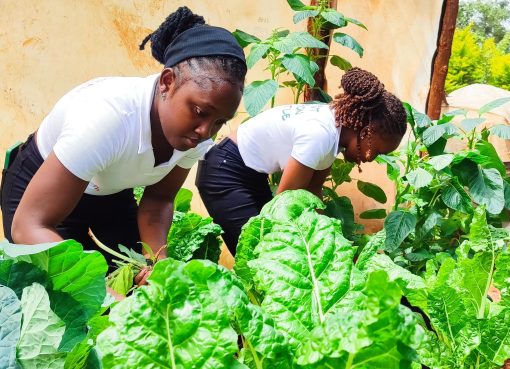
The government is stepping up efforts to strengthen food security and livestock productivity in Kenya’s arid and semi-arid lands through the promotion of climate-resilient agricultural technologies that can withstand changing weather conditions and limited water resources.
The Kenya Agricultural and Livestock Research Organization (KALRO) is working with farmers in Wajir County to test improved cowpea, pasture, and fodder varieties as part of efforts to identify technologies that can support food and livestock production under the county’s harsh climatic conditions.
The initiative is being implemented through the Food Systems Resilience Project (FSRP), a government programme co-funded by the World Bank and the national government, with support from the County Government of Wajir.
The programme is supporting demonstration farms where researchers are assessing the performance of different crop and fodder varieties under local conditions, including sandy soils, high temperatures, erratic rainfall, and irrigation.
At a demonstration farm in Kalkalcha West, Wajir West, KALRO researcher Beatrice Wanjiru Nganga is assessing 10 cowpea varieties to establish those best suited to the local production environment.
Nganga said soil and water samples were collected before the plots were established to provide information on the conditions under which the different varieties would be grown.
She said water quality was particularly important because many farmers in the area rely on shallow wells for irrigation, with saline water having the potential to affect crop performance.
“Continued use of saline water could affect crop production,” Nganga said, adding that the trials would help establish cowpea varieties capable of tolerating the conditions.
The researcher said Wajir’s sandy soils have low water-holding capacity, while high temperatures increase evapotranspiration and consequently the amount of water required by crops.
Despite the challenges, she said the cowpea varieties had generally performed well, with some maturing in about 60 days, demonstrating their potential for dryland production.
KALRO has established cowpea demonstration sites in Wagala Gunyure, Ibrahim Ure, Horof Harar, and Wagberi wards, among other locations, to provide farmers with an opportunity to observe the technologies under local conditions.
KALRO Agronomist Charles Muriuki said the demonstrations were intended to identify and showcase agricultural technologies that could perform in difficult production environments.
“Wajir County is usually faced by very harsh environmental conditions and very erratic rainfall,” Muriuki said.
He said cowpea was selected because it requires relatively little rainfall compared with many other crops and has demonstrated adaptability to dryland conditions.
Beyond providing food and income, cowpea contributes to soil fertility through its ability to fix atmospheric nitrogen. Its short maturity period also gives households an additional food source before longer-maturing crops such as sorghum and millet are ready for harvesting.
At the Kalkalcha West demonstration farm, farmer Halima Kahia is hosting the cowpea trials alongside fodder demonstrations.
Kahia established the farm in 2020 during the COVID-19 period after she began working from home as a journalist. What started as an effort to remain productive later developed into a family farm, where she partnered with the county agriculture department and KALRO.
“So far so good. The ten varieties of cowpea have done very well, except very few of them, which did not grow as planned,” Kahia said.
She said the trials would help farmers determine which varieties are best suited to Wajir’s soil, water, and climatic conditions.
The farm is also being used to demonstrate improved fodder production, an intervention aimed at addressing feed shortages that affect livestock during prolonged dry periods.
The fodder varieties include sweet potato vines, teff, and two sorghum varieties, including one for food and another for forage.
Kahia said expanding fodder production could help farmers reduce the pressure on natural grazing areas and provide livestock with feed closer to their homesteads.
“If we invest really in pasture, this being an arid area, and during the drought we have been losing our livestock because of lack of pasture,” she said.
She added that farmers with access to shallow wells could use irrigation to produce fodder and maintain feed supplies during dry periods.
KALRO researcher Dr. Fred Kemboi said inadequate pasture and forage remained one of the major constraints to livestock productivity in Wajir.
He said declining natural grazing resources made the traditional practice of moving animals over long distances in search of pasture increasingly difficult.
KALRO is therefore testing improved pasture and fodder varieties that could support livestock under more controlled production systems.
The grasses being tested include Bush rye, Cenchrus ciliaris, Boma Rhodes, and Maasai love grass, alongside two forage sorghum varieties, including a dual-purpose variety and another intended specifically for forage production.
Kemboi said some of the fodder could be conserved as hay, while forage sorghum could also be used for silage, giving farmers options for preserving feed for periods of scarcity.
He said improved pasture and forage could also support livestock finishing and feedlot systems by providing a more reliable source of feed.
“The grasses that our pastoralists are using, moving one animal from one place to another, cannot support finishing or feedlot,” Kemboi said.
Kemboi said KALRO had supported the establishment of five demonstration sites where different cowpea, pasture, and fodder varieties were being evaluated.
The official said the county was monitoring the performance of the technologies to determine those suitable for wider adoption by farmers.
“We are telling the people that this can work and that we should work together,” the official said, adding that the county government would support farmers within its capacity.
The Wajir demonstrations form part of broader government efforts to strengthen agricultural resilience and improve food and livestock production in ASAL counties, where erratic rainfall, prolonged dry periods, water scarcity, and declining pasture continue to affect livelihoods.
By generating locally tested evidence on crops, pasture, and fodder, the initiative is expected to support the identification of technologies that can be adapted and adopted by farmers to improve food availability, livestock feeding, and household incomes in climate-vulnerable areas.
By Hamdi Buthul