It is some minutes past 11 am.
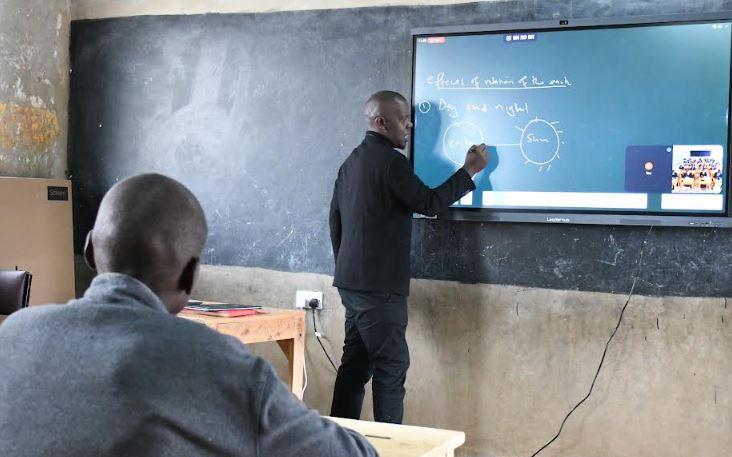
A social studies lesson is in session at Nyaribo Comprehensive School, where the learners are being taken through a lesson on the rotation of the earth and its effects.
A lot is different about this lesson and, by extension, the classroom. Unlike the traditional classrooms where teachers write on a blackboard using a piece of chalk, here the teacher, Mr. Sammy Kiugu, is writing on a 65-inch interactive smartboard using a stylus pen.
A smartboard is a large interactive touchscreen that combines the capabilities of a computer and a projector into a single device.
Moments after the brief introduction, Mr. Kiugu plays a short demonstration video sourced from YouTube. Should it be necessary, he can also conduct research since the smartboard is internet enabled.
But the most outstanding capability of the interactive smartboard is that beyond exposing the learners to experiential learning, the gadget allows learners from different schools to virtually join in the lesson and participate. Their voices are beamed through the inbuilt speaker in the board.
During this lesson, for instance, learners from Nyaribo Comprehensive School are joined virtually by their colleagues from Moi Nyeri Complex Junior School and Nyamachaki Comprehensive School, who participate by answering questions posed by Mr. Kiugu at the end of the lesson.
“This is a brilliant platform that not only allows schools to collaborate but also makes learning very interactive and fun as it exposes students to the global world, allowing them to comprehend the concepts with a lot of ease,” says Mr. Kiugu, who teaches agriculture and pre-technical studies at the school.
Julie Njeri, a learner from Nyaribo Comprehensive School, said that the newly acquired ICT tool will make the learning experience more enjoyable. She was particularly thrilled that the addition of smartboards would allow her teacher to play videos in class as a way of aiding the learning experience.
“The ICT tools help them to communicate with other students in different schools, especially when we have assignments. It particularly helps us to play videos and to store important information from the internet,” she said.
The three schools are part of the 178 public junior schools in Nyeri County that have already received smart boards as the government steps up efforts to integrate digital technology in education and promote collaborative learning among schools. Alongside the smartboard, the school also received a laptop to facilitate the teacher with research.
The devices are being rolled out under the second phase of the Digital Literacy Programme (DLP Phase II) and are being implemented by the ICT Authority through the Kenya Digital Economy Acceleration Project (KDEAP). The project received over Sh 50.3 billion(US$390 million) funding support from the World Bank.
According to Thomas Odhiambo, the Deputy Director at the ICT Authority’s Project Management Office, Nyeri is the 25th county to receive the devices. He said that the rollout is part of a wider government digital transformation agenda that is aimed at bridging the digital gap.
“In the first phase of this project, we had targeted 178 public junior schools out of the 377 public junior schools in Nyeri. In the second phase we will do the remaining 199 schools in the county. We estimate that by the end of the first term next year, we will be done with the implementation of the programme,” he said.
He said that in addition to improving learning outcomes, the devices will facilitate knowledge transfer among teachers and learners.
“The gadgets have come so that the teachers can improve their work. In addition to sharing and exchanging ideas, you can learn from fellow teachers from other schools,” he added.
The devices will serve learners in Grades 7, 8, and 9 as they prepare to join senior school.
Mr. Vincent Mwangi, the head teacher of Moi Nyeri Complex Primary School, said that with the devices, schools will now be able to collaborate by allowing teachers with expertise in particular learning areas to teach learners in other schools. He noted that with the technology in place, learning would go on undisturbed even when the regular teacher is absent, with the learners benefitting from skills from teachers based in other schools.
“The beauty of the smart board is that the students can also learn without the teachers. The other thing is that we may have a teacher who is very good at a particular learning area or a sub-strand; the schools are able to collaborate. If there is a teacher who is good in a certain topic, say in Kericho, he or she is able to teach other schools in another county,” he noted.
Speaking during the rollout, Principal Secretary in the State Department for East African Community Affairs and ASALs, Dr. Caroline Karugu, noted that the devices had also been delivered to Arid and Semi-Arid counties, therefore bridging the information gap in the marginalized counties.
“Over time we have seen that there has not been equity in our learning programs. We have seen a lack of equity because the access to information for that student in the Moi Nyeri complex is higher than the access to information for a child in, say, Nyaribo Primary School. But with these digital platforms that we are launching today, a child in Nyeri can interact with a child in Turkana and share ideas, share knowledge, create knowledge, share cross-cultural experiences, and get to understand how the people of Turkana enjoy their cultural experiences,” she noted.
She also urged the beneficiaries to be cautious while interacting online, noting that the internet is rife with online predators. She also challenged them to become creators of new knowledge.
“I want to challenge you as a younger generation; don’t just be consumers of old knowledge. You have access to the digital world, to new knowledge. Be creators, and once you create new knowledge, be gracious enough to share it across the board and become the iron that will sharpen the students and the teachers from across the county,” she said.
By Wangari Mwangi