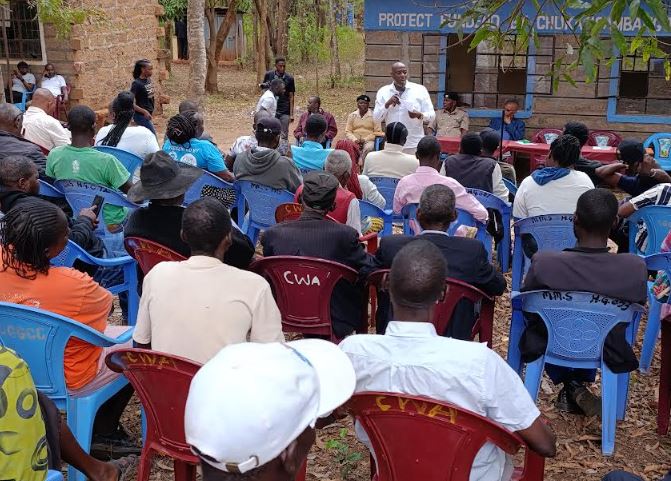
Tobacco farmers in Tharaka-Nithi County gave their views on the proposed changes to the country’s tobacco-control law during a public participation forum held at Kaanwa market in Mariani Ward, Igambang’ombe Constituency.
The National Assembly Departmental Committee on Health sensitized farmers and other stakeholders on the Tobacco Control (Amendment) Bill, 2024, including proposed measures to regulate emerging nicotine products made using synthetic nicotine.
The forum also gave farmers an opportunity to give their views on provisions of the bill touching on tobacco production, packaging, and licensing.
Nyeri Town MP Duncan Maina Mathenge, who led the parliamentary team, said some farmers had initially been misinformed that the proposed amendments were intended to stop them from growing tobacco.
Mathenge said they were introducing controls on new products, some of which were not made from natural tobacco but were synthetic, adding that the existing law did not cover those products because they were not yet on the market when the law was enacted.
“We are introducing the control of new products that are not natural tobacco but synthetic,” Mathenge said.
He explained that the existing law did not cover the products because they were not in the market when it was enacted.
Mathenge said the committee had received substantial views from members of the public on licensing and standards, with some stakeholders recommending a ban on synthetic nicotine products because they compete with locally grown tobacco.
He said tobacco farming remained an important economic activity and source of income for residents in the area, which is among the regions where the crop is widely grown.
Chuka/Igambang’ombe MP Patrick Munene, who is the Vice-Chairperson of the National Assembly Departmental Committee on Health, said the proposed amendments would help protect tobacco farmers from synthetic nicotine products manufactured in laboratories.
Munene said the products were not natural tobacco and could compete with locally grown tobacco, affecting the market and livelihoods of farmers.
He said protecting locally grown tobacco from synthetic alternatives would help safeguard the economic activity supported by the crop, adding that the presence of such products could affect the tobacco economy.
Munene said some synthetic nicotine products were already being sold in supermarkets and chemists, adding that the committee would support measures to regulate products that were not made from natural tobacco.
“We are ready to support our people,” Munene said.
He also encouraged tobacco farmers to form cooperatives to strengthen their bargaining power and enable them to benefit more from tobacco farming.
After receiving the explanation of the proposed amendments, tobacco farmer Erastus Kinyua Mbogori said the bill was important, but some sections required further review to address farmers’ concerns.
Mbogori said farmers were particularly concerned about provisions relating to packaging, noting that they had traditionally used dried banana leaves in handling their tobacco.
He said the bill should clearly explain whether farmers would continue using their normal packaging methods or be required to adopt alternative forms of packaging.
Mbogori also expressed concern over the proposed licensing requirements, saying farmers feared the licenses could come with additional obligations, including taxation.
“As stakeholders, some of those sections need to be amended further,” he said.
PERAK Caucus chairperson Nicholas Mutua echoed the concerns, particularly on the proposed licensing provisions, especially sections 20A(1) to 20A(5), saying they required further consideration to ensure the requirements were clear and workable for businesses dealing with tobacco products.
He called for a regulatory framework that clearly differentiates conventional tobacco products from emerging nicotine products and provides clear licensing requirements for businesses.
The proposed Tobacco Control (Amendment) Bill 2024 seeks to expand Kenya’s tobacco-control framework to cover emerging nicotine products, including electronic nicotine delivery systems, e-hookahs, and nicotine pouches.
It also proposes measures on nicotine content, packaging, and health warnings, as well as restrictions on the sale of tobacco and nicotine products to persons below 18 years.
The bill further proposes restrictions on digital advertising and the use of tobacco and nicotine products in places where food and beverages are prepared, served, or consumed, alongside measures to address tobacco-related waste and pollution.
Also present during the public participation forum was Moyale MP Prof. Guyo Waqo Jaldesa.
The Tharaka-Nithi forum was part of the National Assembly Departmental Committee on Health’s nationwide public participation process on the proposed amendments.
By Dickson Mwiti and Christine Ngitori