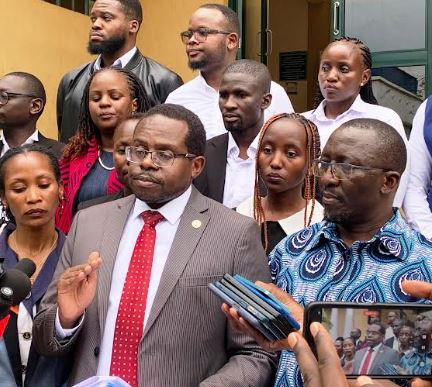
The Law Society of Kenya (LSK) has maintained its targeted boycott of specified judges and judicial officers will continue, citing delays in the implementation of agreed measures on judicial accountability.
Speaking during a press briefing in Kisumu, LSK President Charles Kanjama said advocates should continue to refrain from appearing before judges and judicial officers identified under the targeted boycott, until further communication from the Society.
Kanjama said the position followed a strategic engagement held on July 31, 2026, between the LSK Council, the Judicial Service Commission (JSC) and the Senior Counsel Bar, which resulted in an agreed framework covering judicial performance reporting, complaints handling, pending petitions, court-station integrity committees, disciplinary regulations and the relationship between judicial independence and institutional accountability.
He said although some progress had been made, including communication on the composition of JSC and Judiciary representatives, to a Joint Committee, several commitments remained outstanding.
“The targeted boycott remains in force,” Kanjama said, urging members to comply with the Society’s directive pending further communication.
Kanjama said the Judiciary had also not met the agreed 30-day timeline for publishing institutional and court-level judicial performance reports.
He said LSK had not received an explanation for the delay or an update on the verification process required before individual judicial performance information could be released.
On complaints handling, Kanjama said the parties had agreed to an enhanced electronic system for lodging and tracking complaints, with an implementation period of approximately 60 days.
He said LSK was awaiting confirmation that the system was operational and details on how advocates and the Society would access it.
The LSK President further said the Society was seeking substantive feedback on long-pending petitions, complaints and other processes before the JSC, including matters linked to the targeted boycott.
He called on the Commission to provide the status of outstanding matters and communicate the outcomes of concluded processes to affected parties and the Society. Among the outstanding issues, he said, was the formal constitution and convening of the Joint Committee, which is expected to monitor implementation of the July 31 resolutions, review progress and address emerging concerns.
Kanjama said LSK was yet to receive consolidated contact details for Court-Station Integrity Committees established at various court stations, which he said would facilitate engagement between advocates and the Judiciary on integrity and service-delivery concerns.
On disciplinary procedures, he said the Society was yet to receive the current draft of the Judicial Service Commission Disciplinary Process Regulations agreed upon during the July 31 engagement.
He said LSK intended to review the draft and make submissions to the National Assembly Committee on Delegated Legislation.
On judicial independence and accountability, Kanjama said LSK remained committed to developing a framework clarifying the relationship between judicial decision-making independence and institutional accountability.
He said the Society would contribute to a concept paper drawing from comparative constitutional and Commonwealth approaches, with the matter to be pursued through the Joint Committee once constituted.
The targeted boycott followed a nationwide one-day court boycott by LSK on July 22, 2026. LSK announced the targeted boycott against specified judges and judicial officers a day later, on July 23, 2026, and the action has continued indefinitely.
LSK said the action was linked to concerns over judicial accountability, alleged misconduct, delays in the administration of justice and the handling of complaints against judicial officers.
The boycott later became the subject of a constitutional challenge filed before the High Court by lawyer Adrian Kamotho.
On September 17, Justice David Mburu dismissed LSK’s preliminary objection seeking to have the petition struck out, allowing the substantive constitutional challenge to proceed.
The ruling did not determine the legality or constitutionality of the boycott itself.
Despite maintaining the targeted boycott, Kanjama said the move would not end institutional dialogue between LSK and the JSC.
He said the Society would continue engaging the JSC and the Judiciary on implementation of the resolutions reached during the July 31 meeting.
Kanjama also urged LSK branches and members to continue documenting concerns relating to the administration of justice and to comply with subsequent operational guidance issued by the Society.
The targeted boycott specifically single out judicial officers who obtained conservative court orders to block, halt, or postpone investigations and disciplinary proceedings against them by the Judicial Service Commission (JSC), the Ethics and Anti-Corruption Commission (EACC), or the Directorate of Criminal Investigations (DCI).
The LSK argues that judicial independence must be paired with accountability, and judges should not use legal technicalities to evade oversight.
The Society is protesting widespread allegations of corruption, abuse of office, and unethical conduct among certain members of the judiciary.
Advocates also claim they have continually experienced severe delays in the hearing and determination of cases, as well as lengthy backlogs in delivering critical rulings and judgments.
The LSK also cited persistent operational failures within court registries, including missing files, poor service, and frequent breakdowns of the Judiciary’s e-filing system.
After brief pauses and ongoing deliberations, the LSK renewed and maintained the boycott because they claim the JSC delayed implementing agreed-upon frameworks regarding complaints handling, disciplinary regulations, and performance reporting.
To this end, the LSK insists that the JSC fully operationalize the agreed framework established during their July 31 joint engagement, which covers judicial performance reporting, complaints handling, processing pending petitions, and setting up court-station integrity committees and disciplinary regulations
“The Judiciary must demonstrate transparent administration, tackle delays in the delivery of judgments and rulings, and actively address misconduct, case backlogs, and registry inefficiency’.
In a sharp rejoinder, the Judiciary maintained that all courts would remain open and operational, stating a boycott disrupts justice and punishes innocent court users.
The Judiciary of Kenya through spokesperson, Paul Ndemo and JSC Chairperson, Martha Koome, have since rejected the Law Society of Kenya’s (LSK) court boycott, stating that the action is inappropriate, disproportionate, and primarily harms ordinary litigants rather than resolving grievances.
The institution urged lawyers to pursue accountability concerns and complaints through proper constitutional channels and the Judicial Service Act rather than through what they term as disruptive work stoppages.
The Judicial Service Commission (JSC) led by Chief Justice Martha Koome has also defended its handling of misconduct cases, noting that hundreds of petitions and complaints against judicial officers have been processed.
By Mabel Keya- Shikuku and Chrispine Onyango Oduor