Communities affected by mining activities in Kwale County are calling for stronger representation, equitable access to post-mining benefits, and the productive use of rehabilitated land as Base Titanium prepares to wind up its operations.
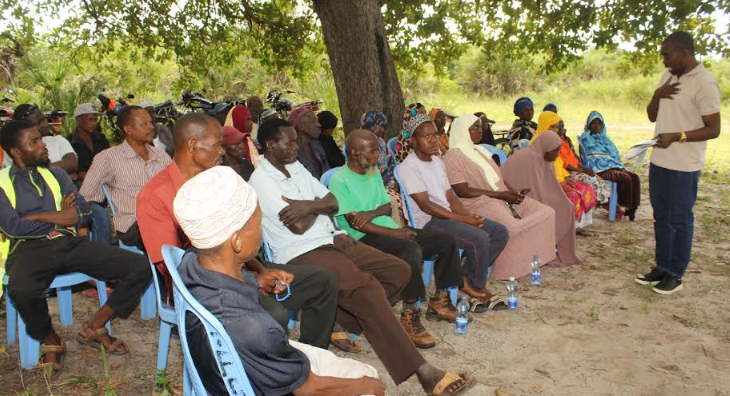
Residents from Fingirika, Nguluku, and Mchanga Mweupe villages made the appeals during a community sensitization meeting facilitated by the Grassroots Organization, which focused on post-mining land rehabilitation and the recommendations contained in the government’s advisory report on future land use.
Speaking during the meeting, Fingirika village chairperson Saudi Bakari Mwanguruwe said the forum has helped residents understand the importance of organizing themselves to protect their rights and interests.
“This meeting has brought together three villages and has helped us understand how to organize ourselves. If an investor comes into our area, we should know our fundamental rights and speak with one voice,” said Mwanguruwe.
He noted that communities should not wait until investors leave before raising concerns about unfulfilled promises.
“We do not want a situation where mining activities end and we remain with scars and unheard grievances while failing to benefit from the investments made in our areas,” he said.
Mwanguruwe emphasized that residents who bore the burden of mining activities should be prioritized in benefiting from remaining infrastructure and resources, particularly water facilities.
“If irrigation projects are established, they should start with the people living closest to the affected areas. It would be unfair for those who suffered the impacts of mining to be left behind while others benefit first,” he said.
He further advocated the use of reclaimed land for commercial agriculture to enhance food security and household incomes.
“This land is vast and can help us achieve food security. We can grow crops such as maize, consume part of the harvest, and sell the surplus. Hunger should not be our reality when we have such an opportunity before us,” he added.
Residents displaced by mining activities also shared their experiences and hopes for the future.
Bahati Mwanzije, a resident of Mchanga Mweupe village, said the sensitization sessions have clarified issues that many community members previously misunderstood.
“There were many things I did not understand before, but today I have learned and benefited. We are grateful to those who came to educate us because these discussions have opened our minds,” she said.
Mwanzije, who relocated after being affected by mining operations, acknowledged that community members initially lacked adequate information about the intended use of reclaimed land.
“We had our own ideas because we did not have enough information. But after receiving this education and understanding the proposals, we can see that moving together in this direction may be better than what we had initially thought,” she said.
Another resident, Ibrahim Saidi Bagule, described the awareness sessions as a transition from darkness to light.
“We were in the dark and did not know what was happening. Now our eyes have been opened, and we understand the need to organize ourselves so that we know what we deserve as a community and what should be addressed by the county and national governments,” said Bagule.
Bagule, who lives near the former mining site, acknowledged that the project brought both opportunities and challenges.
“Some people got employment opportunities, and I was also employed for a few months. But we have also suffered. Wildlife such as monkeys, buffaloes, and hippos destroy our crops, and our concerns are not always adequately addressed,” he said.
For Bakari Mwambuta of Nguluku village, the discussions revived long-standing concerns about displacement and inadequate compensation.
“We want this land to benefit future generations so that the history of mining in this area will be remembered for the good it brought to our community,” he said.
Mwambuta argued that many families remained economically vulnerable after relocation.
“The compensation we received was not enough to rebuild our lives properly. It would be unfair if the land were handed over to others while the communities that endured the impacts continue to live in poverty,” he said.
Grassroots Organization representative Faki Omar, who took us through the community for the discussions, said the initiative seeks to empower communities to actively participate in decisions concerning post-mining land use.
“We are bringing together communities affected by mining to create a social movement and eventually establish a trust through which they can negotiate and benefit from future investments and opportunities,” Omar said.
He explained that the organization had simplified the government’s post-mining advisory report into accessible versions in both Kiswahili and English to enable residents to understand the recommendations.
“The original report is about 100 pages long. We condensed it into a 16-page version so that community members can understand what was proposed and identify areas where they can benefit,” he said.
According to Omar, each affected village is expected to select representatives, including youth, women, village elders, and persons with disabilities, to form a unified leadership structure.
“If the community is well organized, it will be better positioned to negotiate with government institutions and any future investors. Since these are the people who were affected by mining, they must also be among the first to benefit from any post-mining gains,” he said.
The mobilization process, which began earlier this year, is expected to culminate in the formation and registration of a community trust by August.
Residents expressed hope that the end of mining operations would mark the beginning of a new chapter characterized by food security, inclusive development, and social justice for communities that have lived alongside one of Kenya’s largest mineral extraction projects.
By Chari Suche