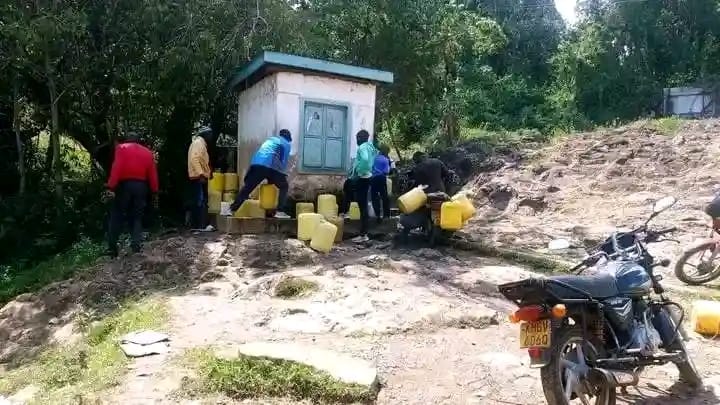
Residents of Lumakanda Ward in Lugari Sub-County continue to face chronic water shortages despite the area receiving substantial rainfall throughout the year, forcing many households to walk long distances in search of water for domestic use, livestock and farming.
The persistent shortage has raised concerns among residents who question why a region known for its fertile soils and reliable rainfall still lacks adequate access to safe and clean water.
According to the Kakamega County Department of Water, only about 40 per cent of households in Lumakanda Ward have access to safe drinking water, leaving the majority dependent on boreholes, protected springs and seasonal streams.
During the dry season, many residents walk up to 10 kilometres to fetch water, with the burden falling mainly on women and school-going children.
Residents say most seasonal streams dry up shortly after the rains, while the few available boreholes and protected springs cannot meet the growing demand of an increasing population.
Jane Naliaka, a resident of Lumakanda Township, said the community continues to struggle despite receiving heavy rainfall almost every season.
“We receive heavy rains almost every season, yet a few weeks later we are back to queuing for water. Women wake up as early as 5 a.m. to fetch water from boreholes or streams. The problem is not lack of rain but inadequate water storage, distribution and maintenance of existing infrastructure,” she said.
The water shortage is also affecting learning in schools, where teachers say inadequate water supply disrupts normal school operations.
Juma Wekesa, a teacher in the area, said schools often experience water shortages after storage tanks run dry, forcing pupils and support staff to fetch water from nearby boreholes.
“Water is essential for drinking, cooking and maintaining hygiene. When our tanks run dry, learners and school staff spend valuable time fetching water instead of concentrating on education. It also becomes difficult to maintain proper sanitation,” he said.
Health facilities are experiencing similar challenges, with medical personnel noting that inconsistent water supply affects infection prevention measures, maternity services and general sanitation.
Farmers have also reported reduced agricultural productivity due to inadequate access to water, particularly for horticulture and dairy farming, which require reliable water supplies throughout the year.
John Wanyonyi, a vegetable farmer, said he had reduced the size of his kitchen garden because prolonged dry spells leave him without sufficient water for irrigation.
“If we had reliable water throughout the year, we would grow vegetables continuously and increase our income,” he said.
Officials from the Kakamega County Department of Water acknowledge that Lumakanda receives adequate rainfall but attribute the water shortage to inadequate investment in water storage and distribution infrastructure.
The department says several interventions are underway to improve water access in Lugari Sub-County.
These include rehabilitation of the Lumakanda Water Supply Project along River Murgusi, drilling and equipping additional boreholes, including one at Majengo Dispensary, and expanding community water supply systems in surrounding villages.
In neighbouring Manyonyi, the Lake Victoria North Water Works Development Agency is rehabilitating and expanding the Manyonyi Community Water Project to improve access to clean water for households and schools.
The multi-million-shilling Musembe Water Project in Chekalini Ward is also expected to benefit more than 28,000 households across Lugari Sub-County once completed.
Environmental experts attribute the recurring water shortages to inadequate rainwater harvesting, degradation of water catchment areas, ageing distribution infrastructure, rapid population growth and the effects of climate change, which have altered rainfall patterns despite the area’s relatively high annual rainfall.
They recommend greater investment in household and institutional rainwater harvesting systems, protection of wetlands and riverbanks, construction of water pans and small dams, rehabilitation of existing boreholes and expansion of piped water networks to underserved communities.
Community leaders say resolving the water crisis would improve public health and sanitation, reduce the burden on women and children, enhance agricultural productivity and strengthen resilience against the effects of climate change.
By Linet Wafula