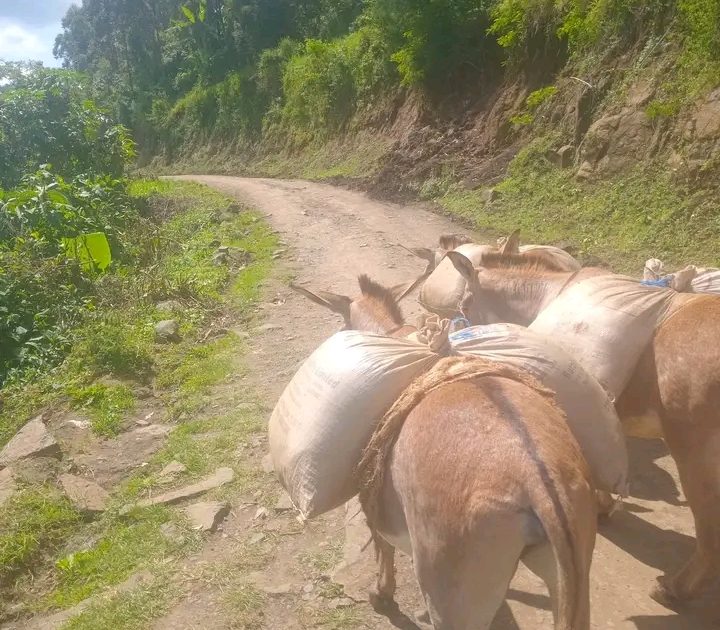
Residents of Songhor-Soba ward in Tinderet Sub County, Nandi county, continue to depend heavily on donkey-based transport, a practice that has stood the test of time despite the gradual expansion of modern mobility options.
In this rural setting, donkeys are a common feature along village paths, carrying water, firewood, farm produce and even building materials. For many households, the animals are not just a means of transport but a critical pillar supporting daily survival and economic activity.
The preference for donkeys, locals say, is largely influenced by affordability and adaptability to the terrain.
Unlike motorcycles and vehicles, which require fuel, spare parts and regular maintenance, donkeys are relatively inexpensive to acquire and keep. They feed on locally available vegetation and require minimal upkeep, making them accessible to low-income families.
Their ability to navigate narrow, rugged footpaths and muddy sections, often impassable by vehicles, makes them specifically suitable for the interior parts of Songhor-Soba, where road infrastructure remains underdeveloped.
According to local resident Jane Chepkemoi, donkeys have significantly eased the burden of manual labour in households.
She explains that before acquiring a donkey, women and children were forced to walk long distances carrying heavy loads on their backs.
“Life was very difficult because we had to fetch water and firewood manually. Now, a donkey can carry several containers of water or a large bundle of firewood in a single trip, saving us time and energy,” she says.
Chepkemoi adds that the time saved is now being redirected to other productive activities such as farming and small-scale businesses.
Farmers in the area also rely on donkeys to transport their produce to nearby markets.
Kipkoech Tanui, a maize and vegetable farmer, notes that the animals have improved his ability to access markets and reduce post-harvest losses.
“During harvest season, I use my donkey to carry maize and vegetables to the market. It is reliable and cost-effective. If I had to hire a motorcycle every time, I would make very little profit,” Tanui explains.
He adds that donkeys are particularly useful during the rainy season when roads become slippery and difficult for motorized transport.
Local leaders have acknowledged the role of donkey transport in sustaining livelihoods and bridging infrastructure gaps.
Area community elder Joseph Kiprotich describes the animals as an essential part of the rural economy. “Not all areas here are accessible by vehicles or motorcycles.
Donkeys ensure that people in remote villages are not cut off from markets and essential services,” he says.
Kiprotich emphasizes the need for recognition of donkey transport as a legitimate and valuable sector that contributes to economic development at the grassroots level.
At the same time, other transport players in the area, particularly boda boda operators, have expressed mixed reactions regarding the widespread use of donkeys.
Peter Langat, a motorcycle rider operating within the ward, admits that donkey transport has affected their business to some extent. “For short distances and carrying goods, many people prefer donkeys because they are cheaper.
This reduces the number of customers we get,” he says. However, Langat acknowledges that motorcycles still play a vital role, especially for transporting passengers and urgent deliveries.
“There are places where donkeys are more convenient, but for speed and longer distances, people still rely on us,” he adds.
Despite their importance, concerns are emerging over the welfare and security of donkeys in the region.
Cases of theft and mistreatment have been reported, raising alarm among residents and leaders.
Mary Jelagat, a local administrator, says there is a need for stronger measures to protect the animals.
“Donkeys are very important to our community, yet they are often neglected. We need veterinary support, proper handling practices and strict action against those who steal or harm them,” she says.
Jelagat also calls for awareness campaigns to educate residents on the value of proper donkey care.
Transport experts at the local level argue that donkey transport should not be viewed as outdated but rather as complementary to modern systems.
They note that in areas where infrastructure is still developing, a combination of traditional and modern transport solutions is necessary.
By integrating donkey transport into local development planning, stakeholders believe the community can achieve more inclusive and sustainable growth.
As Songhor-Soba ward continues to evolve, the donkey remains a symbol of resilience and practicality.
For many residents, it represents a dependable partner in navigating the challenges of rural life.
While modernization is gradually transforming transport systems, the enduring relevance of donkey transport highlights the need to embrace solutions that are tailored to local realities.
by Sammy Mwibanda