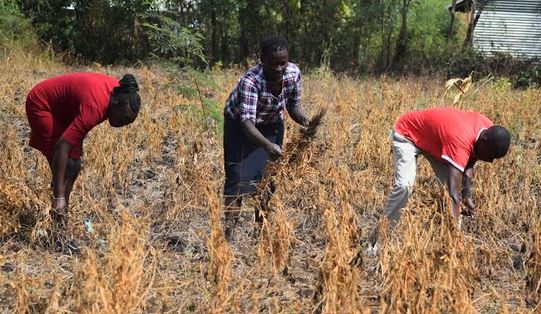
As sacks of freshly harvested soya beans arrive at a village aggregation centre in Homa Bay County, each is carefully weighed, inspected and paid for.
To many farmers, it is another harvest and another payday. But these golden beans are destined for something much bigger than the dinner table.
They are helping feed Kenya’s growing aquaculture industry.
For decades, fish feed manufacturers have relied heavily on imported ingredients to meet the country’s demand for aquaculture feeds. Among the most important ingredients is soyabean meal, a protein-rich product widely used around the world as a plant-based alternative to fishmeal.
According to the Food and Agriculture Organization (FAO), feed is the largest operating cost in fish farming, and soya bean meal has become a key ingredient because it provides high-quality protein while reducing pressure on wild fish stocks used to produce fishmeal.
In Kenya, however, soyabean production falls far short of demand, presenting both a challenge and an opportunity.
At the heart of efforts to bridge that gap is Homa Bay County, where an innovative programme is linking crop farmers with fish farmers to strengthen the aquaculture value chain while creating jobs for young people.
For Elijah Odondo, a village-based soya bean aggregator, the transformation begins at the aggregation centre.
“Our work is to receive soya beans from farmers, check the quality, weigh the produce and pay them but we also support farmers through training, interest-free loans and climate-resilient seed varieties,” he says.
The loans enable farmers to invest in production and are recovered after harvest, making it easier for young farmers to venture into agribusiness without the burden of commercial credit.
Odondo says climate change has become one of the biggest challenges facing farmers, making improved seed varieties increasingly important.
“We encourage farmers to grow varieties that mature within about three months instead of four. They are more resilient to changing weather patterns and help farmers harvest before prolonged dry spells set in,” he explains.
The initiative is part of a programme dubbed “Empowering Sustainable Aquaculture (ESA)”, that is being implemented by Farm Africa and funded by the Mastercard Foundation with the aim of strengthening aquaculture and related value chains including soya bean production.
Dr. Bundi Muguna, Aquaculture Programme Manager at Farm Africa, says integrating soya production into aquaculture was a strategic decision driven by the country’s widening shortage of soybean.
“Soya production in our aquaculture programme is meant to support fish feed production because soya is the main plant-based protein source used in fish feed,” he says.
According to Muguna, Kenya produces only about 2,000 metric tons of soya annually against a national demand of more than 200,000 metric tons.
“That means we are producing only about two to three per cent of what the country requires. Because of this huge gap, we integrated the soya value chain into the programme to increase production and productivity,” he adds.
The shortage has significant implications for fish farmers. Fish feed accounts for the largest share of production costs in aquaculture, and inadequate local supplies of soybean force-feed manufacturers to depend on imports, increasing production costs that are ultimately passed on to fish farmers.
The ESA programme seeks to change that by strengthening the entire value chain, from seed multiplication and production to aggregation and marketing.
Since its launch, the programme has recruited about 124,000 young men and women across six counties. More than 68,000 have received training, while about 58,000 have established businesses in different aquaculture enterprises, including fish farming, fish trading, mariculture, black soldier fly production and soya bean farming.
Approximately 18,000 participants are engaged in soya production, with Homa Bay accounting for about 6,000 young soya farmers.
About 15,000 youths are involved in producing fish feed and black soldier fly larvae, another important ingredient in livestock and aquaculture feeds.
Beyond training, participants receive interest-free loans, business grants and productive assets to help them establish sustainable enterprises.
Recognising the growing impact of climate change, Farm Africa is also promoting climate-resilient soya bean seed varieties through village-based aggregators who distribute and multiply quality seed for farmers.
The organization aims to produce between 50,000 and 60,000 kilograms of improved seed ahead of the next planting season.
For Homa Bay County, the programme represents more than an agricultural intervention, it is a strategy for creating employment while strengthening food systems.
County Director of Agriculture, Kennedy Opiyo, says the county government has identified soya as one of its priority value chains because of its short maturity period, resilience to changing weather conditions and growing demand from the aquaculture industry.
“Our responsibility is to ensure farming puts income into farmers’ pockets. Because government resources are limited, partnerships such as the one we have with Farm Africa are critical in reaching more farmers” he implies.
Opiyo says Homa Bay, home to about 240,000 farmers, has witnessed remarkable growth in soya production through the programme’s support in seed distribution, extension services and capacity building.
According to the 2025 Kenya National Bureau of Statistics (KNBS), Homa Bay is now the country’s leading producer of soya beans.
Farmers are encouraged to adopt climate-resilient varieties such as Saga and SP8, which mature within two-and-a-half to three months, allowing them to cope better with unpredictable rainfall.
The director believes that the crop offers one of the greatest agribusiness opportunities for farmers because demand consistently exceeds supply.
“Whatever Kenya produces is only a small fraction of what the country requires. That means farmers have a ready market. No farmer should grow soya today and fail to sell it,” Opiyo says.
Back at the aggregation centre, the steady flow of farmers delivering their harvest reflects a quiet transformation taking place across Homa Bay.
Each bag of soya represents more than income for a household. It is a vital ingredient in fish feed, a contribution to Kenya’s growing aquaculture industry and a sign that climate-smart agriculture can create opportunities along an entire value chain.
“As demand for fish continues to rise and the need for affordable feed grows, the county’s fields of soya may prove just as important to Kenya’s aquaculture future as the fish ponds they help sustain,” the director implies.
By Sitna Omar