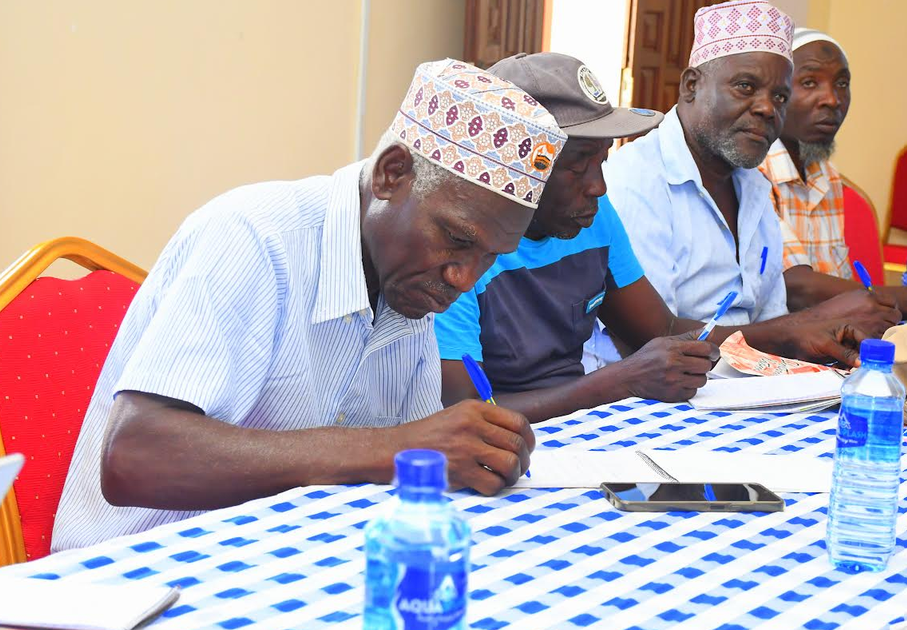
The Kenya Fisheries Service, in partnership with Community Action for Nature Conservation (CANACO), has intensified efforts to strengthen the capacity of Beach Management Units (BMUs) in Mombasa through a training workshop aimed at enhancing their understanding of fisheries laws, regulations and governance.
CANACO (Community Action for Nature Conservation) is a leading Kenyan non-governmental organization dedicated to advancing the rights of small-scale fishers and promoting sustainable marine resource management.
Speaking during the capacity-building workshop held in Utange, Mombasa, Benedict Kiilu, the Assistant Director at the Kenya Fisheries Service (KFS) in Mombasa County, said BMUs play a critical role in promoting the welfare of fishers and driving the sustainable development of Kenya’s fisheries sector.
Keilu said the training equips BMU leaders with a clear understanding of their roles and responsibilities, as well as those of the government, private sector and other stakeholders involved in fisheries management.
“The capacity-building forum gives participants an opportunity to understand their responsibilities, the government’s obligations towards them, and the role of the private sector in supporting the fisheries sector,” said Keilu.
He noted that such forums also sensitize coastal communities on the importance of conserving fisheries resources, which form the backbone of many livelihoods, while creating opportunities for collaboration with government agencies and development partners.
According to Keilu, the Kenya Fisheries Service has been instrumental in promoting compliance with fisheries regulations and advancing the Blue Economy agenda by working closely with local communities.
The blue economy sector also known as the sustainable ocean-based economy encompasses fisheries, maritime biotechnology, aquaculture, tourism and marine transport and logistics.
The training programs focus on data collection, co-management, fish handling, and financial operations.
“We are building the sector together by promoting fisheries compliance for sustainability and demonstrating how beneficial the Blue Economy can be if all stakeholders work together in harmony and collaboration,” he said.
Keilu added that the Kenya Fisheries Service, whose mandate is to regulate, develop and conserve the country’s fisheries resources, has continued investing in community infrastructure. citing the development of the Kidongo landing Site as one of the government’s initiatives that has positively impacted local fishing communities.
CANACO representative Doreen Simiyu said the organization is supporting BMU leaders in Mombasa through training on advocacy, fisheries policing and leadership to strengthen their ability to effectively represent fishing communities.
“One of the core functions of Beach Management Units is advocacy. We are here to support their leaders so they can perform that mandate more effectively,” said Doreen.
She emphasized that effective fisheries management must be anchored in the law, making it essential for BMU leaders to understand the legal and regulatory framework governing the sector.
“The workshop will help participants understand their roles, responsibilities and the legal powers granted to them under fisheries laws and together, we will also develop an action plan to guide BMUs in implementing what they have learned,” she added.
Mombasa BMU Assistant Chairman Alex Ria welcomed the initiative, saying the training would enhance the capacity of BMUs to improve livelihoods and sustainably manage fisheries resources and appealed to the government to issue title deeds for landing sites to secure community investments.
Ria said the capacity-building engagements are key to strengthening BMU governance and sustainable fisheries.
“We appreciate this training because it will improve our capacity to serve our communities and urge the government to provide title deeds for our landing sites,” he said.
His sentiments were echoed by veteran fisherman Said Ali, who expressed concern over inadequate funding for BMUs despite the significant responsibilities assigned to them.
“The responsibilities given to BMUs should be accompanied by an adequate budget to enable us to carry out our mandate effectively,” he said.
Ali also called for harmonization of laws governing the fisheries and wildlife sectors, arguing that conflicting legislation often leads to lengthy legal disputes that disadvantage fishing communities.
He urged Cabinet Secretary for Mining, Blue Economy and Maritime Affairs Hassan Joho to appoint leaders with a strong understanding of fisheries laws to spearhead reforms aimed at eliminating legal contradictions affecting the sector.
The workshop forms part of ongoing efforts by the Kenya Fisheries Service and CANACO to strengthen community participation in fisheries governance, promote sustainable resource management and advance the country’s Blue Economy agenda.
By Mary Mtawa