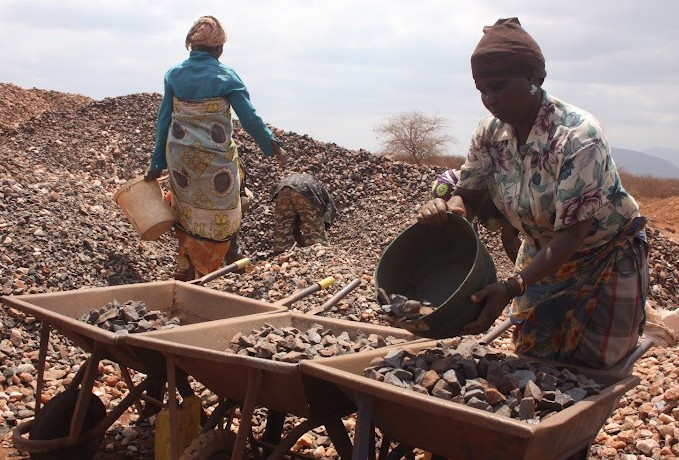
For decades, women in Taita Taveta’s gemstone fields dug through rocky terrain with crude tools, sold precious stones through brokers who dictated prices, and watched them (brokers) build fortunes from their sweat.
Today, those women are positioning themselves at the centre of Kenya’s mining transformation.
Across the mineral-rich county, female artisanal miners are embracing gemstone value addition, demanding better equipment and direct market access, and challenging a system that for years excluded them from meaningful participation in one of the country’s most lucrative sectors.
The shift has found expression at the Voi Gemstone Value Addition and Marketing Centre, where women miners from communities including Kasigau, Chawia, Mwatate, Alia, Mwakitau, Mkuki and Taveta have increasingly become active participants in discussions about the future of Kenya’s extractive industry.
Their message is straightforward: reforms must translate into tangible benefits for those working at the grassroots.
Veteran artisanal miner and Vice Chairperson of the Taita Women Mining Group, Elizabeth Wawuda Kihika, has witnessed both the hardships of the old system and the promise of the new one.
“In the past, people used to measure our gemstones using empty Blue Band margarine tins,” she recalled. “We were deeply hurt because we were practically giving away our minerals for free. The buyers became rich while those of us who mined remained poor,” she lamented.
The absence of standardised valuation methods left many small-scale miners vulnerable to exploitation by middlemen who bought gemstones at throwaway prices before exporting them for substantial profits.
For many women, mining became synonymous with hard labour and little reward.
However, currently, gemstones brought to the Voi centre undergo professional identification and valuation by trained experts using certified equipment. Geologists and inspectors verify the type and weight of the stones while ensuring the collection of royalties and regulatory fees.
Frank Righa, Chairman of the Voi Gemstone Value Addition and Processing Centre Committee, says the reforms are aligned with the national government’s push to ensure Kenya benefits more from its mineral wealth.
“No mineral output from Kenya should be sold in its raw form,” he said. “Value addition gives Kenyan market leverage, creates employment opportunities, increases government revenue and improves livelihoods.”
The policy reflects a broader effort by the national government to move away from exporting raw resources and instead develop domestic industries capable of processing and marketing finished products.
For women miners, however, value addition represents an opportunity to reclaim ownership of their labour.
Kihika says training in gemstone cutting and polishing has enabled women to view even small mineral finds differently.
Previously, only larger stones attracted buyers, leaving miners with fragments and lower-grade gemstones that had little market value.
“Large-scale buyers often only want bigger stones,” she said. “But if we can process the smaller pieces into bangles, rings and earrings, we can sell everything and make profits,” she added.
She believes local processing factories would allow communities to maximise every gemstone extracted from the ground while creating employment opportunities for young people.
Yet despite the optimism, women miners say major obstacles remain.
Many continue to work using shovels, hoes and handmade sieves, exposing them to hazardous conditions while limiting productivity.
Mbololo community representative, Dina Mwasi, argues that without investment in equipment, the gains from policy reforms may fail to reach the women they are intended to empower.
“The county government should empower these women with proper equipment. Many are still using basic tools that they have made themselves. If they receive support through available empowerment programmes, they can achieve much more,” she said.
Women miners are also calling for easier access to financing, mining licenses and markets, saying these barriers have historically reinforced male dominance within the sector.
While policy shifts and institutional support have laid the foundation for transformation, implementation at the community level remains critical.
According to Righa, the county’s first iron ore processing factory at Manga, Voi is nearing completion and is expected to open new opportunities for employment and industrial growth.
“For the first time since independence, we have a factory for steel and iron ore processing, which will create jobs and generate revenue for our people,” he said.
Combined with gemstone processing initiatives, the developments could significantly alter the county’s economic landscape.
Taita Taveta is home to some of Kenya’s most valuable gemstones, including tsavorite, ruby, green garnet and blue sapphire. Yet the communities living closest to these resources have historically derived limited benefits from them.
Women miners now hope the current reforms will finally reverse that trend. They seek fair prices, safer working conditions, access to machinery, opportunities to add value to what they mine, and a seat at the decision-making table.
If realised, those aspirations could redefine not only women’s participation in mining but also Kenya’s approach to managing its natural wealth.
by Dennis Munga, Jimistone Safari and Wilson Maghanga