For decades, residents of the remote interior of Tana River County have lived with a painful reality.
Every dry season, families walked kilometres in search of water, children missed school, livestock perished and conflicts over scarce water sources became inevitable.
That cycle may finally be coming to an end in parts of the vast Tana River County which experiences historic resource-based tensions pitting nomadic pastoralist communities against sedentary farmers over access to dwindling water points and grazing lands.
Observers note that climate change and drought have severely exacerbated these seasonal disputes driving recurring cycles of violence.
The national government has completed two earth-fill dams worth nearly Sh190 million in Tana North and Bangale sub-counties, a major investment expected to transform livelihoods for thousands of pastoralists in one of Kenya’s most drought-prone regions.
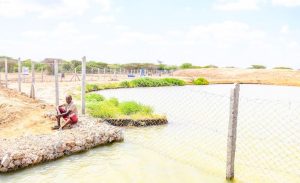
Constructed under the Drought Mitigation and Flood Control Programme through the Coast Development Authority (CDA), the Miidi and Hambaresa earth-fill dams each have a storage capacity of 100,000 cubic metres.
The projects are designed to improve access to water, strengthen climate resilience and enhance food and nutrition security in vulnerable communities that have long struggled with recurring drought.
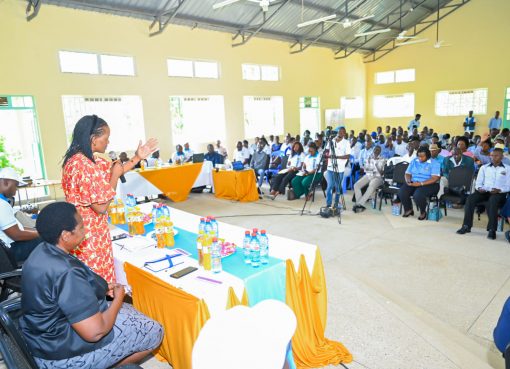
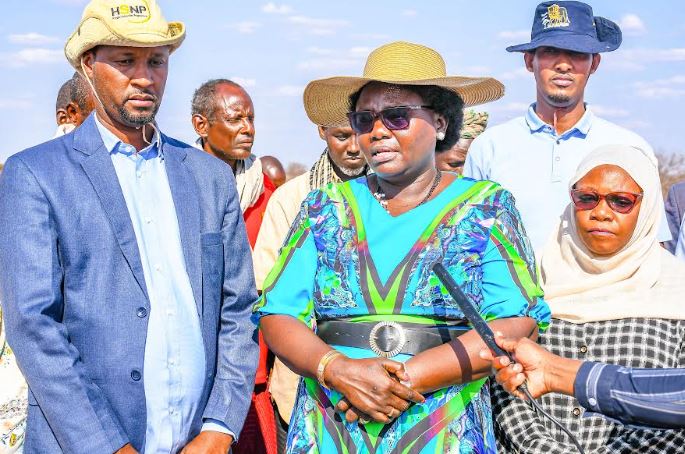
Speaking during the commissioning of the projects, Cabinet Secretary (CS) for East African Community Affairs, Arid and Semi-Arid (ASALs), and Regional Development Beatrice Askul Moe described the dams as proof that government investments are reaching the country’s most marginalized communities.
“What I’ve come to witness is value for money. The services are reaching the most vulnerable and marginalized communities, especially pastoralists who depend on livestock for their upkeep. Seeing such an investment in the heart of Tana River shows that government development is reaching the people who need it most,” she said.
CS Moe said the projects in underserved communities would spare families from the hardships that have forced pastoralists to migrate in search of water and pasture.
She said during periods of drought, pastoralists are forced to walk longer distances in search of water and pasture for their livestock as such resources are increasingly dwindling.
“The pastoralists move long distances looking for water; sometimes children are withdrawn from school because families cannot leave them behind and, in some cases, armed conflicts arise over access to water and grazing land,” she said.
She went on ‘but now there is a glimmer of hope. The livestock will have water; communities will have clean water closer to their homes and their dignity will be restored.
The CS challenged local community leaders and residents to protect the water facilities, saying they represent a huge public investment.
CS Moe said the government will continue to launch a network of water infrastructure projects such as dams and boreholes to resolve shortages for both communities and their livestock.
She said the water supply initiatives are also designed to tackle water shortages for livestock and reduce farmer-herder conflicts.
“I urge the community to safeguard these projects the same way they protect their livestock. If we fail to protect it, we risk losing an investment that may not easily be replaced,” she said.
The Miidi Earth-fill Dam, located in Chewele Ward, Tana North sub-county, was constructed at a cost of Sh95.8 million by Holwadhe Investment Limited.
The project has reached 100 percent completion and includes a reservoir, embankment, water kiosk, livestock watering troughs, fencing and other auxiliary structures.
It is expected to benefit 1,349 households in Miidi, Village 15, Kware and Sigale villages while providing water for between 30,000 and 40,000 cattle, up to 200 camels, about 6,000 goats and sheep, and hundreds of donkeys.
The second project, the Hambaresa Earth-fill Dam in Sala Ward, Bangale sub-county, was built by Crossland Construction and General Supplies Limited at a cost of Sh93.98 million.
The dam will serve about 2,000 households in Dalolo Garse, Boca, Gelmad and neighbouring villages.
It will also provide water for between 30,000 and 40,000 head of cattle, about 40,000 camels and thousands of goats and sheep.
CDA Managing Director (MD) Dr. Mwanasiti Bendera said the projects represent a milestone in the authority’s efforts to improve water security in the coastal region’s arid counties.
“Today we have completed both Hambaresa and Miidi earth-fill dams, each with a capacity of 100,000 cubic metres. We are happy that the communities can already see the impact these projects will have on their lives and their precious livestock,” she said, adding that the water expansion program would continue.
Dr. Bendera noted that reliable water supplies will reduce the long distances residents travel in search of water while improving livestock production, the main economic activity in the area.
The CDA MD says the dams are expected to reduce conflicts over scarce water resources, improve school enrolment and retention, enhance livestock productivity and strengthen resilience against climate change.
CDA Chairperson Mzee Mwinyi described the dams as a demonstration of the government’s commitment to taking meaningful development to grassroots communities.
“We are reaching the grassroots and improving livelihoods. This is exactly what the CDA was established to do, supporting communities through projects that positively impact people’s lives,” he said.
Tana River County Commissioner (CC) Joseph Mwangi said projects in the area will not only solve the water challenge for the livestock but will now help the pastoralists to also think about irrigated farming.
“We have witnessed investors coming to the region for large-scale farming. I also want to encourage the locals to now get into farming because we now have an adequate water supply,” he said.
CC Mwangi said dams are designed to support all-season irrigation farming and thus significantly boost local agricultural output.
By Hussein Abdullahi