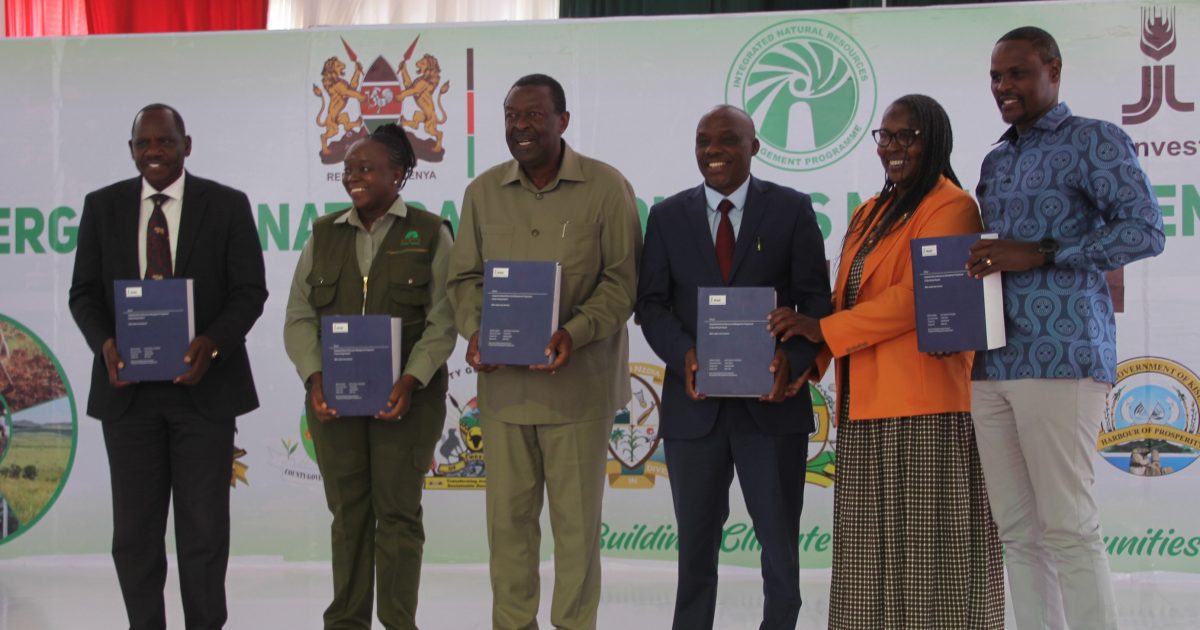
The Government has officially launched the Integrated Natural Resources Management Programme (INReMP), a Sh34.1 billion (USD 262 million) initiative that will run for eight years to strengthen climate resilience, restore degraded ecosystems, improve food security and enhance livelihoods for more than two million Kenyans.
The programme, jointly funded by the Government of Kenya and the International Fund for Agricultural Development (IFAD), targets 407,176 households across 10 counties in western Kenya through investments in climate-smart agriculture, natural resource conservation and sustainable rural development.
Prime Cabinet Secretary and Cabinet Secretary for Foreign and Diaspora Affairs Musalia Mudavadi presided over the national launch at the University of Eldoret under the theme, “Building Climate Resilient Livelihoods Through Inclusive and Sustainable Development.”
Mudavadi described the programme as a major milestone in the country’s efforts to address climate change while accelerating socio-economic transformation through sustainable management of natural resources.
He said the initiative would enable counties endowed with rich agricultural potential, biodiversity and water resources to better respond to the growing challenges of climate change, environmental degradation, food insecurity and rural poverty.
“Implementing this programme demonstrates our determination as a nation to turn these challenges into opportunities by restoring our environment, improving livelihoods and strengthening our resilience. It will contribute to our socio-economic transformation journey and secure a better future for present and future generations,” Mudavadi said.
The Prime Cabinet Secretary was accompanied by Environment, Climate Change and Forestry Cabinet Secretary Dr. Deborah Mlongo Barasa, Agriculture Principal Secretary Dr. Paul Ronoh, Environment Principal Secretary Dr. Eng. Festus Ngeno, Treasury Principal Secretary Dr. Chris Kiptoo, Gender Principal Secretary Anne Wang’ombe, Trade Principal Secretary Regina Ombam, Uasin Gishu Governor Jonathan Bii Chelilim and other senior national and county government officials.
The programme will be implemented in Elgeyo Marakwet, West Pokot, Trans Nzoia, Uasin Gishu, Nandi, Kakamega, Kericho, Kisumu, Homa Bay and Migori counties, which continue to experience increasing climate-related shocks affecting agriculture, water resources and livelihoods.
According to Mudavadi, the focus on western Kenya reflects the urgent need to address environmental degradation and strengthen resilience in one of the country’s most productive agricultural regions.
He noted that Kenya is richly endowed with forests, wetlands, rivers, fertile agricultural land and other natural resources that form the backbone of food production, water security, biodiversity conservation and the rural economy.
However, he observed that these resources continue to face mounting pressure from land degradation, deforestation, declining soil fertility, biodiversity loss and shrinking water catchments, all of which threaten sustainable development.
Mudavadi said INReMP provides a comprehensive response to these challenges by integrating environmental conservation with livelihood improvement and institutional capacity building.
The programme is anchored on three strategic pillars. The first focuses on ecosystem services and climate action through restoration and protection of forests, wetlands, watersheds and critical water towers, particularly the Mau and Cherangany ecosystems.
The second pillar seeks to improve sustainable rural livelihoods by promoting regenerative agriculture, climate-smart farming technologies, irrigation, value addition, enterprise development and commercialization of nature-based value chains to increase household incomes.
The third pillar focuses on strengthening institutions by supporting policy development, enhancing coordination among implementing agencies and establishing regional offices to oversee programme implementation.
Mudavadi said the programme’s overall goal is to improve food, nutrition and income security for rural households while ensuring communities live within sustainable and climate-resilient ecosystems.
He added that the initiative seeks to enhance integrated natural resource management while increasing resilience to climate change, particularly among women, youth, persons with disabilities, indigenous communities and other vulnerable groups.
The Prime Cabinet Secretary said restoration of degraded landscapes will involve supporting communities to conserve forests, rangelands, wetlands, water sources and agricultural land through soil and water conservation, carbon sequestration and climate action initiatives.
He said the programme would also improve agricultural productivity by promoting modern farming technologies, climate-smart agriculture, irrigation infrastructure, value chain development and rural enterprise growth to create employment and increase household incomes.
Mudavadi called for greater investment in capacity building for national and county governments, community institutions and local organisations to ensure successful implementation of the programme under the Bottom-Up Economic Transformation Agenda.
He noted that deliberate inclusion of women, youth and vulnerable groups would ensure equitable access to opportunities created by the programme while stimulating entrepreneurship, job creation and social inclusion in rural areas.
“The successful implementation of INReMP will strengthen our national food system. Building on lessons from previous natural resource management programmes will improve productivity, reduce vulnerability, strengthen food and nutrition security and create more resilient communities,” he said.
Mudavadi underscored the importance of partnerships, accountability and community ownership, saying the programme’s success would depend on close collaboration between the national government, county governments, development partners, technical experts and local communities.
He urged county governments to integrate the programme into their development plans, provide effective leadership and coordinate implementation to maximise impact.
The Prime Cabinet Secretary also challenged communities to actively participate in planning, protect investments made under the programme and strengthen local institutions to ensure long-term sustainability.
He said success would ultimately be measured by restored ecosystems, improved household incomes, increased agricultural productivity, empowered women and youth, strengthened community institutions and healthier rural environments.
Mudavadi expressed confidence that successful implementation would encourage IFAD and other development partners to continue supporting Kenya’s green growth agenda and environmental restoration efforts.
He said the initiative aligns with the country’s broader climate action commitments and sustainable development goals by restoring degraded landscapes, protecting water resources, strengthening food systems and improving livelihoods.
Calling on leaders and residents of the beneficiary counties to fully embrace the programme, Mudavadi said it provides an opportunity to transform rural economies while safeguarding natural resources for future generations.
“Let us use this programme to restore landscapes, protect water resources, improve farming systems, strengthen rural enterprises and build hope for beneficiary communities. Through ownership, participation and accountability, we can secure lasting benefits for all,” he said.
By Ekuwam Sylvester and Nelson Obwana