Data from the Ministry of Agriculture shows Kenya imports about 740,000 to 900,000 metric tonnes of rice annually to meet its growing demand.
The country consumes over one million metric tonnes each year, but local farms only produce about 150,000 to 230,000 metric tonnes which is just 14 per cent to 20 per cent of the nation’s ne forcing Kenya to heavily rely on imports (largely from Pakistan, India, and Tanzania)
Kenya Kwanza`s Bottom-Up Economic Transformation Agenda (BETA) aims to boost local rice production, cut heavy import costs, and ensure food security. The strategy is shifting from rain-fed farming to irrigation by rehabilitating 78,341 acres of existing schemes and opening 27,500 new acres to double output of rice in Kenya.
For decades, Kano plains in Kisumu which is prone to flooding chocked under a punishing economic paradox; while the waters of the River Nyando provided the perfect conditions for intensive rice cultivation, the local farming community remained locked in a cycle of poverty.
They did not have a choice but to sell their rice paddy at a throwaway price to middlemen because they did not have proper machines to mill it.
Farmers sweated for months under a scorching sun only to hand their raw paddy over to outdated, erratic village hulling machines that crushed, fractured, and contaminated the grain, thus aggravating their agony and many times ended giving it to middlemen who went to mill it in Uganda.
However, a towering industrial landmark has changed the whole story and now they are smiling all the way to the bank! Courtesy of the county government of Kisumu.
The newly commissioned, Sh30 million automated Ahero Rice Mill has brought a high-tech mechanical revolution to the region, acting as the primary engine driving smallholder farming into a highly lucrative, modern commercial industry.
Before the introduction of this multi-million shilling facility, the journey from harvest to market was a financial nightmare. Traditional milling methods across the plains relied on basic, single-pass machinery that lacked the capability to clean, de-stone, or properly polish the grain.
This structural inefficiency meant that up to thirty percent of a farmer’s total harvest value was completely lost due to poor post-harvest handling and broken kernels.
Unable to compete with clean, cheaply imported rice filling the supermarket shelves in Kisumu City, local farmers were forced to sell their sub-standard yields to exploitative middlemen at throwaway prices just to clear their debts.
Thus, the installation of the automated factory has systematically dismantled this exploitative system by placing state-of-the-art value addition directly at the source.
The Ahero Rice Mill is not just a standard hurler, it is a multi-stage, high-capacity industrial processing plant designed to clean, de-stone, hull, polish, and grade rice in a single, continuous, fully automated process.
When raw paddy enters the facility, it undergoes a rigorous, mechanized purification process that separates dust, straws, and small rocks that manually operated sorting lines routinely miss.
The process moves seamlessly from raw paddy input, through automated des-stoning and cleaning, careful hurling, followed by polishing and grading, before finishing at premium market packaging.
By removing these impurities, the mill ensures that the local grain meets the highest national and international food quality standards. Furthermore, the high-volume daily processing capacity solves the massive regional crisis of post-harvest rot.
During peak harvest seasons, a delayed milling schedule used to cause moisture accumulation within damp storage bags, leading to rapid fungal growth.
With the new mill running consistently, thousands of tons of paddy are dried, hurled and safely packaged within minutes of arriving from the fields, stabilizing the local food supply chain and preserving grain integrity.
For 54-year-old veteran farmer Tobias Omondi, the mechanical precision of the centralized mill has completely rescued his household from seasonal debt.
”In the past, taking my paddy to the local village mills felt like watching my money get ground into dust,” Omondi explains, standing outside the modern facility’s intake bay. “The old machines would crush the rice into small, broken pieces.
If your rice is full of broken grains and tiny stones, no premium buyer will look at it. You are forced to sell it for nothing.”
The narrative changed completely when Omondi began routing his seasonal harvest straight to the automated Ahero Rice Mill.
”The automated sorters handle the grain so gently that the percentage of broken rice has dropped to almost zero,” Omondi says. “I am getting clean, whole, premium-grade white rice that commands top shilling in city markets”.
He says last season, because of the mill’s high efficiency, my net earnings jumped by over sixty percent.
“For the first time in my life, I paid university fees for my eldest daughter on time, without taking a single bank loan or begging a broker for an advance.”
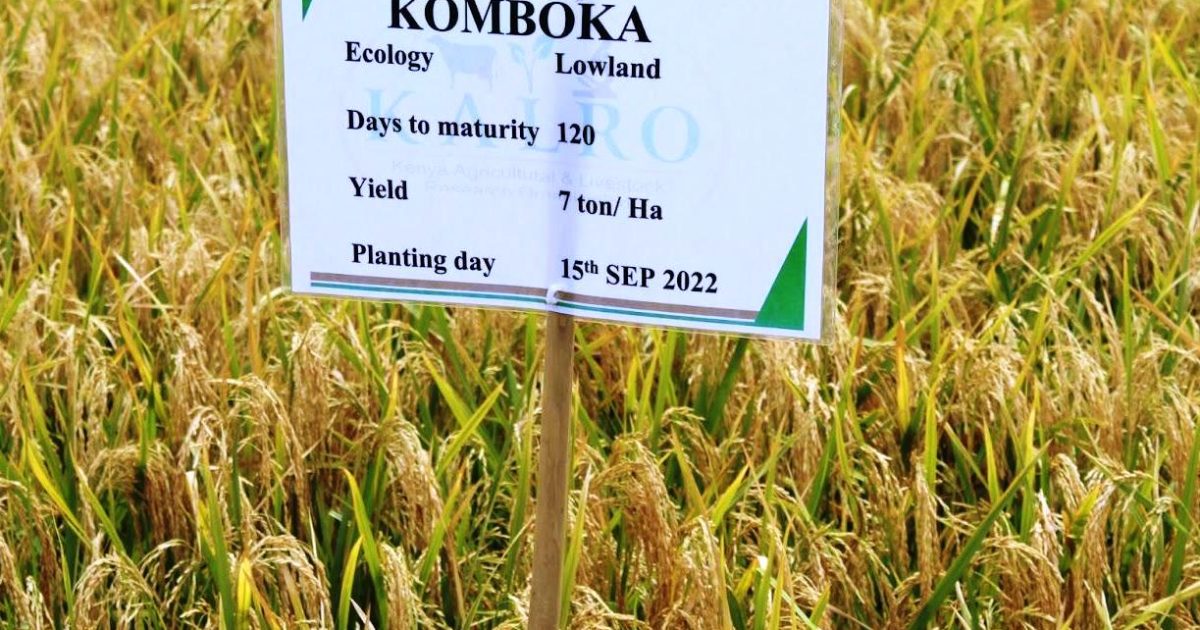
While the multi-million shilling mill stands as the mechanical saviour of the plains, its high efficiency is perfectly matched by a breakthrough in agricultural science by the introduction of the Komboka rice variety.
Developed to withstand the increasingly unpredictable weather patterns of Western Kenya, Komboka has quickly become the preferred fuel for the new mill.
Unlike the traditional, fragile Sindano variety which features tall, delicate stalks that easily fall over and rot when the River Nyando bursts its banks, Komboka variety boasts a short, sturdy, semi-dwarf architecture. This low profile makes it highly resistant to lodging (falling over) during seasonal flash floods.
Under the old system, using Sindano coupled with village hurlers meant coping with high rates of broken grains, long processing delays, and constant vulnerability to post-harvest mold. The new era pairs Komboka’s structural flood resilience with the automated mill’s high-speed processing line, guaranteeing premium, whole-head white rice that commands top-tier aromatic prices in urban markets. From a processing perspective, Komboka has an exceptional milling recovery rate.
The benefits of the Sh30 million mill extends far beyond the production of clean white rice, the facility has accidentally sparked a secondary gold rush through its industrial by-products.
In the old village milling setups, rice husks and bran which were once treated as environmental waste and dumped in massive, burning piles along the roadsides are now cleanly separates and cleaned, opening up fresh economic avenues for local youth and women’s self-help groups.
The highly nutritious rice bran is collected and sold at low costs to local entrepreneurs, who use it to manufacture affordable, high-protein animal and poultry feed, boosting the region’s livestock sector.
Meanwhile, the thick rice husks are bought by youth groups who use hydraulic presses to compress the waste into eco-friendly briquettes for cooking fuel.
These briquettes provide a long-burning, smoke-free alternative to firewood, which is now being sold back to local schools and households thus saving trees, reducing respiratory health hazards, and creating a secondary layer of employment right in the heart of Ahero.
Dr. Evans Kipkorir, an agricultural economist and regional food security consultant based in Kisumu notes that the intersection of specialized infrastructure and resilient crop genetics will help rural economies break out of systemic poverty cycle.
”What we are witnessing in Ahero is a textbook example of industrial value addition at the source,” says Dr. Kipkorir. “For decades, Kenyan rice farmers lost an unsustainable portion of their wealth due to inefficient milling.
The Sh30 million investment completely eliminates that waste. When you process rice with zero stone contamination and minimal breakage, it immediately outcompetes cheap, sub-standard imports in terms of presentation and consumer trust.
This commercial viability keeps millions of shillings circulating right among the people of Kisumu County thus creating more wealth.
The factory has also enforced a major upgrade in regional water resource management. Eng. Maurice Onyango, an irrigation infrastructure expert specializing in the Lake Victoria basin, explains how the mill’s predictable processing schedule has optimized the use of the River Nyando.
”Because the automated mill can process large volumes rapidly, farmers can now coordinate their planting and harvesting dates with absolute precision,” Eng. Onyango states. “This predictability allows us to schedule water canal gate rotations perfectly”.
We can pump and direct water from the River Nyando to specific sectors exactly when the Komboka crop requires it, eliminating the chaotic water waste and dry-season canal shortages that used to cause widespread crop failures.”
The presence of a centralized, corporate-grade mill has also completely reorganized the social fabric of the Kano Plains. In the past, individual smallholders operated in isolation, making them easy targets for predatory buyers.
Today, the strict quality standards and structured intake system of the automated mill have forced local farmers to organize themselves into professional digital cooperative societies.
Through these smart co-ops, farmers collectively pool their harvests to secure bulk transportation, negotiate better processing rates directly with the mill management, and bypass middlemen entirely.
Furthermore, because the mill maintains meticulous, digital records of every delivery, local banks are now using these processing receipts as formal collateral. Farmers can easily access low-interest credit lines to purchase certified seeds and fertilizer, a financial milestone that was completely impossible under the old village milling system.
This shift from exhausting manual labor to modern, tech-driven agribusiness is also drawing a new demographic back to the soil. For years, the youth of Kisumu County fled the rural plains, viewing rice farming as a punishing, low-yield activity reserved only for the older generation.
But with mechanized tractors preparing the fields, Komboka maturing rapidly in 120 days, and the automated mill handling the heavy processing and packaging, young tech-savvy entrepreneurs are returning to Ahero.
They are managing family plots like modern corporations, utilizing mobile money platforms linked directly to the mill’s payout system to track their profits in real time.
As evening sets over Ahero, long lines of tractors, trailers and humming vehicles loaded with heavy sacks of freshly harvested paddy line up neatly outside the gates of the Ahero Rice Mill.
The steady, rhythmic hum of the heavy machinery serves as an industrial heartbeat for a community that has finally broken free from post-harvest exploitation.
Through the mechanical precision of a multi-million shilling automated mill, backed by the resilience of Komboka rice and smart cooperative systems, the farmers of the Kano Plains are no longer just surviving on the land—they are building a powerful commercial empire. The impact of the Ahero Rice Mill extends beyond the production of quality white rice. The facility has created new economic opportunities through the utilization of rice by products that were previously considered waste.
“Because the automated mill can process large volumes quickly, farmers can now plan their planting and harvesting periods with greater accuracy,” says Eng. Onyango.
“This allows better scheduling of water distribution through canals. Water from River Nyando can be directed to specific areas when the Komboka crop needs it most, reducing wastage and minimizing dry-season shortages.”
The establishment of the centralized processing facility has also transformed the way farmers organize themselves.
Previously, individual smallholders operated independently, making them vulnerable to exploitation by middlemen. However, the need to meet the mill’s quality requirements has encouraged farmers to form organized cooperative groups.
Through these cooperatives, farmers are pooling their harvests, arranging affordable transportation, negotiating better processing arrangements, and accessing markets collectively.
The digital record systems used by the mill have further improved farmers’ access to financial services. Records of deliveries and payments provide evidence of production, enabling some farmers to access credit facilities for purchasing certified seeds, fertilizers, and farm inputs.
This financial shift has created opportunities that were previously unavailable to many small-scale producers.
The modernization of rice farming in Ahero is also attracting young people back into agriculture.
For many years, young residents of Kisumu County moved away from rural areas because farming was viewed as a difficult activity with limited returns. However, improved mechanization, better markets, and modern processing facilities are changing that perception.
With tractors assisting in land preparation, improved rice varieties maturing faster, and automated milling reducing post-harvest challenges, young entrepreneurs are increasingly investing in rice farming.
Some are managing family farms as commercial enterprises, using digital platforms to monitor production, track payments, and improve decision-making.
The transformation has positioned rice farming as a viable business opportunity rather than merely a traditional livelihood.
As the sun sets over Ahero, the sight of tractors, trailers, and vehicles carrying freshly harvested paddy waiting outside the rice mill reflects a changing agricultural landscape.
The steady operation of the automated facility represents a new chapter for farmers who for years struggled with poor processing systems and unfair market conditions.
Through modern milling technology, resilient rice varieties such as Komboka, improved irrigation planning, and stronger farmer organizations, the Kano Plains is emerging as a key centre of commercial rice production.
The Sh30 million Ahero Rice Mill has become more than a processing facility. It is a symbol of local value addition, economic empowerment, and a renewed future for thousands of farmers who can now earn more from their labour.
For the rice farmers of Ahero, the journey is no longer about simply surviving on the land. It is about building a sustainable agribusiness future, one quality grain at a time.
By Mabel Keya – Shikuku and Tonaee Bryane