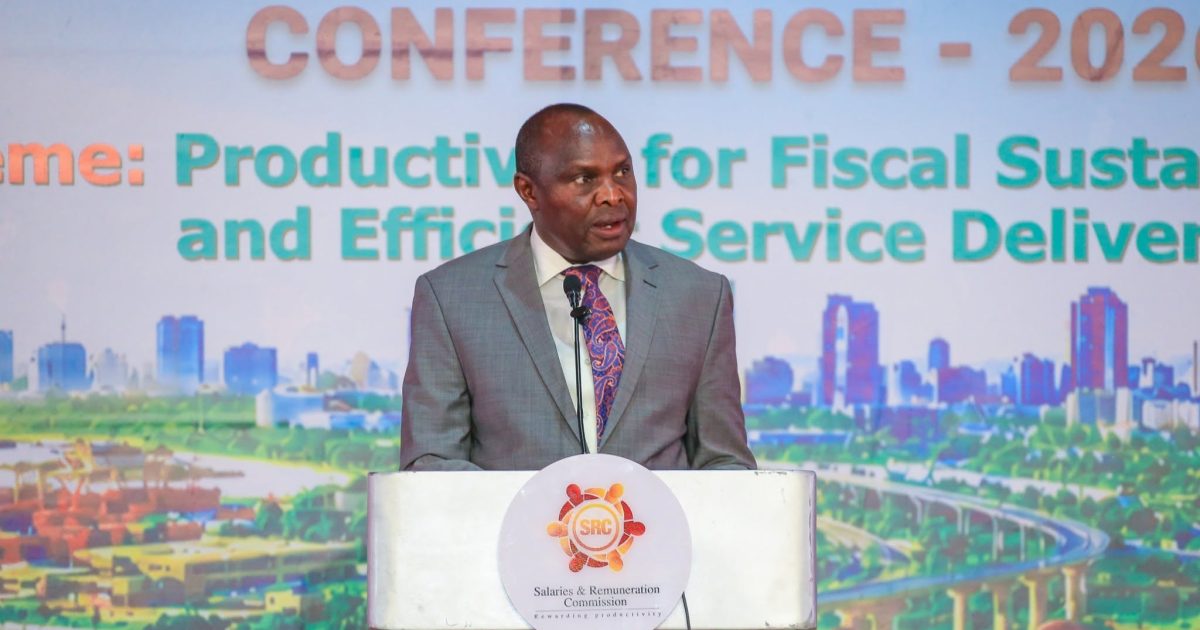
Senior government leaders and policymakers have called for far-reaching structural and cultural reforms across the public sector, warning that Kenya’s long-term fiscal sustainability and service delivery ambitions depend on significantly improving productivity.
Speaking during the official opening of the National Performance and Productivity Conference in Nairobi on Wednesday, Chief of Staff and Head of Public Service Felix Koskei challenged public servants to abandon outdated operational cultures that hinder efficiency and innovation within government institutions.
Koskei emphasized that productivity should not be viewed as a temporary initiative or a policy requirement but as a continuous commitment to creating greater value from public resources.
“Productivity is not a one-time initiative, a policy document, or a performance plan; it is a habit of continuously creating greater value from the resources entrusted to us,” he said.
He urged public institutions to move beyond a culture of compliance and embrace value creation as the cornerstone of public service. He further called for the protection of professional public service from political interference, arguing that an independent and efficient bureaucracy is critical for achieving national development goals.
The three-day conference, themed “Productivity for Fiscal Sustainability and Efficient Service Delivery,” brought together representatives from the national government, all 47 county governments, the private sector, trade unions, and development partners. Organizers adopted a whole-of-government approach aimed at fostering collaboration and sharing best practices on productivity enhancement.
Salaries and Remuneration Commission (SRC) Chairperson Sammy Chepkwony said Kenya had made notable progress in managing its public wage bill, which has declined from 55 percent in 2020 to 40 percent in 2026 through strategic expenditure controls and workforce management measures.
However, he cautioned that expenditure reduction alone cannot guarantee sustainable fiscal health.
“The expenditure control curve is starting to flatten at its tail end, proving that the more you control, the results are not significant,” Chepkwony observed.
He noted that future fiscal gains must be driven by measurable productivity improvements that focus on outcomes and impact rather than simply controlling inputs and costs.
Presentations by technical experts highlighted significant productivity gaps both within Kenya and globally. Drawing from International Labour Organization (ILO) data, speakers noted that Kenya’s public sector productivity remains lower than that of the domestic private sector and significantly behind high-performing countries such as Singapore and Estonia.
Participants were told that meeting the statutory requirement of maintaining a wage bill below 35 percent of revenue would require both national and county governments to improve revenue generation, maximize asset utilization, and strengthen efficiency in service delivery.
Council of Governors Chairperson and Wajir Governor Ahmed Abdullahi identified weak workplace culture as one of the major barriers to productivity. He criticized the tendency by some public officers to treat government employment as a secondary commitment while prioritizing private business interests.
Abdullahi said public resources and working hours must be utilized effectively to ensure citizens receive quality services and value for money.
Kenya School of Government (KSG) Director General Prof. Nura Mohamed said the institution was aligning its training programmes with emerging governance and productivity needs. As part of its centenary celebrations, KSG announced the establishment of specialized Centres of Excellence focusing on Strategic Foresight, Customer Service Excellence, and Artificial Intelligence (AI).
The centres are expected to strengthen the capacity of public officers and prepare them for the demands of a modern, technology-driven public service.
Delegates were urged to use the conference to develop concrete policy, institutional, and legislative frameworks that will embed productivity as a core principle of public sector management and accelerate efficient service delivery across the country.
By Lilian Gichohi