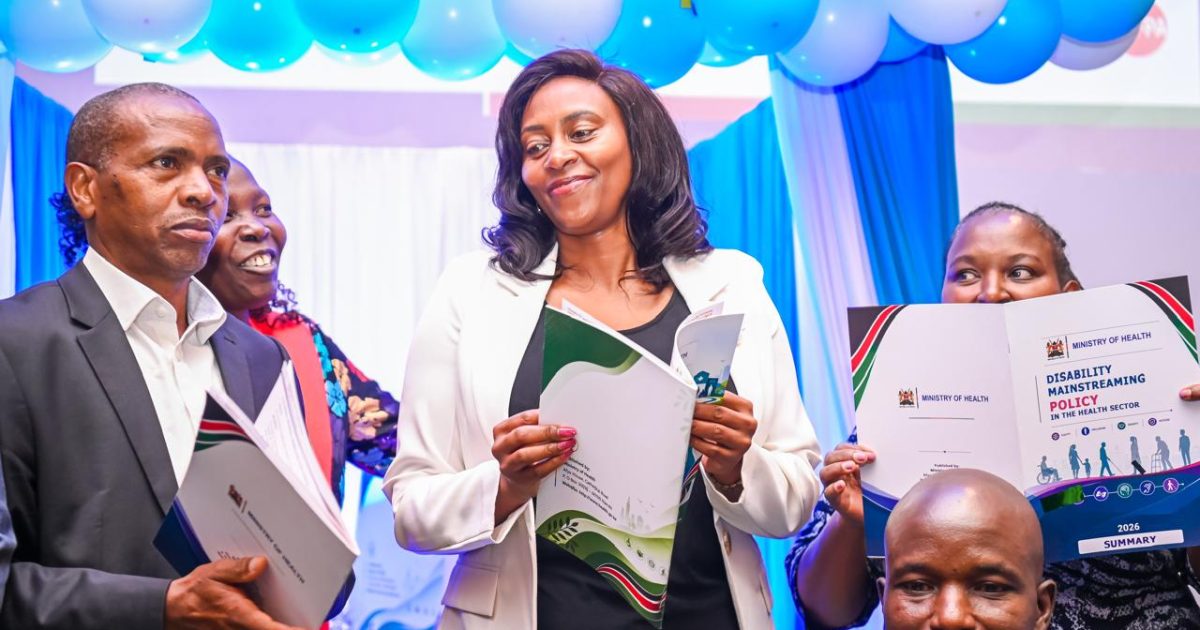
The Ministry of Health has officially launched the Health Sector Disability Mainstreaming Policy to ensure that all healthcare facilities across the country are fully inclusive and accessible to persons with disabilities (PWDs).
The policy, which has been under development for over six years, targets physical, institutional, and attitudinal barriers within public, private, and faith-based healthcare facilities.
Speaking during the launch in Nairobi, Principal Secretary for the State Department for Public Health and Professional Standards, Mary Muthoni, emphasized that disability mainstreaming was a fundamental commitment to human dignity rather than a mere policy narrative.
“For too long, the narrative around disability has been one of limitation,” PS Muthoni stated. “Today, by integrating disability perspectives directly into our health system, we are decisively shifting that narrative. We are moving away from exclusionary models towards a system that guarantees equitable access for all Kenyans.”
To ensure immediate execution, the ministry fast-tracked both the policy and its operational guidelines simultaneously. “We are not going to have it sit on the shelves waiting for implementation guidelines,” Muthoni said, adding, “We want to hit the ground running.”
Ministry of Health’s Head of Rehabilitative Services Ms. Irene Gichohi called for immediate compliance across all healthcare sectors.
“The idea is that, from the very beginning, we should design services, infrastructure, and equipment that are universally accessible,” she said, stressing that institutions should avoid relying on makeshift, retrofitted adjustments after facilities are built. Gichohi welcomed the collaboration that made the document’s launch possible after a long six-year journey.
Following Gichohi’s remarks, the government highlighted its plans to integrate Community Health Promoters (CHPs) to identify, assess, and refer PWDs within their neighborhoods. Muthoni revealed that plans are underway to incorporate disability mainstreaming into the CHP training curriculum.
“It is not just about identification of who is unwell or who is disabled,” the PS explained. “It is equally an opportunity to ensure that we prevent disability from happening, right from conception.”
Representing the National Council for Persons with Disabilities (NCPWD), Senior Disability Services Officer Mr. Isaac Manyonge highlighted the everyday hurdles PWDs face, ranging from inaccessible registration desks to a lack of sign language interpreters in hospitals.
“Article 54 of our Constitution speaks about the right of a person with a disability to access institutions and the facilities within them.” Manyonge noted, explaining, “It is one thing to access an institution, and it is another to access the actual facilities inside.”
Manyonge emphasized the need for disability etiquette among healthcare providers, noting that medical professionals must understand that PWDs require equal respect and dignified care.
He added that the policy also seeks to leverage CHPs to collect reliable demographic data, which will help reform medical procurement to include disability-specific treatments and assistive devices.
Under the Social Health Authority (SHA), the government is tailoring specific benefit packages to cover essential assistive devices and rehabilitative services. PS Muthoni also reaffirmed the government’s commitment to enforcing a two percent public procurement quota specifically for PWD-owned enterprises.
“Disability is a club that anyone can join at any time of life,” Manyonge said. “This policy is about all of us, protecting those who have disabilities today, and those who may acquire them tomorrow.”
By Lilian Gichohi