

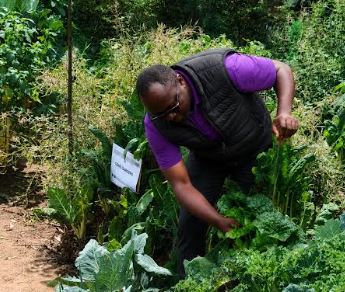
An international non-governmental organization, Ripple Effect, is encouraging farmers in Kakamega County to embrace agro-ecology, sustainable and climate-smart agriculture to lower production costs and boost yields and soil fertility.
During a smallholder farmers’ field day held at Emathayi, organized by Ripple Effect in collaboration with Vivamos, a Swiss organization and the Kenya National Farmers Federation (KENAFF), farmers learned practical and easy-to-access technologies to improve food security, restore soil health and support the transformation of rural livelihoods.
Farmers, agricultural experts and agricultural officials attended the event where live demonstrations were conducted on making suitable homemade organic fertilizers, making keyhole gardens, fertility trenches, preservation of indigenous seeds, bee farming, and making of Black Soldier Fly larvae as inexpensive manure for poultry industries.
Speaking at the event, the Kakamega County Executive Committee Member for Agriculture, Mophat Mandela, said the County is encouraging farmers to practice climate-smart agriculture to lower production costs for farmers and boost soil fertility and yields.
“Overdependence on costly farm inputs has become a serious load to many farmers; locally made organic fertilizers with biodegradable waste is a sustainable alternative,” he added.
He highlighted the fact that the soils in the county are facing acidity and low levels of essential nutrients in the soil but added that these new techniques are improving because the farmers have adopted homemade fertilizers and commercial farming.
“While agricultural production continued to improve substantially in the past decade, more measures are needed to attain food security and improve farmers’ incomes,” he added.
Mandela suggested that farmers integrate the application of both organic and conventional fertilizers, as needed, to increase soil fertility and promote budding agripreneurs to lend a helping hand to fellow farmers by organizing peer-to-peer learning opportunities.
He said the county has employed extension officers in all the wards and sub-counties to serve their best interests, also urging them to collaborate more with the farmers for improved agricultural production.
Ripple Effect Country Manager Isaac Ogutu said the organization was promoting agro-ecological farming, which was centered on providing higher output in order to sustain the environment for posterity.
“The farmers should put into practice the knowledge they have learnt on the field day and transfer their knowledge to people around them to help more farmers understand the sustainable agriculture techniques and practice them,” Ogutu stated.
He also urged farmers to grow and conserve their original seeds, which are more resistant to climate changes, pests, diseases, and were better keepers of food and income.
“Ripple Effect would increase farmer groups in order to have wide access to training and support systems based on the community,” Ogutu revealed.
Habakuk Khamala, a representative of the KENAF, urged farmers to embrace new technologies in the farming process and indigenous farming, particularly technologies like keyhole gardens, fertility trenches that play a big role in crop production amidst changing climate conditions.
“Farmers should embrace modern methods even when farming indigenous breeds,” Khamala said.
Peer farmer trainer Reuben Malinja demonstrated how Black Soldier Fly larvae can be raised to feed low-cost chickens and farmers can optimally make use of organic waste in chicken farming, which would improve the profitability of the farms.
“Farmers should join SACCOs and self-help groups and avail themselves for training, financing and modern farming technologies,” Benjamin Maina urged farmers.
Maina also spoke about the economic and medicinal importance of beekeeping. Apart from the production of honey, the bees also generate an extra source of income to the rural households as they generate wax which would be utilized for the making of candles apart from other cottage industries.
Another peer farmer trainer, Evelyne Karakacha, exhibited successful production of local vegetables such as cowpea leaves and jute mallow with home-grown organic fertilizers.
“The farming of local vegetables using organic fertilizers has increased my productivity, while also lowering production costs,” Evelyne said.
Another beneficiary, Esther Osimbo, said she transitioned from hardship to self-reliance after embracing the new farming techniques.
“By learning and picking up the skills, I can now produce food, care for my husband who has a disability, and educate my children; this was something I had not been able to do before the training,” Osimbo said
The programme has also enabled her to train other farmers, showcasing the far-reaching potential of knowledge transfer to boost opportunities and strengthen livelihoods in entire communities, she said.
The field day climaxed with a renewed appeal to farmers to join farmers’ groups and encouraged them to accept climate-smart agriculture and adapt low-cost sustainable technology that can help create resilient farms for improved household income and long-term food security.
By Paul Nyokech

