The government has reaffirmed its commitment to unlocking the vast potential of Kenya’s maritime sector to create jobs, attract investment, spur enterprise development, and improve livelihoods.
Principal Secretary (PS) for Shipping and Maritime Affairs, Aden Millah, said Kenya’s strategic location and vast marine and inland water resources provide enormous opportunities that remain largely underexploited.
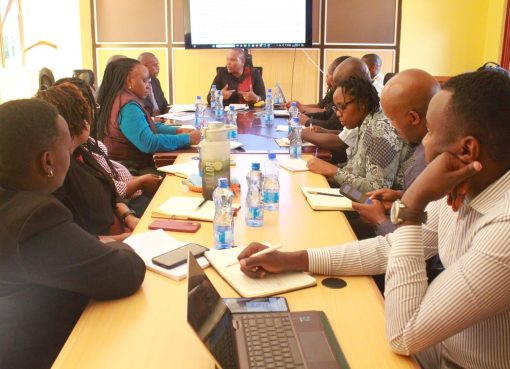
PS Millah spoke during the State Department for Shipping and Maritime Affairs stakeholders’ engagement forum for the 2027/28 Financial Year and Medium-Term Expenditure Framework (MTEF) in Mombasa.
He said the government would focus its resources during the 2027/28 Financial Year and the Medium-Term period on interventions aimed at unlocking the sector’s potential and delivering measurable results.
In the Fourth Medium-Term Plan of Kenya Vision 2030, which implements the Bottom-Up Economic Transformation Agenda (BETA), the Blue Economy has been identified as a key value chain with the potential to transform Kenya’s economy.
The State Department will prioritise maritime education, training, and labour, strengthen Kenya’s shipping and logistics capacity; and develop maritime transport infrastructure.
Other priorities include maritime spatial planning and sustainable utilisation of marine resources, strengthening maritime safety, security, and environmental protection, and enhancing Kenya’s national shipping capacity.
The PS said Kenya could not fully realise its ambition of becoming a competitive, industrialised and prosperous economy without unlocking the enormous potential of the maritime sector.
“Our geographical location gives us a strategic advantage. Kenya sits along the Eastern Coast of Africa and on major international shipping and trade routes,” he said.
He added that Kenya boasts 640 kilometres of coastline, territorial waters covering about 9,700 square kilometres and an Exclusive Economic Zone (EEZ) of approximately 230,000 square kilometres.
The figures, he explained, demonstrate that the maritime sector is not peripheral but lies at the heart of Kenya’s trade, logistics, food security, industrialisation, employment creation, foreign exchange earnings and national competitiveness.
He noted that the sector presents enormous opportunities in international shipping, maritime transport and logistics, shipbuilding and repair, marine cargo handling, maritime education and training, maritime law, safety and security, marine salvage, offshore energy, offshore mining, and marine biotechnology.
Other opportunities include blue data, cargo consolidation, freight forwarding, marine insurance, ship handling, port agency services, oil bunkering, tourism, sport fishing, and marine governance.
“Our responsibility as Government is to create an enabling environment in which these opportunities can be transformed into bankable investments and sustainable jobs. This requires a deliberate partnership between Government, counties, private investors, financial institutions, development partners, academia, professional bodies and communities,” said PS Millah.
He added, “The sector must be approached as an integrated economic ecosystem from the training of a seafarer, to employment on a vessel; from cargo arriving at our ports, to its movement into the hinterland; from ship registration and maritime insurance, to ship repair, logistics and ancillary services; and from our marine resources, to sustainable economic exploitation.”
PS Millah affirmed that if properly developed, the maritime sector could make a significant contribution to job creation, poverty reduction, food security and foreign exchange earnings, while expanding the tax base, boosting exports and promoting inclusive economic development.
By Sadik Hassan