The government has appealed to development partners to engage in stronger partnerships to unlock the economic and environmental potential in Kenya’s forestry sector.
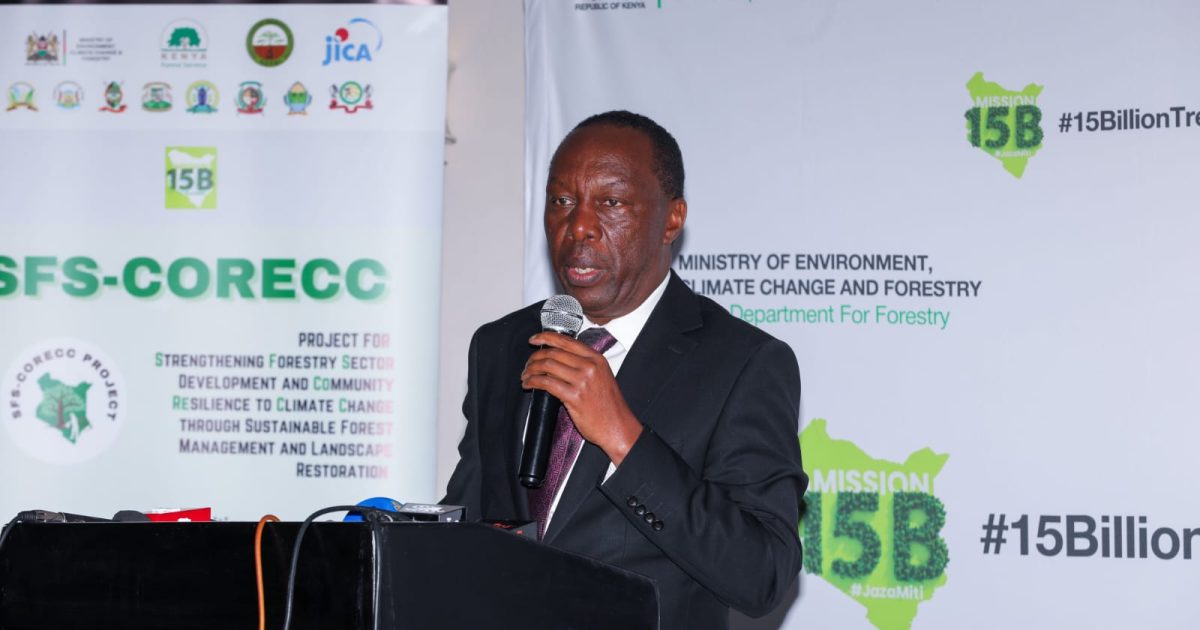
Speaking during a donor roundtable breakfast meeting on forestry restoration, Principal Secretary (PS) for Forestry Gitonga Mugambi reported that Kenya was seeking enhanced collaboration to accelerate restoration of degraded landscapes, particularly in arid, semi-arid, and coastal ecosystems.
Mugambi highlighted that the country’s arid and semi-arid lands account for about 89 percent of the national landmass and possess immense potential for sustainable economic development, biodiversity conservation, tourism, and climate resilience.
However, he noted that the ecosystems continue to face threats, including land degradation, deforestation, biodiversity loss, invasive species, desertification, recurrent droughts, and the effects of climate change.
“The success of this restoration agenda cannot be achieved by the government alone. It requires a whole-of-society approach founded on partnerships, collaboration, innovation, and shared prosperity,” he advised.
The PS further pointed out that the National Landscape and Ecosystem Restoration Strategy (2023–2032) seeks to restore 10.6 million hectares of degraded landscapes while contributing to the country’s target of increasing tree cover to 30 percent by 2032.
Earlier, Mr. George Tarus, the Acting Secretary for Forest Conservation at the State Department for Forestry, presented four investment-ready concepts aimed at mobilizing donor financing to accelerate restoration efforts. The concepts focus on restoration of arid and semi-arid lands, mangrove ecosystems, management of invasive species, and expansion of commercial forestry and agroforestry.
Tarus stressed that the initiatives are designed to restore degraded landscapes, create green jobs, strengthen climate resilience, and improve livelihoods while supporting the government’s 15-billion-tree growing programme.
“The projects would also promote commercial forestry, enhance biodiversity conservation, and attract private sector investment into the forestry sector,” he added.
Tarus announced that the government had already made significant progress towards the national tree-growing target through increased production and distribution of quality seedlings by the Kenya Forest Service (KFS) and the Kenya Forestry Research Institute (KEFRI), saying stronger partnerships would be essential in scaling up implementation.
In a quick rejoinder, Mugambi insisted that implementation of the restoration strategy would rely on collaboration among national and county governments, local communities, research institutions, civil society organisations, development partners, and the private sector in order to mobilize the required resources and accelerate restoration efforts.
In addition, he mentioned that the government was promoting community-led restoration models that integrate environmental conservation with livelihood improvement, noting that successful initiatives piloted in Kaptagat had already been replicated in other parts of the country.
“We have seen that when communities are actively involved in restoration and supported with alternative livelihoods, pressure on forests reduces significantly,” he said.
Further, Mugambi added that the forestry sector was being repositioned as a driver of economic growth through commercial forestry and agroforestry, with priority value chains including cocoa, avocado, and oil palm expected to create employment opportunities and boost household incomes.
He equally appealed to development partners to support the sector through financing, technology transfer, and provision of quality seedlings to accelerate restoration and expand commercial tree growing.
Japan International Cooperation Agency (JICA) Chief Representative Dr. Fumihiko Suzuki stated that JICA has partnered with Kenya’s forestry sector for more than four decades through technical cooperation, research collaboration, and institutional capacity building.
He divulged that the agency had supported the development of key policy frameworks, including the Forest Conservation and Management Act, the Commercial Forestry Strategy, and the Agroforestry Strategy, while promoting drought-tolerant tree species to enhance landscape restoration and climate resilience.
“The key challenge is not only developing policies and technologies but also ensuring their effective implementation through strong collaboration among government, research institutions, communities, the private sector, and development partners,” Dr. Suzuki highlighted.
Meanwhile, representatives from the Food and Agriculture Organization (FAO) reaffirmed the agency’s commitment to supporting Kenya’s forestry restoration agenda through closer collaboration with the State Department for Forestry and other stakeholders, particularly in mangrove restoration and sustainable forest management.
The meeting brought together government officials, development partners, conservation organizations, and private sector stakeholders to explore financing opportunities for forestry restoration and climate resilience initiatives.
By Zipporah Odionyi and Lilian Gichohi