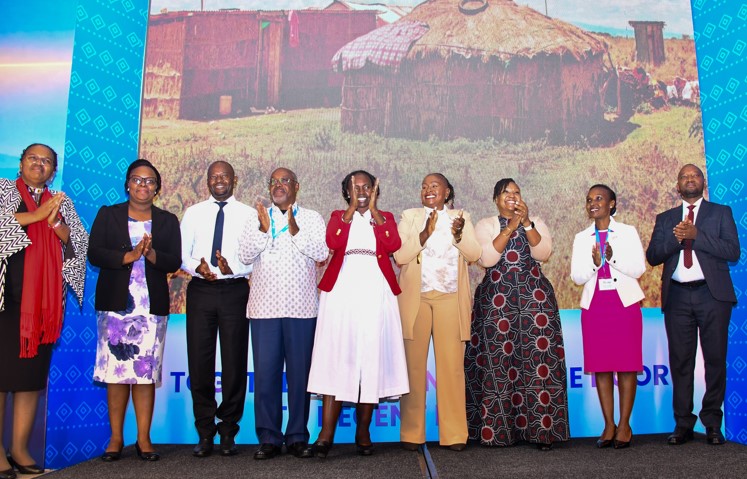
Habitat for Humanity Kenya has launched the “Let’s Open the Door” campaign, a nationwide initiative aimed at promoting decent, affordable and climate-resilient housing as a catalyst for improved health, education, economic empowerment and sustainable development.
The campaign unveiled two flagship initiatives: Opening the Door to Women Building Resilient Manyattas, which will empower Maasai women to construct stronger and healthier traditional homes while preserving their cultural heritage, and Opening the Door to Jigger-Free Homes, a five-year programme that seeks to improve 10,000 household floors in jigger-endemic communities, directly benefiting about 50,000 people.
Speaking during the launch in Nairobi, Habitat for Humanity International Area Vice President for Africa Abi Riak said Africa faces a housing deficit of about 56 million units, while Kenya requires approximately 250,000 new housing units annually.
She said housing should no longer be viewed merely as shelter but as a foundation for better health, education, economic opportunity, climate resilience and human dignity.
“When we open the door to housing, we open the door to many other opportunities for communities to thrive,” she said, adding that the campaign is a global movement seeking to place housing at the centre of the development agenda.
Riak noted that Habitat for Humanity continues to partner with governments, financial institutions, savings groups and the private sector to expand access to housing finance and innovative solutions that enable families to improve their homes incrementally.
She added that through a partnership with the Kenya Medical Research Institute (KEMRI), Habitat has developed healthy housing innovations that lower indoor temperatures and reduce the number of malaria-carrying mosquitoes entering homes by up to 77 per cent, improving the health and productivity of vulnerable families.
Habitat for Humanity Kenya National Director Dr. Eileen Mokaya said the organization has served vulnerable communities in Kenya for the past 25 years by promoting decent housing and access to basic services.
She said the resilient manyatta initiative will equip Maasai women with improved construction technologies while maintaining the cultural identity of traditional manyattas through better ventilation, natural lighting, energy-saving cookstoves and rainwater harvesting systems.
Dr. Mokaya said the Jigger-Free Homes initiative will address one of Kenya’s persistent public health challenges by replacing mud floors with durable flooring to prevent repeated jigger infestation and improve the health, dignity and wellbeing of affected families.
Head of the Division of Vector-Borne and Neglected Tropical Diseases at the Ministry of Health Dr. Wyckliff Peter Omondi said inadequate housing remains one of the key drivers of neglected tropical diseases, many of which are associated with poverty, poor sanitation and limited access to safe housing.
He noted that jigger infestation continues to affect several counties because of earthen floors and poorly constructed houses that provide favourable conditions for the parasites to thrive.
Dr. Omondi said improving housing conditions, access to clean water and sanitation would significantly reduce disease transmission and lessen the burden on the country’s healthcare system.
He welcomed Habitat for Humanity’s interventions, saying they complement government efforts to prevent neglected tropical diseases by addressing their environmental causes rather than relying solely on medical treatment.
Beneficiary Regina Mwelu said Habitat for Humanity had transformed her family’s life by providing a decent home, noting that she no longer lives in fear whenever it rained.
“I never imagined that one day I would live in a house where I don’t have to worry every time it rains,” she said.
Another beneficiary, Mary Kanini, said her family’s living conditions and health had greatly improved after moving into a better house.
She recalled that the cold and rain in her former house frequently made her sick and thanked Habitat for Humanity for restoring hope and dignity to vulnerable families through decent housing.
By Sharon Njeru and Nancy Omondi