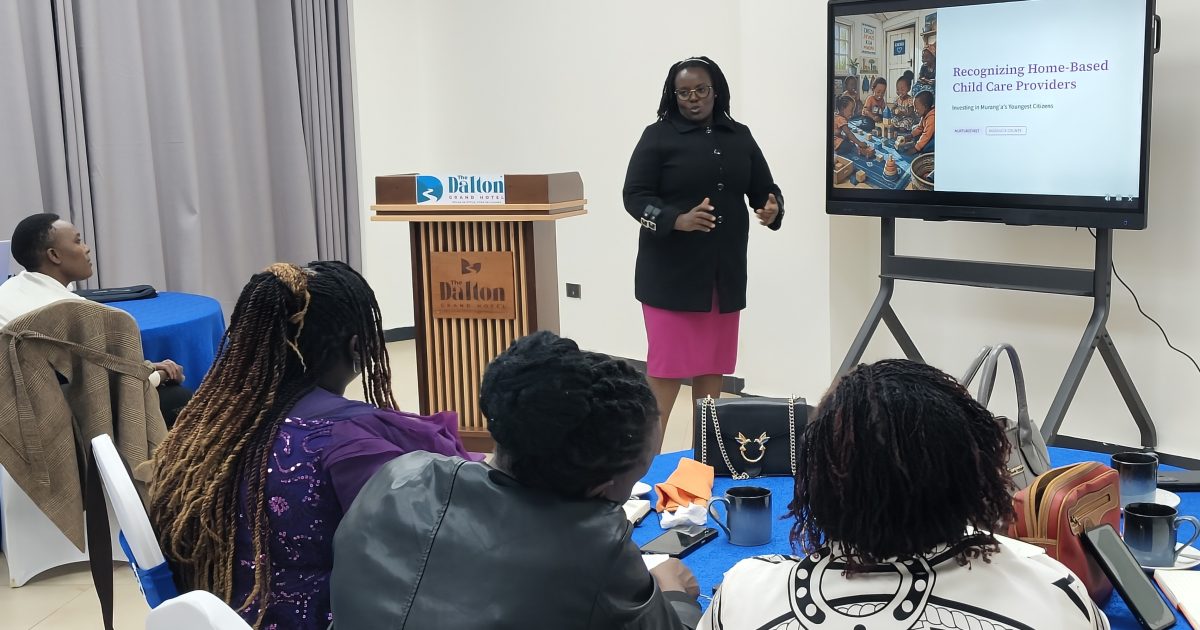
Home-based childcare providers in Murang’a County have called on the county government to standardize licensing fees and formally recognize their role in providing early childhood care, saying inconsistent charges and limited government support continue to hinder their operations.
The appeal was made during a roundtable meeting between members of the Murang’a County Assembly Gender and Social Services Committee and participants of the Nurture First Programme, where stakeholders discussed challenges facing home-based childcare providers and explored policy interventions to strengthen the sector.
The forum was organized by the Nurture First Programme in partnership with the Catholic Diocese of Murang’a (CDM).
The childcare providers said they play a critical role in supporting working families by offering safe and affordable care for young children, yet many continue to operate without adequate recognition, training or financial support from the government.
Elizabeth Wairimu Muiruri, Project Officer at the Catholic Diocese of Murang’a under the Nurture First Programme, said a 2024 mapping exercise identified 1,268 home-based childcare providers across the county who collectively care for more than 6,000 children aged between birth and three years.
She noted that the programme is also being implemented in Kisumu and Mombasa counties, where similar initiatives are underway to improve the quality of childcare services and strengthen support for caregivers.
Wairimu said the programme is advocating for the inclusion of home-based childcare providers in county policies and budgets to ensure they receive the recognition, training and resources needed to deliver quality childcare services.
She observed that despite their important contribution to communities, many caregivers operate with limited resources and lack formal training in critical areas such as first aid, child development, nutrition, hygiene, safety and self-care.
“We want these providers to be recognized for the important work they are doing and be equipped with the knowledge and skills needed to provide safe, quality and nurturing care for children,” she said.
Murang’a County Assembly Gender and Social Services Committee Chairperson Pauline Njeri Muchiri said the engagement had highlighted the significant contribution made by home-based childcare providers, adding that many leaders were unaware of the scale of the sector in the county.
She noted that the committee had learned that more than 1,200 providers operate across Murang’a, many of whom face challenges arising from inconsistent and sometimes expensive licensing fees charged by different authorities.
Muchiri said the committee would engage relevant county departments to harmonize licensing charges while ensuring all childcare facilities continue to meet the required standards for children’s safety, health and wellbeing.
She further pledged to advocate for the allocation of funds in the county budget to support home-based childcare providers through training, capacity building and improved regulation.
“The committee will work with the relevant departments to ensure licensing fees are fair, affordable and standardized while maintaining the standards required to protect children. We will also push for budgetary support for home-based childcare providers,” she added.
Eva Wangari, a member of the Nurture First Programme, said many caregivers provide an essential service to families that cannot afford domestic workers or formal daycare centres, making home-based childcare a lifeline for low-income households.
She added that the programme continues to equip caregivers with skills in child wellbeing, nutrition, hygiene, safety and responsive caregiving to improve the quality of services offered.
Participants said strengthening the home-based childcare sector would enhance early childhood development while enabling parents, particularly mothers, to participate in income-generating activities with the assurance that their children are receiving safe and quality care.
By Bernard Munyao and Yvonne Wanja