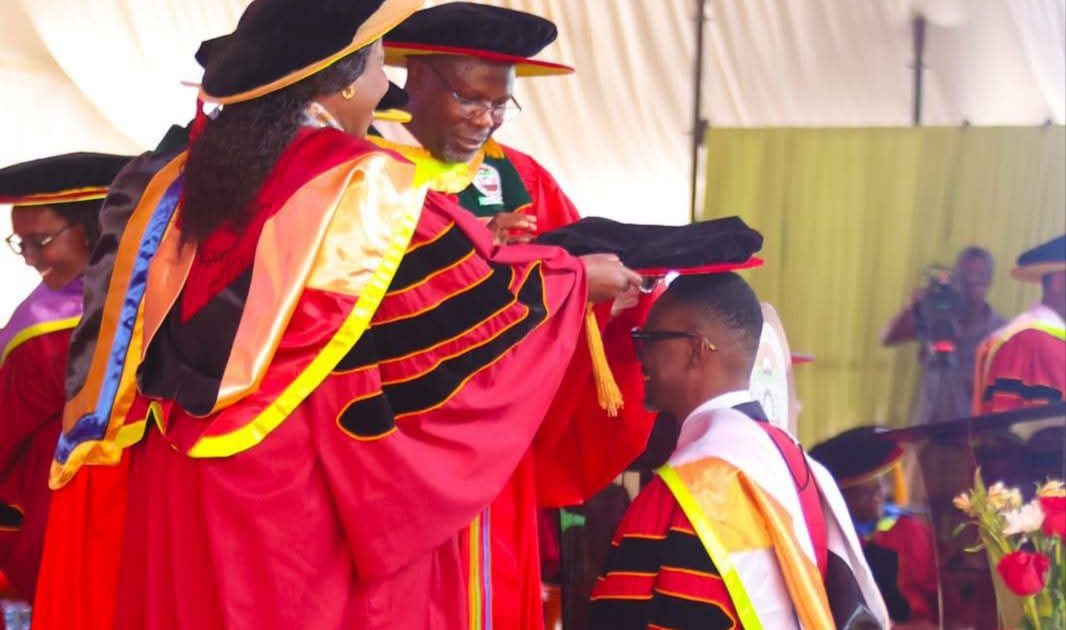
The Principal Secretary for Higher Education, Dr. Beatrice Inyangala, has challenged university graduates to embrace innovation, entrepreneurship, and continuous learning as they venture into a rapidly changing world.
Speaking during the Murang’a University of Technology (MUT) 10th Graduation Ceremony, Dr. Inyangala reminded the graduates that the degrees they had received were not the destination but a passport to greater responsibilities as members of society and the global community.
She challenged the graduates to use the knowledge and skills acquired at the university to solve problems, create enterprises, introduce innovations, and leave a positive legacy in society.
“The question, dear graduates, is no longer simply, what have you learned? The question is, what you will do with what you have learned?” asked Dr. Inyangala.
The PS said the rapidly changing global economy requires graduates to continuously upskill, reskill, and acquire multiple skills, noting that artificial intelligence, automation, biotechnology, robotics, fintech, and digital platforms are transforming workplaces.
Citing the World Economic Forum’s Future of Jobs Report 2025, she said global structural transformation could create 170 million jobs while displacing 92 million by 2030.
She urged graduates to combine technological skills with human qualities such as sound judgment, ethics, empathy, creativity, courage, leadership, and wisdom, which she said machines cannot easily replace.
Dr. Inyangala also challenged MUT to position itself as a leading center of applied research and technological innovation in Africa, urging the institution to anticipate the technologies of tomorrow rather than merely teach those of today.
“Do not wait for Silicon Valley to tell Africa what the future looks like. Let Murang’a help Africa define its own Silicon Valley,” she said.
She highlighted the university’s innovations, including the MUT001 electric vehicle, as evidence that African institutions can design, build, and innovate rather than remain consumers of technology developed elsewhere.
Dr. Inyangala commended MUT for maintaining an uninterrupted academic calendar, saying the students’ ability to complete their studies on time demonstrated institutional discipline, effective governance, and respect for students and their families.
She urged the graduates to embrace four key values: curiosity, courage, integrity, and compassion, as they begin their professional journeys.
The PS also encouraged them to actively pursue employment, internships, scholarships, and overseas opportunities through government platforms, while urging innovators and aspiring entrepreneurs to explore available government funding opportunities.
Meanwhile, MUT Chancellor Prof. Justin Irina called for increased investment in research, agricultural education, and clean-energy technologies to strengthen the university’s contribution to national development.
Prof. Irina urged academic staff and researchers to pursue competitive grants, strengthen interdisciplinary collaboration, and undertake community-responsive research, particularly in areas such as food security.
“The true value of research is realized when knowledge moves beyond publications and contributes to better policies, stronger institutions, productive communities, and sustainable livelihoods,” he said.
The Chancellor acknowledged the support of the County Government of Murang’a through the transfer of land at Mariira, saying the partnership had enabled the university to begin infrastructural development for agricultural and environmental programmes.
He appealed to the national government and development partners to provide financial resources to establish a fully functional teaching, research, and innovation campus at Mariira.
Prof. Irina said the campus would expand access to quality agricultural education while strengthening MUT’s contribution to food security, climate resilience, and sustainable development.
The Chancellor further disclosed that the university had been granted three patents arising from its research and innovation activities, describing the achievement as significant, particularly in the clean-energy sector.
Prof. Irina also called for investment in reliable energy and human capital to support Kenya’s industrialization and value addition of its mineral resources, citing titanium mining in Kwale as an example of the need for adequate energy and technical expertise.
By Purity Mugo and Ann Kendi