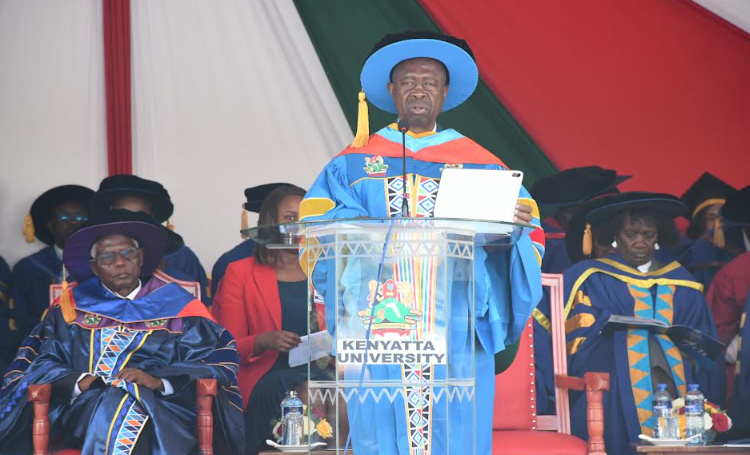
Newly installed Kenyatta University Vice-Chancellor Prof. John Okumu has been challenged to build on the institution’s achievements and steer it towards greater excellence, sustainability, innovation, and global impact.
Prof. Okumu formally assumed leadership of the university during an installation ceremony held at the Graduation Square at the Main Campus on Friday, where university leaders called for unity and collective effort in advancing the institution’s mission.
In his brief remarks during the ceremony, Prof. Okumu said his experience at the university had shaped his career and placed him in a position to contribute to the development of Kenya.
“There is something that I have seen during my time here. There is something that I have seen to be able to build my whole career, to be able to help build the future of Kenya,” Prof. Okumu said.
His installation marked a new chapter in the leadership of the university and coincided with the matriculation of first-year students joining the institution.
The Chancellor of Kenyatta University, Ambassador Francis Muthaura, congratulated Prof. Okumu on his installation as the seventh Vice-Chancellor, saying the office carried both honour and responsibility.
Amb. Muthaura said Prof. Okumu had inherited an institution built over decades through the labour, imagination, and sacrifice of many people and therefore had a responsibility to preserve what had served the university well while improving areas requiring change.
“The responsibility entrusted to you is to preserve what has served this institution well, improve what must change, and open new possibilities for those who come after us,” he said.
Amb. Muthaura said the theme of the occasion, “Forging Ahead in Unity, Excellence, Sustainability, and Greater Global Impact,” appropriately captured the task facing the university.
On unity, he said universities thrived when diversity did not become a source of division, noting that institutions of higher learning bring together people from different disciplines, generations, backgrounds, and schools of thought.
He urged the University Council, management, Senate, staff, students, and alumni to support the new Vice-Chancellor, stressing that while leadership may reside in an office, institutional success remains a collective responsibility.
“Universities thrive when their communities understand that difference need not become division,” Amb. Muthaura said.
On academic excellence, the Chancellor said Kenyatta University had established a strong reputation in teaching, research, innovation, arts, sports, community engagement, and public service but cautioned that such a reputation could not be sustained without continuous effort.
He called for high academic standards, intellectual courage, integrity, innovation, and global competitiveness, while urging the university to adapt to changing circumstances without abandoning its core values.
Amb. Muthaura described quality education as the most effective route for transforming Kenya from a developing country into a developed nation.
He challenged Kenyan scholars and students to take greater responsibility for the country’s transformation, warning that other countries would continue advancing if Kenya failed to take advantage of available opportunities.
He noted that global competitiveness was increasingly driven by productivity, service delivery, and innovation, adding that job creation depended on expanded production, services, and innovative solutions.
The Chancellor further challenged Kenyatta University to aspire to become a leading institution on the African continent.
“Why can’t our university be the Harvard of Africa? Why can’t it be the Oxford of Africa?” he posed, attributing such ambitions to determination, hard work, innovation, cooperation, and the continuous exchange of ideas.
Amb. Muthaura said sustainability was equally important as universities faced changing funding models, technological disruption, and growing public expectations.
He urged the institution to use its resources responsibly, strengthen research and innovation, develop meaningful partnerships, and establish systems that would remain effective beyond individual leaders.
He said a strong university should not merely survive difficult periods but emerge from them better prepared for the future.
The Chancellor also urged the university community to cultivate an open and creative mindset, learn from other countries, and reject the perception that Africans were destined to remain followers.
“Please erase that in your mind. We are capable of being leaders,” he said, challenging Kenyatta University students and scholars to seek leadership not only in sports but also in education, science, technology, innovation, and other fields.
On global impact, Amb. Muthaura said Kenyatta University must continue looking beyond Kenya’s borders while remaining firmly rooted in the needs of Kenya and Africa.
He said the university’s international standing should be measured not merely by the number of partnerships it establishes but by the quality of knowledge it produces, the calibre of graduates it sends into the world, and the solutions it contributes to challenges facing humanity.
He encouraged students to regard education as a means of opening their minds, expanding their options, and developing innovative and creative approaches to challenges.
Amb. Muthaura also welcomed the new students to the university, urging them to take advantage of the opportunities available, pursue their studies with discipline and curiosity, and become active members of the university community.
Quoting an African proverb, he reminded the students that those who want to go far should go together, emphasising the importance of shared purpose in advancing the institution.
He challenged Prof. Okumu to listen widely, consult sincerely, and make courageous decisions, reminding him that the office of Vice-Chancellor was a trust for current and future students as well as the wider society the university exists to serve.
“A new Vice-Chancellor does not begin a new university. It takes the baton in a continuing institutional journey,” Amb. Muthaura said.
He urged the university community to build on what had already been achieved rather than start afresh and to move forward with renewed purpose towards higher levels of achievement.
Meanwhile, the Non-Executive Chairperson of the Kenyatta University Council, Prof. Clara Momanyi, expressed confidence in Prof. Okumu’s ability to lead the institution, citing his extensive institutional knowledge and leadership experience.
Prof. Momanyi said the Council had sought a leader with experience, sound judgement, integrity, and an appreciation of the responsibilities associated with managing a large and complex public university.
She said Prof. Okumu’s previous service in senior management positions and more than a decade of leadership experience had given him an understanding of the university’s history, strengths, and challenges.
Prof. Momanyi said his background as a physicist and scholar would also be valuable in leadership, particularly at a time when universities were required to make difficult decisions in an increasingly complex environment.
She identified student and staff welfare, institutional operations, financial sustainability, and innovation among the issues requiring attention under the new administration.
Prof. Momanyi urged Prof. Okumu to listen carefully, consult widely, and remain focused on the university’s priorities, saying integrity, fairness, and results should guide his leadership.
She assured him that the University Council would work with management within its governance and oversight mandate while providing the institutional support necessary to achieve the university’s strategic objectives.
The Council Chairperson also called for mutual respect, accountability, and clarity of responsibility between the Council and management, noting that the Council would provide policy direction and oversight while management implemented the university’s plans.
She encouraged Prof. Okumu to lead with firmness and empathy, draw on the experience and talent within the university, empower staff and students, and promote an environment conducive to innovation.
Prof. Momanyi said the occasion’s theme demanded shared purpose, high standards, responsible stewardship of resources, stronger research and partnerships, and graduates capable of making an impact beyond the university.
She also acknowledged the contribution of former Vice-Chancellor Prof. Paul Wainaina, saying his leadership had played an important role in moving the university forward and facilitating a peaceful transition.
The installation ceremony also provided an opportunity to welcome first-year students and highlight the support systems available to help them settle into university life.
The Director of Student Affairs said the university had various services aimed at helping students pursue their studies successfully while enjoying healthy, active, and secure campus lives.
These include accommodation services, chaplaincy for students from different religious backgrounds, security services, health and wellness services, counselling, career development, and support for students living with disabilities.
The university’s innovation center was also highlighted for its role in nurturing students’ ideas into viable start-ups and encouraging a problem-solving and job-creating mindset.
New students were encouraged to prioritise their academic work, make use of the library, form study groups, and participate in online classes.
They were also urged to maintain healthy lifestyles, participate in sports, clubs, and creative activities, avoid drug and alcohol abuse, uphold discipline, and resist negative peer pressure.
The students were reminded to observe university rules and regulations, avoid examination irregularities, and adhere to the institution’s social media policy.
On security, they were urged to take personal responsibility for their safety by knowing their friends, classmates, and roommates; reporting suspicious persons or activities; and identifying emergency exits in buildings they use.
Student leaders were similarly called upon to ensure that first-year students were properly oriented and assisted to adapt to campus life.
The university leadership urged the new students to make the most of their years at Kenyatta University by developing intellectual curiosity, personal growth, meaningful relationships, and academic competence, with the ultimate goal of contributing positively to Kenya and the wider world.
Other dignitaries included the representative of the Principal Secretary for Higher Education, Dr. Beatrice Inyangala, and Nyali lawmaker Mohamed Ali.
By Aron Kinyamasyo