The Judiciary and the National Council on the Administration of Justice (NCAJ) have launched five major justice-sector reform instruments aimed at improving coordination, efficiency, and access to justice across Kenya.
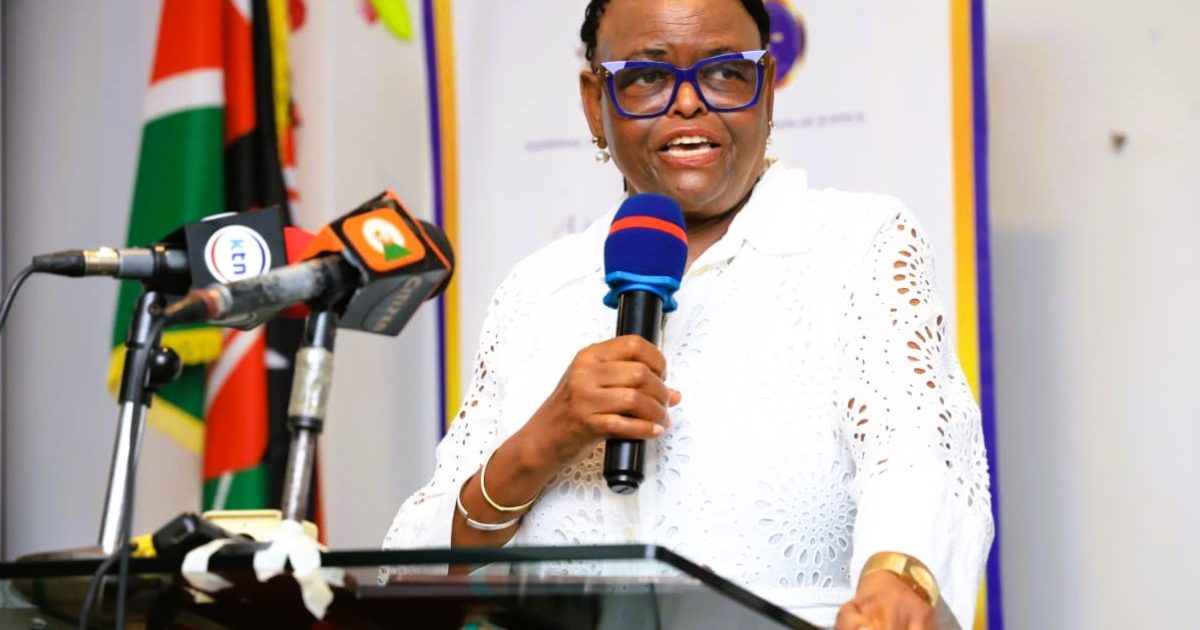
Speaking during the 38th NCAJ meeting in Mombasa, Chief Justice (CJ) Martha Koome who is also the chairperson of the council, emphasized that no single institution can deliver justice effectively on its own, noting that the challenges facing the country’s justice system are complex and interconnected.
“This is why the NCAJ exists to bring together institutions with different mandates around one shared goal of delivering fair, timely, efficient, and people centered justice for every Kenyan,” CJ Koome said.
She went on ‘we are going to ensure that every Kenyan can access justice that is fair, timely, efficient, accessible and responsive to their needs,’.
The five reform instruments launched are, The Justice Sector ICT Policy and Action Plan, Standard Operating Procedures (SOPs) on Sexual and Gender-Based Violence (SGBV), People-Centred Justice Guidelines, The People-Centred Justice Study; and Standard Operating Procedures for Service Delivery Initiatives and described the documents as evidence of what coordinated institutional collaboration can achieve.
She said the justice system is experienced by the public not as a collection of separate institutions, but as one interconnected justice chain.
“The effectiveness of investigation, prosecution, adjudication, legal aid, corrections, probation and rehabilitation is therefore deeply interconnected,” she said.
The top judicial official further noted that a weakness in one part of the chain inevitably affects confidence in the entire justice system.
On digital transformation, CJ Koome said as technology advances, the Kenya Justice sector should adapt to meet the needs of a digital society. Technology has become essential for improving coordination, with secure information, data governance, and evidence-based decision making across the justice sector.
Koome said progress has been made which includes the integration of the Office of the Director of Public Prosecutions’ Uadilifu System with the Judiciary’s Case Tracking System.
Others she said are the creation of digital accounts for the Kenya Prisons Service, integration with the National Transport and Safety Authority (NTSA) for vehicle verification, and ongoing efforts to connect with the Ministry of Lands’ Ardhi Sasa platform, the Probation Service, and the Department of Children’s Services.
Justice Koome added that confidential digital accounts have also been established for the Ethics and Anti-Corruption Commission (EACC), while similar integration is underway for the Witness Protection Agency.
She called for live demonstrations of the digital systems and urged justice institutions to transition fully to electronically authenticated documents to reduce paperwork, improve efficiency, and eliminate unnecessary delays.
‘’The People-Centred Justice Guidelines and the accompanying People-Centred Justice Study, reforms have shifted the focus from institutional performance and case statistics to the actual experiences of people seeking justice’’ she said.
She noted that the new approach prioritizes whether justice services are understandable, accessible, affordable, inclusive, and responsive to the needs of citizens.
“Kenya is positioning itself among jurisdictions that treat people centred justice as a core reform principle,” she said.
Justice Koome also underscored the importance of the Standard Operating Procedures for Service Delivery Initiatives, saying they will enable institutions to move beyond one off outreach activities and establish sustained, coordinated programmes that respond to communities’ justice needs.
She commended NCAJ committees, the Secretariat, justice-sector institutions, and development partners for collaboratively developing the reform documents through extensive consultation.
However, she cautioned that the success of the reforms will depend on effective implementation.
“The public experiences the justice system as one chain, weakness in any part undermines confidence in the whole,” she said.
Over the next two days, the council will deliberate on several key policy and legislative issues, including the Draft Sexual Offences Amendment Bill, with particular focus on strengthening responses to femicide, progress on the implementation of instant traffic fines, and enhanced coordination in combating wildlife crime.
The meeting will also discuss preparations for the 2027 general election, strengthened identification parade procedures, national guidelines for interviewing children within the justice system, a legal aid strategy for court users’ committees, the open prison model, and recovery treatment courts for offenders battling substance-use disorders.
“Together, through the NCAJ, we must continue to strengthen public confidence in the rule of law, deepen access to justice and build a justice system that is truly people-centred,” she said.
Justice Koome further directed the committee on criminal justice reforms to finalize the training manual for criminal justice actors handling youth and informed members that the NCAJ Strategic Plan (2026–2030) is nearing completion and called on institutions to submit their feedback.
“Success will be measured not by the number of policies or meetings held, but by the real improvements experienced by ordinary Kenyans who rely on the justice system every day,” CJ Koome said.
By Mary Mtawa