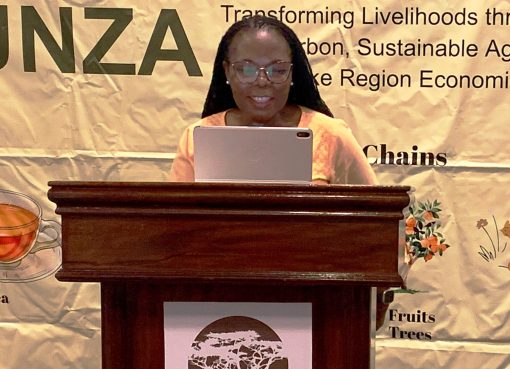
By C, KNA
County governments have been urged to domesticate the Soil Management Policy 2023 developed by the Ministry of Agriculture to save the country’s rapidly depleting soils.
Agricultural Engineering Secretary, Eng. Laban Kiplagat said the policy, which outlines a clear roadmap for restoring soil health, must be fully adopted at the county level because agriculture was a devolved function.
Eng. Kiplagat made the remarks in Kisumu during the closure of the GIZ Pro-Soil Project and the celebration of World Soil Day, where he warned that more than 60 per cent of Kenya’s high-potential soils are now degraded due to acidity, erosion and poor land-use practices.
“Kenyan soil is not in good shape. We have severe degradation, massive erosion and widespread soil acidity,” he said.
“Our rivers draining into Lake Victoria and the Indian Ocean show how much soil we continue to lose. It is a big shame, but we are now marshalling support from farmers, development partners and county governments to reverse this,” he added.
He said the 2023 policy and a 10-year AU-sanctioned soil action plan now guide Kenya’s recovery strategy, providing a framework for research, capacity building, funding and adoption of sustainable land management.
Several Western Kenya counties, he noted, have already domesticated the policy, supported by the ProSoil programme.
The ProSoil project, which has been implemented by GIZ since 2015, piloted low-cost soil regeneration technologies across Western Kenya.
Eng. Kiplagat said the encouraging results should now guide a national rollout.
“For a long time, we did not invest enough in soil management, but ProSoil has shown what is possible. We look forward to building a national programme to restore soil fertility as we move into the next decade,” he said.
Kakamega County Executive Committee Member (CECM) in charge of Agriculture, Moffat Mandela said counties were celebrating tremendous gains, including improved yields, stronger extension services and policies that will outlive current office-holders.
He cited testimonies of farmers whose maize yields rose from 2.5 bags to as high as 20 bags per acre after adopting ProSoil practices.
“This has improved food security and even reduced domestic tensions. Families now have food and incomes, enabling them to pay school fees, invest in dairy animals and avoid conflicts that arise when households lack food,” he said.
Siaya County Assistant Director of Agriculture and ProSoil focal person, Julia Samba, said the project had strengthened extension capacity, enabled domestication of the soil policy and generated crucial data showing widespread acidity across the county.
He announced that Siaya was building a Sh4.5 million soil testing lab to cut analysis costs from Sh2,000 to as low as Sh800, allowing farmers to access scientific soil information before using subsidised fertiliser.
“For years we gave fertiliser subsidies blindly. With routine testing, we will advise farmers properly and purchase fertiliser based on actual nutrient needs,” he said.
He added that Pro-Soil project Coordinator David Kersting through the initiative, over 220,000 farmers have been trained on soil management creating a pool of Champions to drive the efforts as the project comes to a close.
“We have put in place sustainability structures, including trained community-based extension champions who will continue supporting farmers as the project ends,” he said.
He lauded the counties for embracing science-based soil care, urging the national government to scale up proven technologies such as liming, erosion control, crop rotation and farmer-led soil testing.
“The last ten years have shown that even severely degraded soils can be restored when farmers have the right knowledge and support. The momentum built here must not be lost,” he said.