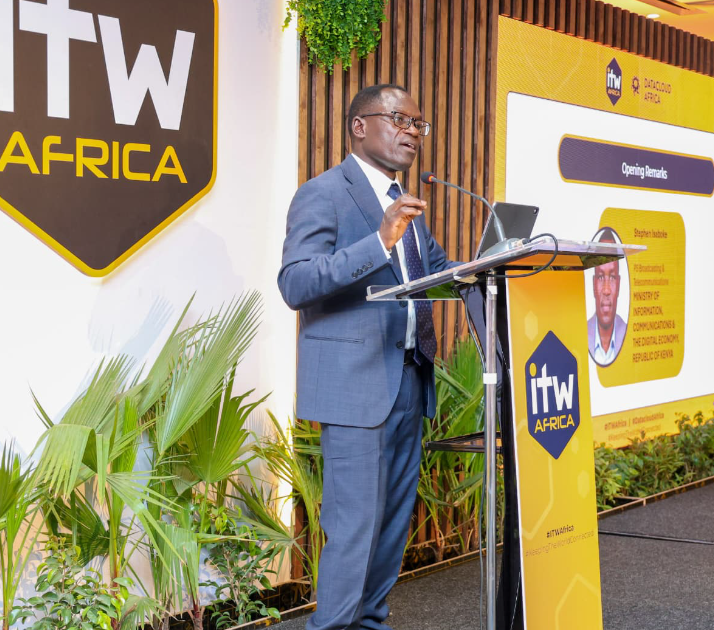
Kenya is positioning itself as a leading digital infrastructure and investment hub in Africa, with the Government prioritizing fibre connectivity, data centres, cloud computing and artificial intelligence (AI) to attract global investment and accelerate economic growth.
Broadcasting and Telecommunications Principal Secretary Stephen Isaboke said digital infrastructure had become critical national infrastructure, comparable to roads, water and electricity, as countries increasingly rely on technology to drive economic activity and deliver public services.
“Digital infrastructure for us as a government is actually critical national infrastructure. It is equivalent to roads, water, and power. It’s probably even more critical now in the digital era,” Isaboke said.
Speaking in Nairobi during the fourth edition of the ITW Africa and DataCloud Africa Summit, Isaboke noted that Kenya’s ICT sector was growing at an average rate of about 10 percent annually, while the digital economy expanded by about nine percent and contributed approximately nine percent of the country’s Gross Domestic Product (GDP) in 2025.
He outlined Government efforts to establish secure, resilient and trusted digital infrastructure capable of supporting banking, healthcare, education, transport, manufacturing and public services.
At the centre of the strategy is the Digital Superhighway and Creative Economy programme, which targets the rollout of about 100,000 kilometres of fibre optic infrastructure and establishment of 1,450 digital hubs across the country.
The hubs are expected to equip young people with digital skills and expand access to opportunities in the digital economy, while public Wi-Fi is being deployed in marketplaces, schools and hospitals.
“Our purpose is not simply to lay fibre. It is actually about connecting schools, hospitals, government offices, businesses and communities to lower the cost of access and to allow every Kenyan, wherever they live, to participate in the digital economy,” Isaboke said.
More than Sh16 billion has been allocated to the Digital Superhighway programme over the past four years, with about 33,000 young Kenyans already earning income through related digital and online work initiatives.
Isaboke stressed that the rapid expansion of AI requires countries to rethink infrastructure development, pointing to data centres, reliable electricity, fibre networks and secure data as essential components of the emerging technology ecosystem.
“AI is actually physical infrastructure, storage, not just software,” he said.
Kenya, he added, was seeking to play an active role in the AI economy by developing and adopting technologies rather than remaining a market for solutions produced elsewhere.
“For Kenya, we have actually made a choice to be a pillar, not merely a consumer. And actually, I believe I am speaking for Africa. In the new AI era, Africa is actually not going to watch and basically be a market. It’s actually going to be a contributor,” Isaboke said.
Industry experts participating in the summit, however, cautioned that Africa must overcome several barriers to unlock greater investment in digital infrastructure.
They identified policy stability, affordable electricity, investment incentives and predictable regulation as critical to attracting capital, noting that data-centre projects require substantial investments and commitments extending between five and 10 years.

According to experts, affordability also remains a challenge to digital adoption. They observed that although about 90 per cent of Africa’s population lives in areas with network coverage, only about 28 per cent is connected to the internet, partly because of the cost of smart devices.
The experts called for governments to stimulate demand by migrating public data and services to local data centres and providing incentives such as tax breaks, streamlined permits and easier importation of technology equipment.
Reliable and competitively priced electricity was singled out as another major factor in determining where investors establish data centres.
A panelist cited a $300 million investment targeting expansion of data-centre capacity in Nigeria, South Africa and the Democratic Republic of Congo, alongside investments in terrestrial and metro fibre networks.
The discussion also underscored the importance of developing local AI solutions suited to African languages and sectors such as healthcare, agriculture and finance. Such applications, the experts noted, could generate local demand while making the continent more attractive to investors.
The panelists further advocated a balance between national digital sovereignty and regional connectivity and harmonisation to create larger markets capable of attracting international capital.
Kenya’s strategic location, according to Isaboke, gives it an advantage as a gateway to East and Central Africa. Eight submarine cables currently land in Mombasa, providing connectivity to Kenya and the wider continent.
The Government is engaging Tanzania, South Sudan, Ethiopia and Uganda to strengthen regional connectivity and extend digital infrastructure beyond Kenya.
Isaboke also emphasized the importance of human capital, noting that engineers, technicians and cybersecurity specialists would be required to operate and maintain the country’s expanding digital ecosystem.
ICT and the Digital Economy Principal Secretary John Tanui described the summit as an opportunity to showcase Kenya’s readiness for digital infrastructure investment.
Tanui noted that Kenya already has more than 20 data centres, citing recent investments as evidence of the country’s growing attractiveness to technology companies.
“Demand is not the issue. We are ready to facilitate you. The demand is there and you are the people who will unlock the economic prosperity of our continent,” Tanui said.
The three-day summit, running from September 8 to 10, has brought together about 2,000 delegates from nearly 80 countries to discuss connectivity, digital infrastructure, cloud technologies and investment opportunities across Africa.
By Nancy Omondi and Samuel Njoroge