The national government’s tailor-made rehabilitation interventions for street families have borne remarkable progress, with the vulnerable population reducing by half over the last eight years.
Investment in rehabilitation, integration, family care and child protection programmes has seen the population decline from over 46,000 persons in 2018 to 18,049 by the end of 2025.
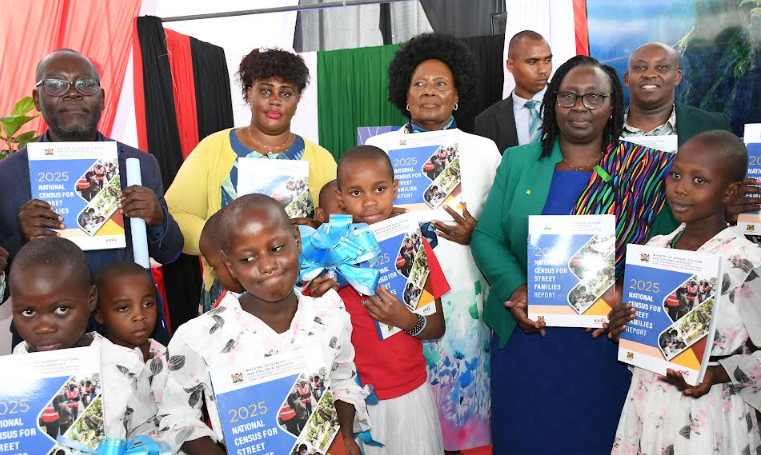
The results were contained in the 2025 National Census for Street Families report, undertaken by the Street Families Rehabilitation Trust Fund in partnership with the Kenya National Bureau of Statistics (KNBS), to guide data-informed approaches as the country geared towards a street-families-free environment.
This emerged as Nairobi, Nakuru, and Mombasa counties continue to record the highest numbers, with poverty, family instability, economic hardships, and drug and substance abuse being the major contributors to the influx.
Of the 18,049 street-connected persons recorded during the months-long 2025 census, 78.6 per cent were male and 21.4 per cent female. Nairobi recorded the highest count at 4,690 persons, followed by Nakuru with 1,546, Mombasa 1,428 and Kiambu 1,370, while Nyandarua, Lamu, and Tana River recorded the lowest figures.
According to Gender, Culture, and Children Services Cabinet Secretary Hanna Wendot, the government was committed to scaling up rehabilitation and integration interventions to rid the country of street families.
Wendot noted that since the rehabilitation exercise was initiated in 2003, the country had made significant strides and remained on course to ensure all persons enjoyed equal human dignity.
Speaking at the launch of the report in Naivasha, the CS said the government had allocated Sh40 million in the current financial year towards rehabilitation programmes and skills training for vulnerable persons.
The CS said the report had flagged rising poverty, economic hardship, drug and substance abuse, and social and family instability as the primary drivers of street migration.
“The census confirms that poverty, family instability, lack of economic opportunities, substance abuse and social exclusion contribute significantly to street migration,” she said
Wendot noted that the census showed most of the population expressed a willingness to leave street life if alternative measures and viable solutions were provided.
She added that through collaboration with county governments, civil society organisations, the private sector, and local communities, the state was investing in family support systems, education, and child protection frameworks to address the problem.
“Increased poverty levels, corporal punishment, denial of food, and alcohol-dependent parents were the main causes of family separation, pushing children onto the streets,” noted the report.
The CS, who also presided over the launch of the Street Families Information Management System, said the new platform was a game changer and was capable of providing real-time data and statistics on the vulnerable population to inform evidence-based interventions.
On the recent wave of school arson incidents and student strikes, Wendot condemned the acts, calling for a parental and whole-of-society approach to address the crisis.
Street Families Rehabilitation Trust Fund Board Chairperson Mary Wambui said the organisation was seeking additional funding to scale up rehabilitation support systems and ensure those in rescue centres received life-enabling skills.
KNBS Director General Macdonald Obudho attributed the sharp decline in the street families’ population from over 46,000 in 2018 to 18,048 in 2025 to targeted government interventions.
He added that stronger family structures had proved a key catalyst in addressing the problem and that the organization had begun incorporating refugees and asylum seekers into the national census framework ahead of the 2028/29 financial year.
The report indicated that street-connected girls and women had suffered sexual, physical and emotional abuse, largely at the hands of fellow street dwellers and law enforcement officers.
It noted that 71 per cent of street families had used at least one substance, with glue, cannabis and alcohol the most commonly abused, amid limited access to healthcare.
By Erastus Gichohi