As the country joins the international community in marking the 2026 World Environment Day, Kenya has renewed its call for strategic efforts towards addressing the impact of climate change.
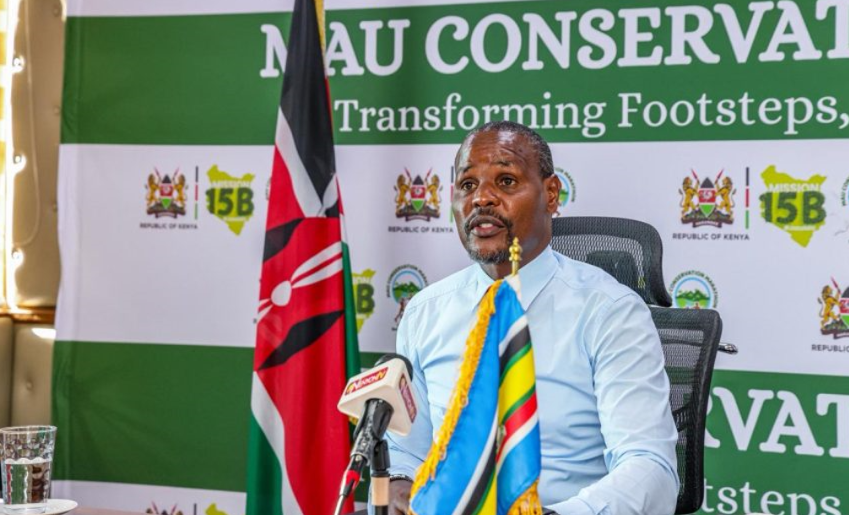
Briefing the media in his office at the SHA building, Environment and Climate Change Principal Secretary (PS), Dr Eng. Festus Ng’eno, said this year’s event presents an opportunity for Kenyans to reflect, make informed decisions, and take collective action to address escalating effects of climate change.
“We meet at a time when the world is confronting what the United Nations Environment Programme has termed the triple planetary crisis: climate change, biodiversity loss, and pollution,” said Dr Ng’eno.
“These are interconnected, human-driven challenges that are accelerating at an alarming rate and represent some of the most complex problems facing this generation,” PS added.
Dr Ng’eno said in Kenya, the scientific evidence highlights the severity of climate change and called for urgent action to keep global warming within the goals of the Paris Agreement, which seeks to limit temperature rise to below 2 degrees Celsius.
According to PS, Kenya’s latest State of Climate Change Report shows that the national temperatures have increased by approximately 0.88 degrees Celsius since 1960, with recent years ranking among the hottest ever recorded.
“Here in Kenya, our most recent state of climate change Report reveals that temperatures have risen by about 0.88 degrees since 1960, with recent years among the hottest ever recorded,” the PS indicated.
He said the impacts are evident in arid and semi-arid regions such as Turkana County, where temperatures have surpassed 41 degrees Celsius, placing immense pressure on communities, ecosystems, and livelihoods.
The PS said evidence from the Intergovernmental Science-Policy Platform on Biodiversity and Ecosystem Services (IPBES) shows that climate change is driving severe losses in biodiversity, water resources and food systems, with risks projected to double for every 0.5-degree Celsius increase in global temperatures. He added that extreme weather continues to impose significant economic and human loss worldwide.
“Extreme weather continues to impose significant economic and human costs across the world,” Dr Ng’eno said. “This is why climate change, biodiversity conservation and pollution control must be addressed.”
In Kenya, the National Celebration was held in the Ol-Kalou Arboretum in Nyandarua County, a location selected because of its ecological significance, particularly Lake Ol Bolossat, which is a critical wetland ecosystem and bird habitat.
Meanwhile, the global World Environment Day celebration is being held in Azerbaijan, where nations will convene to discuss environmental challenges and climate solutions.
This year’s theme is “Inspired by Nature. For Climate. For Our Future” serves as a call for collective action to address the interconnected global crises of climate change, biodiversity loss and pollution.
The PS commended the government for spearheading the national tree-planting initiative targeting 15 billion trees by 2030. He said approximately 1.7 billion trees have so far been planted.
On rising water levels across Rift Valley lakes, the Principal Secretary expressed concern, urging Kenyans to intensify tree-growing efforts, warning that environmental degradation is real and is driving climate-related impacts.
He cited growing threats at lakes Baringo, Bogoria, Nakuru and Naivasha, where flooding has displaced hundreds of communities, submerged millions of pieces of infrastructure and altered natural ecosystems.
According to Dr Ng’eno, poor land-use practices, deforestation, landscape degradation and excessive soil erosion are contributing to sediment accumulation in lakes and rivers, reducing their capacity and increasing flood risks.
“Our degraded landscapes are creating serious environmental consequences,” he said. “The siltation of rivers and lakes is directly linked to poor farming practices, destruction of forests and cultivation close to water bodies.”
He warned farmers to avoid farming along riparian and water catchment areas, saying fertilisers, soil and other pollutants washed from farms during rainfall eventually end up in rivers and lakes, affecting water quality and ecosystem health.
Dr Ng’eno stressed that forest restoration remains one of the most effective natural solutions for climate mitigation and adaptation.
“Healthy forests help absorb carbon emissions, regulate water cycles, reduce flooding, stabilize soils and support biodiversity,” said PS, adding, “They improve resilience against climate shocks such as droughts and extreme rainfall.”
He pointed to the Mau Forest Complex, one of Kenya’s most important water towers, as an example of why restoration efforts are essential.
“Changes in river flow patterns originating from degraded catchment areas have already affected ecosystems downstream, including the Maasai Mara, where high river levels have disrupted farming and wildlife movements,” he said.
Dr Ng’eno called for a whole-of-society approach from citizens, businesses, communities and development partners to actively participate in environmental conservation efforts.
“The easiest and most effective way to mitigate climate change is through increased forest and tree cover,” he said. “Conserving our landscapes, protecting our water towers and restoring degraded ecosystems is essential for Kenya’s future,” he added.
By Ian Chepkuto