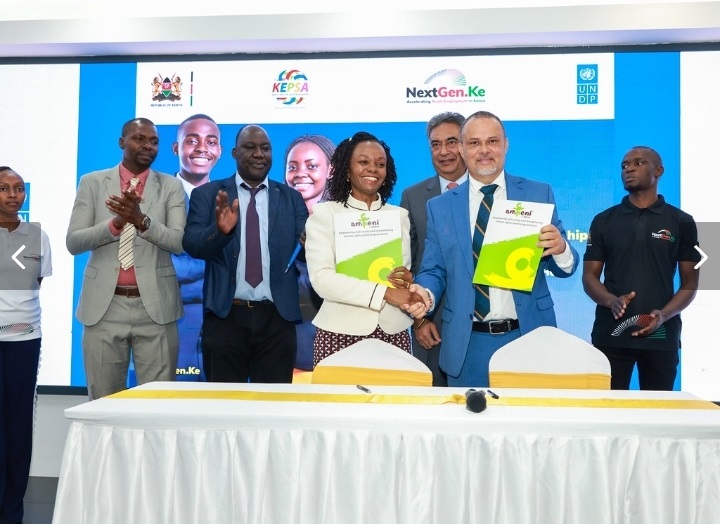
The Kenya Private Sector Alliance (KEPSA) and the United Nations Development Programme (UNDP) have signed a Memorandum of Understanding (MoU) to implement the NextGen.Ke Youth Employment Programme, a national initiative aimed at enhancing youth employability and creating pathways into private sector jobs.
The agreement was signed during the 22nd KEPSA Annual General Meeting (AGM) held in Nairobi.
The event brought together senior government officials, business leaders, development partners and youth representatives.
The programme comes at a time when Kenya continues to face a growing youth unemployment challenge, with nearly one million young people entering the labour market annually.
Implemented by KEPSA with strategic support from UNDP, the initiative seeks to connect pre-screened and work-ready graduates with private sector companies through structured 12-month internship placements. Participants will receive monthly stipends, work-readiness training and continuous professional development support.
The pilot phase, scheduled to run between July and December 2026, targets approximately 500 graduates drawn from universities, Technical and Vocational Education and Training (TVET) institutions and other training centres. The beneficiaries will include 250 degree holders, 150 diploma holders and 100 certificate holders.
If sustained, the programme is expected to reach more than 15,000 graduates over the next three years.
Speaking during the signing ceremony, KEPSA Chief Executive Officer Carole Kariuki said the initiative builds on the private sector’s long-standing commitment to addressing youth unemployment.
“KEPSA made a strategic decision in 2008 that youth employment is not simply a government responsibility; it is a private sector responsibility. Businesses are not just job creators; they are market shapers, skills developers and the primary bridge between training and real economic participation,” said Kariuki.
She noted that through the partnership with UNDP, the private sector is creating a practical model that directly links trained young people to businesses where employment decisions are made.
Kariuki emphasized that employers have a critical role in defining industry skills requirements, opening workplaces to young people and helping bridge the gap between education and the labour market.
The programme has also received strong backing from the Government, which recently allocated KSh2 billion towards its implementation in the National Budget Statement. The Government further called on development partners and the private sector to support the initiative.
UNDP Kenya Resident Representative Dr. Jean-Luc Stalon said the programme seeks to address one of the major barriers facing young job seekers the requirement for prior work experience.
He observed that many graduates struggle to secure employment because employers often expect experience that they have not yet had an opportunity to gain.
“This initiative is designed to complement existing government and partner interventions. The aim is not to duplicate existing efforts but to strengthen the ecosystem of youth employment pathways,” said Dr. Stalon.
He added that beyond internship placements, participants will benefit from structured mentorship, workplace learning and mandatory online training modules designed to strengthen their professional skills.
Dr. Stalon noted that employers will play a central role not only as hosts for interns but also as active contributors to skills development and talent nurturing.
The National Treasury also welcomed the partnership, describing it as a significant step towards strengthening collaboration between the public sector, private sector and development partners in advancing youth employment and economic empowerment.
In a statement delivered on behalf of Principal Secretary for the National Treasury Dr. Chris Kiptoo by Hezbon MacObong’o, the Government reaffirmed its commitment to creating an enabling environment for investment, innovation and job creation under the Bottom-Up Economic Transformation Agenda (BETA).
Dr. Kiptoo said ongoing economic reforms are aimed at enhancing competitiveness and ensuring inclusive growth that benefits all Kenyans, particularly young people.
“As we formalize this partnership today, I encourage all stakeholders to remain committed to translating this agreement into tangible outcomes. The true measure of success will be reflected in the number of young people whose lives are transformed through decent employment and improved livelihoods,” said Dr. Kiptoo.
He stressed that addressing youth unemployment requires collective action, noting that government efforts alone are insufficient to meet the growing demand for employment opportunities.
The NextGen.Ke programme adopts a merit-based selection process and employer matching system to ensure transparency and fairness. It also provides standardised onboarding, supervised workplace learning and continuous monitoring of participants’ progress.
The signing took place under the theme of this year’s KEPSA AGM, “Shaping Kenya’s Future: Private Sector Leadership in AI Governance, Strategic Investment, and Youth Employment.”
The forum reviewed the private sector’s achievements over the past year while exploring future opportunities in strategic investments, artificial intelligence governance and youth employment.
Stakeholders expressed optimism that the NextGen.Ke programme will contribute significantly to reducing unemployment among graduates while equipping young Kenyans with the practical experience needed to compete in the job market.
by Anita Kariuki