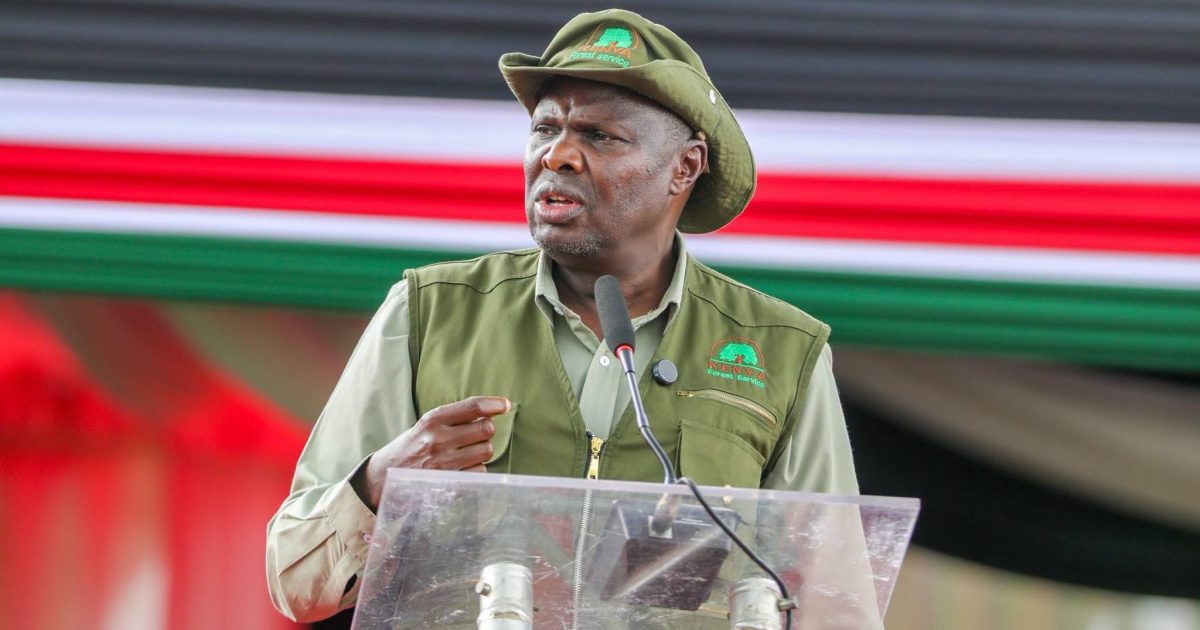
Chief of Staff and Head of the Public Service Mr Felix Koskei has hailed the impact of the Mau Forest Complex Integrated Conservation and Livelihood Improvement Programme (MFC-ICLIP), disclosing that the initiative is already restoring degraded ecosystems while improving livelihoods for thousands of households living around Kenya’s largest water tower.
Mr Koskei welcomed the MFC-ICLIP as a model for how forest conservation and community prosperity can advance together through an integrated approach that combines ecosystem restoration with sustainable livelihoods.
He noted that the conservation initiative is one of the key projects that reflect the government’s commitment to environmental sustainability and community empowerment adding that it would not only help conserve and restore one Kenya’s biggest water tower but also benefit thousands of households through clean energy and improved livelihoods.
Mr Koskei emphasized that the government was committed to achieving the 15 billion tree target in the next ten years as outlined in President William Ruto’s environmental plan.
Speaking after inspecting several MFC-ICLIP community projects, including milk coolers at the Kapteta and Milikwen Farmers Milk Cooperative Societies, the Kenyatta Dam and the Mengit Dam rehabilitation, reticulation and irrigation projects in Nakuru the Chief of Staff and Head of the Public Service said the initiative was born out of a desire to reverse decades of environmental degradation that had severely affected the Mau Forest Complex and the communities that depend on it.
In June, the State Department for Irrigation announced a Sh480 million rehabilitation of Kenyatta Dam under MFC-ICLIP.
The project is expected to support approximately 1,800 households through irrigation covering about 1,200 acres.
It includes rehabilitation of the dam embankment, a solar-powered pump house, a 300-cubic-metre storage tank and water reticulation infrastructure.
The irrigation investment is expected to improve agricultural productivity while providing communities with alternatives that can strengthen incomes without increasing pressure on protected forest areas.
Mr Koskei who was accompanied by Principal Secretary for the State Department for Environment and Climate Change Dr Engineer Festus Ng’eno and Nakuru Deputy Governor Dr David Kones called on professionals from Kuresoi South, Kuresoi North, Njoro, Molo, and Rongai Sub-Counties to actively engage in the Mau Forest Complex Integrated Conservation and Livelihood Improvement Programme (MFC-ICLIP) to ensure local communities reap its full benefits.
MFC-ICLIP is a 10-year, Sh21.5 billion initiative spanning over 317,000 hectares across major forest blocks, including Eastern, Western, Molo, and South-West Mau. The programme aims to reverse historical deforestation, illegal encroachment, and unsustainable land use by combining ecosystem restoration with community economic empowerment.
Mr Koskei pointed out that the programme was designed to address both environmental and socio-economic challenges by integrating forest restoration, livelihood improvement, environmental education, circular economy initiatives and community participation.
“The MFC-ICLIP is a mission to restore the Mau Forest to its former beauty and value at the local, national, regional and international levels, while renewing its ability to sustain freshwater systems, regulate rainfall, support agriculture and secure millions of livelihoods,” he said.
Launched by President William Ruto in October 2025, the programme has grown into a broad partnership bringing together national and county governments, development partners, private sector players, schools, conservation groups and local communities under the rallying call, “Linda Mau, Boresha Maisha.”
Mr Koskei noted that the programme has already restored more than 1,500 hectares of degraded forest through the planting of approximately 1.5 million tree seedlings in the Marindas and Gacharage restoration sites.
The initiative has also attracted significant support through its Adopt-a-Forest campaign, with leaders and institutions collectively adopting 1,635 hectares for restoration. Among those who have joined the effort are President William Ruto, Nakuru Governor Susan Kihika, Safaricom, Kenya Commercial Bank and Kenya Power. Mau Forest Complex is one of Kenya’s most critical water towers, supporting livelihoods, biodiversity, and climate resilience across the region.
It was designed as a comprehensive and integrated response to restore degraded landscapes while improving the socio-economic well-being of forest-adjacent communities.
Mr Koskei emphasised that protecting forests and water catchments remains critical as Kenya grapples with the growing effects of climate change and mounting pressure on natural resources.
He added that healthy ecosystems are essential for sustaining agriculture, securing water supplies and supporting livelihoods for future generations.
Mr Koskei observed that Nakuru’s agricultural potential could provide a strong foundation for improving household incomes while reducing economic pressure on the Mau ecosystem.
He encouraged professionals to use their knowledge, networks and expertise to support initiatives that promote productive agriculture, value addition and sustainable use of natural resources.
Dr Ng’eno explained that the Mau Forest Complex Integrated Conservation and Livelihood Improvement Programme (MFC-ICLIP) was specifically designed to tackle environmental degradation while simultaneously enhancing the livelihoods of communities residing near the forest.
The Mau Forest Complex, Kenya’s largest water tower, supports millions of livelihoods through agriculture, hydropower generation, and water supply. It is also the source of twelve major rivers and five significant lakes.
Dr Ng’eno stressed that the Mau’s conservation must incorporate livelihood opportunities because communities living around the ecosystem are central to its long-term protection.
The Mau Forest Complex is one of Kenya’s most important water towers and supplies catchments for about 12 rivers.
These rivers support water systems linked to Lake Nakuru, Lake Victoria, Lake Turkana and other major water bodies.
However, the Principal Secretary cautioned that the ecosystem remains under severe threat from illegal logging, shifts in land use, and an over-reliance on forest resources, largely driven by poverty.
Dr Ng’eno described the initiative as a unique ten-year programme that integrates conservation with livelihood improvement. He said the initiative requires an estimated funding of Ksh21 billion over this period, equating to approximately Ksh2.1 billion annually.
According to Dr Ng’eno, the programme focuses on five core areas, including sustainable land management, community livelihood enhancement, circular economy initiatives, environmental education, and project governance.
“The programme targets in 10 years are huge. We aim to rehabilitate 33,138 hectares of South West, Eastern, Western and Molo Forest blocks and restore 668.7 hectares of wetlands and 143,803 hectares of agro-ecosystems, benefiting 148,000 households,” he elaborated.
Dr Ng’eno noted that the programme aligns with Kenya’s broader climate and environmental objectives, including Vision 2030, the Bottom-Up Economic Transformation Agenda, and the national goal of planting 15 billion trees.
Since its inception in August 2025, the PS disclosed that the initiative has attracted 74 partners who have contributed approximately Ksh884 million, primarily through in-kind support.
The Principal Secretary highlighted the Trees Establishment and Livelihood Improvement Scheme (TELIS), commonly known as the shamba system, as a significant breakthrough in restoration efforts.
Through the initiative, communities are allowed to cultivate crops while nurturing tree seedlings, thereby strengthening household food security and diversifying incomes.
“In total, we have 657 hectares approved for TELIS by the Kenya Forest Service and we have 4,625 households producing crops, mostly potatoes, as they tend to tree seedlings,” he explained.
Dr Ng’eno further noted that over 10,000 farmers have also benefited from complementary livelihood programmes such as pyrethrum farming, avocado growing, beekeeping, agroforestry, and tree nursery establishment. The programme has additionally established avocado orchards in 180 schools.
Deputy Governor Dr Kones said the county government was complementing the national conservation programme by strengthening agricultural production, cooperative development, market access and affordable financing.
He said the county has invested in farmer groups and cooperatives while supporting value addition and water infrastructure to help farmers increase production and improve household incomes.
Dr Kones noted that the Mau ecosystem supports about 600 megawatts of hydropower and contributes to tourism ecosystems, including Lake Nakuru and the Maasai Mara.
The Deputy Governor said the Mau Forest Complex is not just important to Nakuru County—it is vital to Kenya and significant far beyond Kenyan borders.
“As one of our main water towers, it sustains rivers, supports biodiversity, regulates climate, and underpins millions of livelihoods. Protecting it is not a choice; it is a duty we all share, requiring coordination across county, national, and global levels.”
Dr Kones said the progress made so far under the MFC-ICLIP Programme is both encouraging and commendable.
“The restoration of over 1,200 hectares of degraded forest land, alongside the planting of more than one million tree seedlings, marks a major step forward. Just as important are the community-focused initiatives that are already changing lives in tangible ways.”
Dr Kones said the county government has taken deliberate steps to complement these efforts. “Through our countywide greening programme, we have planted millions of trees across schools, farms, public spaces, and riparian areas. We have strengthened community tree nurseries, promoted farm forestry, and restored degraded landscapes, all while working closely with local communities to ensure ownership and long-term sustainability.”
He said the efforts are part of the broader commitment to increasing forest cover and safeguarding the environment for future generations.
by Jefther Simeon Afuyo and Esther Mwangi