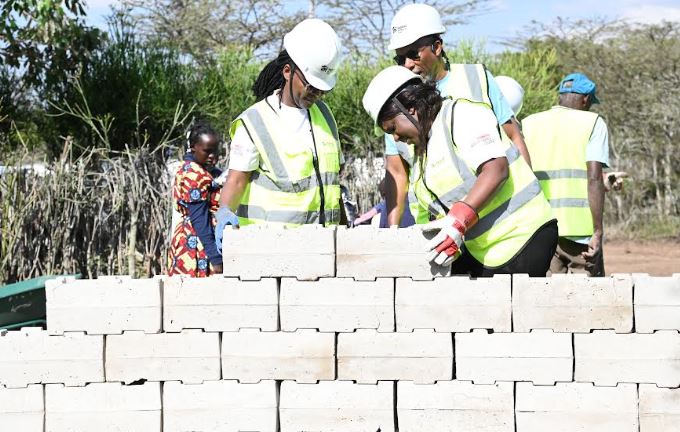
A group of youths in Laikipia County are taking the mantra of affordable homes to a new level within the villages through application of modern building technology recently introduced into the country.
The rural youths, majority being girls aged below 30 from Segera Ward have ventured into masonry work, through learning the art of Interlocking Hollow Blocks (IHB), skills they have gained after a recent training by Habitat for Humanity-Kenya, a global organization promoting access to free low-cost houses to vulnerable groups.
“We have been equipped with the skills of Hollow Blocks and it is really beneficial, it’s even easy on molding the bricks and youth are now earning a living. In our group, majorities are women and we are good at using the construction technology as ladies,” says Mary Waithera, a youthful contractor, adding that her family had benefited from the IHB building technology where she got the insight to venture in the sector.
Habitat for Humanity Kenya construction supervisor Charles Misau reveals that technology is utilizing locally available materials like quarry dust, sand and a little cement to mold the blocks in plastic containers that eventually end up building climate resilient, fireproof, acoustic houses with the cost of construction going down by up by 30 percent while compared to ordinary stone houses.
‘’The cost of using this technology compared to traditional construction materials is relatively cheap since the brick is hollow and you’re using small amounts of sand and cement , on curing , it’s not needed hence saving on time,” reveals Misau.
He notes that, in a day, one can do a whole block depending on the project scope which further brings the cost of construction down.
The first beneficiary of a decent home courtesy of the efforts of the budding youthful masons is Napeiyo Ngilekoi a 71-year-old widow from Muramati village, currently taking care of three socially orphaned children and who have lived in a dilapidated dwelling with a leaking roof for years.
“I am very excited to benefitting from a decent home; I have stayed with my grandchildren in a dilapidated housing with a leaking roof for years. I am the sole breadwinner of these children after their parents passed away, sometimes we get support from well-wishers,” Joyful Ngilekoi says.
Habitat for Humanity-Kenya chairperson Ms Rose Sang while commissioning the construction of the pioneer house announced that several other vulnerable families within the locality would benefit from a similar initiative as a way of encouraging capable individuals to adopt the new building technology and in the process empower skilled youths with job opportunities.
“We are here for board building, our mandate as Habitat for Humanity Kenya is to provide decent housing because every child deserves an opportunity to be able to learn and that equalizes us through provision of housing,” says the Habitat Board Chairperson.
She revealed that about €150,000 would be spent for construction of decent houses and also provision of water services through borehole drilling initiatives.
‘’We really want to thank our donors for providing the funding so that we can be able to support vulnerable families with decent housing and put up a borehole that would serve the community. We know that is an important factor in every household because without water, you’re vulnerable to diseases,” notes Ms Sang.
National Director of Habitat for Humanity Kenya, Dr. Eileen Mokaya, revealed that they were working in more than 18 counties on construction of decent homes to vulnerable families.
‘’Our major focus is to ensure the most vulnerable families have access to a decent home and the type of families we support are those in need of decent shelters . When we say a home is decent, they also have access to basic services including water and sanitation facilities,” points out Dr. Eileen.
The youths are currently in the process of producing 30,000 blocks used in putting up seven additional houses already identified with the youthful masons set to undertake the task.
Laikipia County becomes the second county after Tana River to adopt the IHB technology which has been borrowed from Asian countries, Latin America and South Africa and which is different from the common Interlocking Stabilized Soil Block (ISSB) that mainly utilizes garden soils as the main raw material.
By Muturi Mwangi