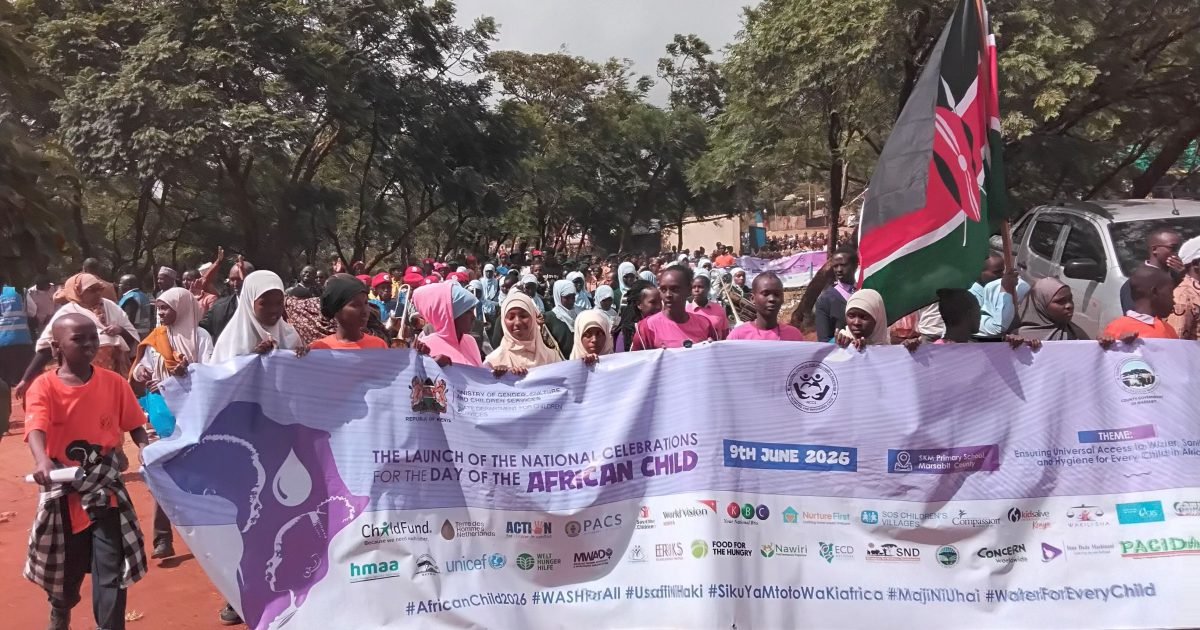
Marsabit county Tuesday played host to the national launch of the Day of the African Child 2027 celebrations, attracting participants from a cross section of stakeholders.
The colourful ceremony brought together government officials, development partners, civil society organizations, community’s leaders and hundreds of children with special reflection on the challenges facing children across Kenya and Africa including access to water, sanitation and hygiene.
Held at Sangante Kargi Maikona SKM Primary School in Marsabit County, the event served as a platform for stakeholders to renew their commitment to protecting children’s rights and improving their welfare.
Speakers at the event highlighted the urgent need to address water scarcity, child protection concerns, harmful practices, educational barriers and climatic related challenges that continue to affect children, especially those living in arid and semi-arid regions.
The event was officially launched by Joseph Wanje of the National Council for Children Services (NCCS, representing the Cabinet Secretary for Gender, Culture and Children’s Services, Hannah Wendot Cheptumo.
In his remarks, Wanje said the National Council for Children’s Services is a state corporation established by law to regulated, coordinate, oversee and advise on all matters relating to children’s services in Kenya.
He noted that that the Day of the African Child remains one of the most significant annual events dedicated to highlighting the issues affecting children and mobilizing stakeholders to collectively seek solutions.
He thanked the organizers, the County Government’s office, development partners and stakeholders for ensuring the successful launch of the celebrations.
He also assured children that the government remains committed to safeguarding their rights and promoting their best interests at all times.
In her speech, the CS noted that the Day of the African Child commemorates the children who lost their lives during the Soweto Uprising of June 16, 1976, when thousands of school children in South Africa protested against the apartheid regime’s discriminatory education policies.
Cheptumo said this year’s theme, ” Ensuring Universal Access to Water, Sanitation and Hygiene for Every Child in Africa, ” provides an opportunity to reflect on the progress made in promoting children’s social and economic rights while also addressing the gaps that still exist.
The CS emphasized that access to clean and safe water, adequate sanitation and proper hygiene is a fundamental right for every child and is enshrined under Article 43 of Kenya’s Constitution.
She noted that improving sustainable water availability and sanitation systems is critical in advancing social and economic development, while safeguarding the health and future of children across the continent.
According to the ministry, inadequate access to water, sanitation and hygiene continues to contribute to preventable child deaths, malnutrition, waterborne diseases, poor educational outcomes and child labour, particularly in arid and semi-arid areas.
Children are often forced to travel long distances in search of water, exposing them to various risks including abuse, neglect and exploitation.
The ministry further observed that inadequate WASH services disproportionately affect children living in rural areas, informal settlements and children living with disabilities.
Girls are especially affected during menstruation due to the lack of proper sanitation facilities, menstrual hygiene products and safe water, resulting in absenteeism from school and undermining their dignity and confidence.
The CS noted that the government acknowledged that Kenya, like many other African countries, has experienced severe drought cycles in recent years, significantly affecting food security, water availability and sanitation services. Marsabit was identified as one of the regions hardest hit by prolonged drought.
In response to these challenges, she noted the government reaffirmed its commitment to strengthening climate resilient water, sanitation and hygiene services.
The CS disclosed the ministry pledged to continue investing in water infrastructure projects, borehole drilling, expansion of piped water systems, and construction of sanitation facilities in schools and public institutions, and promotion of hygiene awareness campaigns.
The government is also committed to strengthening partnerships with county governments, development partners and humanitarian organizations to improve access to safe water and sanitation services, particularly in vulnerable and drought-prone regions.
Marsabit Deputy Governor Solomon Gubo Riwe welcomed the forum and thanked the national government for choosing Marsabit to host the event.
He said Marsabit has made significant progress in development over the years, but continues to face major challenges associated with water scarcity.
He noted that the county experiences acute water shortages, particularly during prolonged dry seasons, forcing families and children to travel long distances in search of water.
The Deputy Governor observed that the burden of water scarcity falls heavily on children, affecting their health, education and overall wellbeing.
He added that many families depend on livestock for livelihood live hoods and frequently migrate in search of pasture and water during drought periods, disrupting children’s education.
Riwe also raised concern over harmful cultural practices that continue to affect children in the county, including female genital mutilation ( FGM),child marriage and teenage pregnancies. He said these practices contribute significantly to school dropout rates and negatively affect the future prospects of many children.
He further pointed out that despite efforts by the county government to drill boreholes and construct water dams, prolonged droughts often overwhelm existing water sources, creating recurring challenges for local communities.
Marsabit County Commissioner Stanley Kamande described FGM as one of the most serious threats facing girls in the county.
He revealed that approximately 83 percent of girls in Marsabit have undergone the practice, making it one of the county’s most pressing child protection concerns.
Kamande noted that FGM often leads to child marriage, as some communities consider girls who have undergone the practice to be adults ready for marriage.
He called on residents to join the global campaign against FGM and work together to eliminate the practice.
The County Commissioner also raised concerns over school dropout rates among boys, noting that many leave school to herd livestock or become involved in cattle rustling and other harmful activities.
He warned that government agencies would take action against individuals violating children’s rights to education, health and protection.
The Secretary for Children’s Services Shem Nyakutu urged parents and community members to take greater responsibility in protecting children from abuse, neglect and exploitation.
He warned that cases of missing and disappearing children remain a concern and encouraged the public to utilize the government’s toll-free child helpline number 116 to report child protection cases and seek assistance whenever necessary.
UNICEF Child Protection Specialist Zainab Ahmed emphasized that water, sanitation and hygiene are closely linked to child protection, education, health and nutrition outcomes.
She acknowledged the numerous challenges facing children in remote areas of Marsabit and called on development partners, government institutions and civil society organizations to strengthen collaboration in delivering services to vulnerable children.
Ahmed said partners must remain committed to supporting child protection, education, nutrition, health and WASH interventions to ensure that no child is left behind, particularly those living in hard-to-reach areas.
Marsabit Senior Principal Magistrate Christine Wekesa highlighted the role of the judiciary in protecting children’s rights. She noted that the Children’s Act places the best interests of the child at the center of all decisions affecting children.
She also encouraged families to utilize court-annexed mediation services, which help vulnerable individual’s access justice through trained mediators supported by the government.
by Sebastian Miriti and Anthony Melly