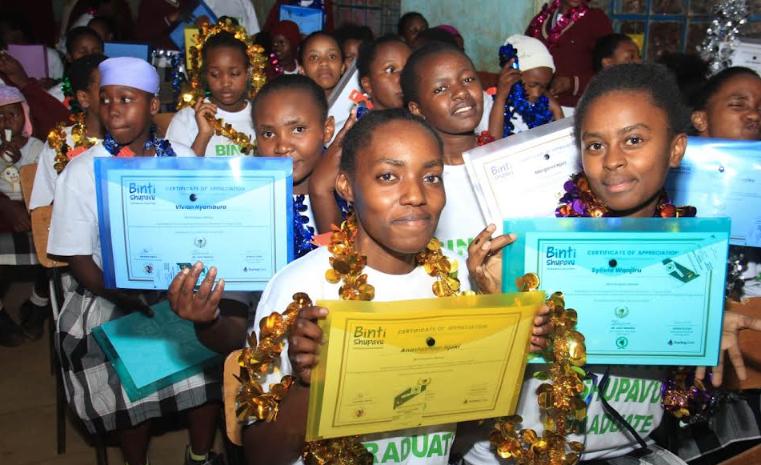
Sixty-three girls from Kaganda Senior School in Murang’a East Sub-County have graduated after a four-year mentorship programme that achieved a 100 per cent school retention rate, with all participants completing secondary education while acquiring leadership skills, confidence, and resilience.
The programme, dubbed Binti Shupavu, is implemented by the Center for Women Empowerment in Technology (CWE-Tech) in partnership with Darling Girls of the United States and the Glami Girls Livelihood and Mentorship Programme of Tanzania.
The girls were enrolled in the programme in 2023 when they joined Form One after obtaining consent from their parents and the school administration.
Speaking during the graduation ceremony, CWE-Tech Co-founder and Chief Executive Officer Dr. Judy Makira said the initiative was established to address social and personal challenges that often force girls to drop out of school, including teenage pregnancies, family conflicts, low self-esteem, peer pressure, and the lack of positive role models.
She described the graduation of all the participants as a major milestone, noting that previous school cohorts often recorded cases of learners dropping out before completing their secondary education.
“The fact that every girl who joined the programme has completed secondary school is clear evidence that the mentorship model is working. We have witnessed remarkable transformation in their lives,” said Dr. Makira.
She explained that every participant was paired with a trained mentor who met with her every week throughout the four years, offering guidance, emotional support, and encouragement while helping the girls navigate academic, social, and personal challenges.
According to Dr. Makira, the close relationship between mentors and the girls created a safe environment where participants could openly discuss issues affecting them.
“The mentor becomes like an elder sister whom the girls trust. Unlike parents or teachers, they freely share their fears, dreams, and personal experiences, making it easier to identify and address challenges before they become overwhelming,” she said.
Besides mentorship, the programme promotes the girls’ well-being by providing free sanitary towels through partner organisations to ensure menstrual health challenges do not interrupt learning.
Dr. Makira said the initiative had transformed many participants from shy and withdrawn learners into confident young women capable of expressing themselves, making informed decisions and assuming leadership roles both in school and within their communities.
“When they joined Form One, many lacked confidence and could hardly speak before an audience. Today they are bold, self-assured, and ready to pursue their dreams. They have truly become Binti Shupavu—courageous daughters,” she said.
She noted that mentorship had also strengthened the girls’ self-esteem, improved discipline, and encouraged them to remain focused on their education despite various social and economic challenges.
To ensure continued support after secondary school, the graduates will join an alumni network that will provide career guidance, mentorship sessions, networking opportunities, and forums where they can share experiences as they transition to higher education, vocational training, and the job market.
Dr. Makira said CWE-Tech plans to expand the mentorship programme to more schools and counties by partnering with organisations interested in replicating the model to reach more vulnerable girls across the country.
“We want this programme to benefit more girls because we have seen the positive impact it has made. It keeps girls in school, builds confidence, nurtures leadership, and prepares them to become responsible citizens,” she said.
She expressed optimism that sustained mentorship would enable more young women to overcome social barriers, make informed life choices, and pursue higher education and successful careers.
Dr. Makira congratulated the pioneer graduating class and urged them to uphold the values they had acquired through the programme, remain focused on their ambitions, and use their knowledge, confidence, and leadership skills to inspire and positively transform their communities.
By Bernard Munyao and Ann Kendi